East Flatbush in Brooklyn in Kings County, New York — The American Northeast (Mid-Atlantic)
Harry Maze Playground
2.427 acres
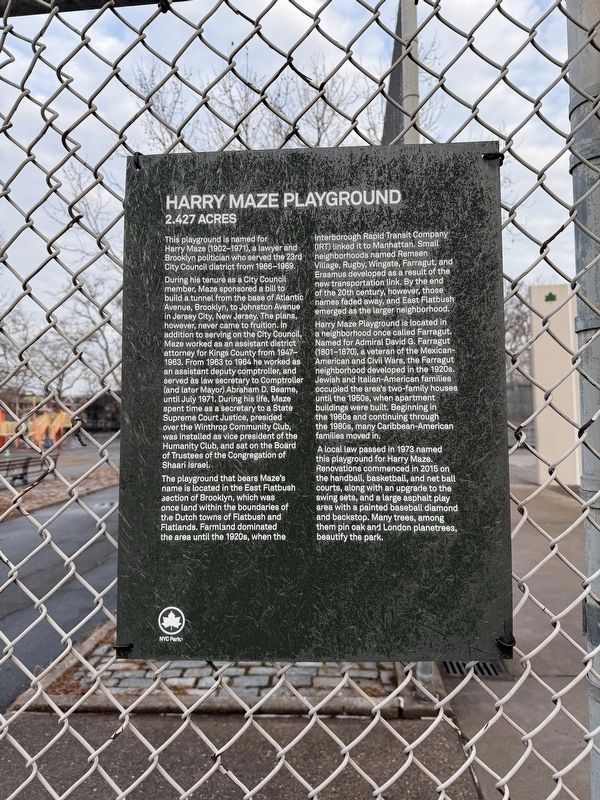
This playground is named for Harry Maze (1902-1971), a lawyer and Brooklyn politician who served the 23rd City Council district from 1966-1969.
During his tenure as a City Council member, Maze sponsored a bill to build a tunnel from the base of Atlantic Avenue, Brooklyn, to Johnston Avenue in Jersey City, New Jersey. The plans, however, never came to fruition. In addition to serving on the City Council, Maze worked as an assistant district attorney for Kings County from 1947-1963. From 1963 to 1964 he worked as an assistant deputy comptroller, and served as a law secretary to Comptroller (and later Mayor) Abraham D. Beame, until July 1971. During his life, Maze spent time as a secretary to a State Supreme Court Justice, presided over the Winthrop Community club, was installed as vice president of the Humanity Club, and sat on the Board of Trustees of the Congregation of Shaari Israel.
The playground that bears Maze's name is located in the East Flatbush section of Brooklyn, which was once land within the boundaries of the Dutch towns of Flatbush and Flatlands. Farmland dominated the area until the 1920s, when the
this page online
Harry Maze Playground is located in a neighborhood once called Farragut. Named for Admiral David G. Farragut (1801-1870), a veteran of the Mexican-American and Civil Wars, the Farragut neighborhood developed in the 1920s. Jewish and Italian-American families occupied the area's two-family houses until the 1950s, when apartment buildings were built. Beginning in the 1960s and continuing through the 1980s, many Caribbean-American families moved in.
A local law passed in 1973 named this play for Harry Maze. Renovations commenced in 2015 on the handball, basketball, and net ball courts, along with an upgrade to the swing sets, and a large asphalt play area with ha painted baseball diamond and backstop. Many trees, among them pin oak and London planetrees, beautify the park.
Erected by NYC Parks.
Topics and series.

Location. 40° 38.573′ N, 73° 55.385′ W. Marker is in Brooklyn, New York, in Kings County. It is in East Flatbush. It is on Avenue D west of East 57th Street, on the right when traveling west. Touch for map. Marker is at or near this postal address: 5601 Avenue D, Brooklyn NY 11203, United States of America. Touch for directions.

Regionally, this marker is in New York City and on Long Island. It is also in the American Northeast, in the Mid-Atlantic, and on the Eastern Seaboard. Globally, it is in the North Atlantic Region, North America, the Western Hemisphere, the Western World, and the Anglosphere. Historically, it finds itself in what was once New Netherland and also one of the original Thirteen Colonies.
Other nearby markers. At least 8 other markers are within 2 miles of this marker, measured as the crow flies: Wyckoff House Museum (approx. 0.2 miles away);
Photographed by Devry Becker Jones (CC0), January 19, 2025
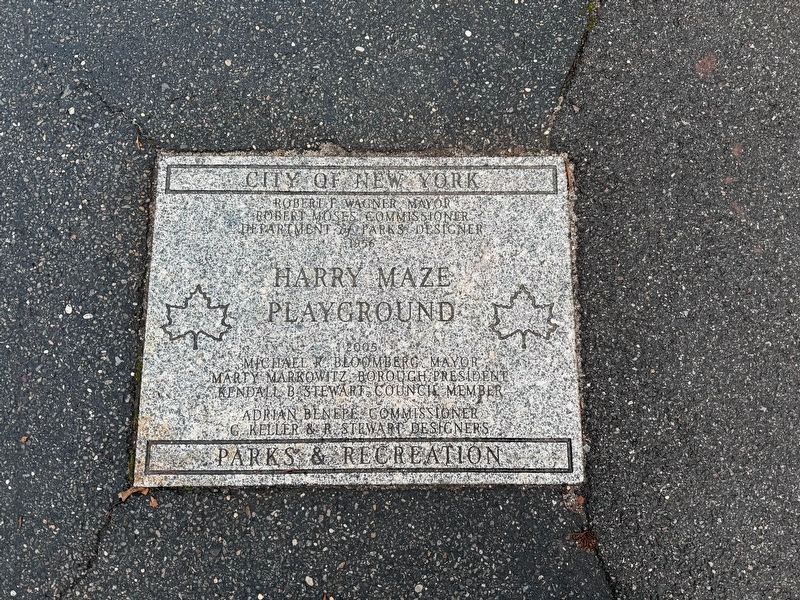
3. NYC Parks paver for Harry Maze Playground
Another marker is no longer nearby. Pieter Claesen Wyckoff House (was approx. 0.2 miles away but has been permanently removed).
Credits. This page was last revised on January 22, 2025. It was originally submitted on January 22, 2025, by Devry Becker Jones of Washington, District of Columbia. This page has been viewed 297 times since then and 22 times this year. Photos: 1, 2, 3. submitted on January 22, 2025, by Devry Becker Jones of Washington, District of Columbia.
