Whitneyville in Hamden in South Central Region, Connecticut — The American Northeast (New England)
The Mill Stones
Photographed by Conrad Ward, August 11, 2024
1. The Mill Stones Marker
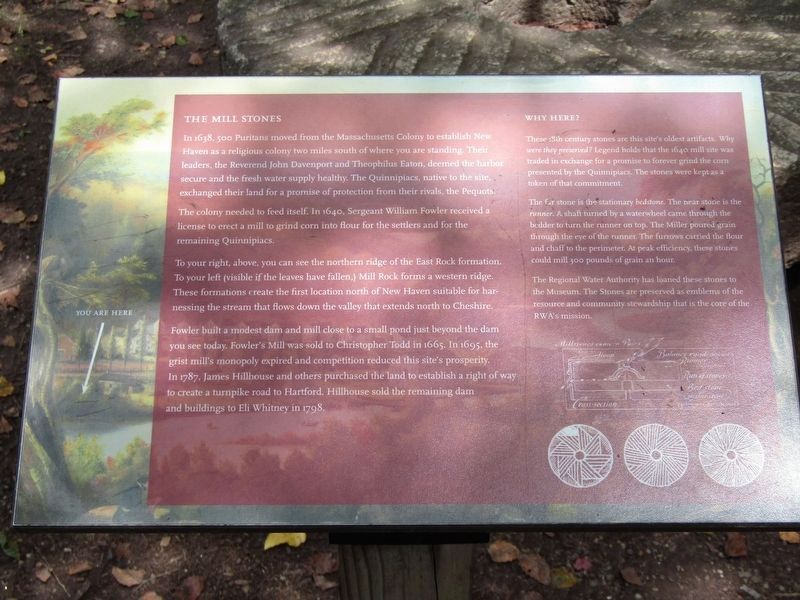
In 1638, 500 Puritans moved from the Massachusetts Colony to establish New Haven as a religious colony two miles south of where you are standing. Their leaders, the Reverend John Davenport and Theophilus Eaton, deemed the harbor secure and the fresh water supply healthy. The Quinnipiacs, native to the site, exchanged their land for a promise of protection from their rivals, the Pequots.
The colony needed to feed itself. In 1640, Sergeant William Fowler received a license to erect a mill to grind corn into flour for the settlers and for the remaining Quinnipiacs.
To your right, above, you can see the northern ridge of the East Rock formation. To your left (visible if the leaves have fallen,) Mill Rock forms a western ridge. These formations create the first location north of New Haven suitable for harnessing the stream that flows down the valley that extends north to Cheshire.
Fowler built a modest dam and mill close to a small pond just beyond the dam you see today. Fowler's Mill was sold to Christopher Todd in 1665. In 1695, the grist mill's monopoly expired and competition reduced this site's prosperity.
this page online
Why Here?
These 18th century stones are this site's oldest artifacts Why were they preserved? Legend holds that the 1640 mill site was traded in exchange for a promise to forever grind the corn presented by the Quinnipiacs. The stones were kept as a token of that commitment.
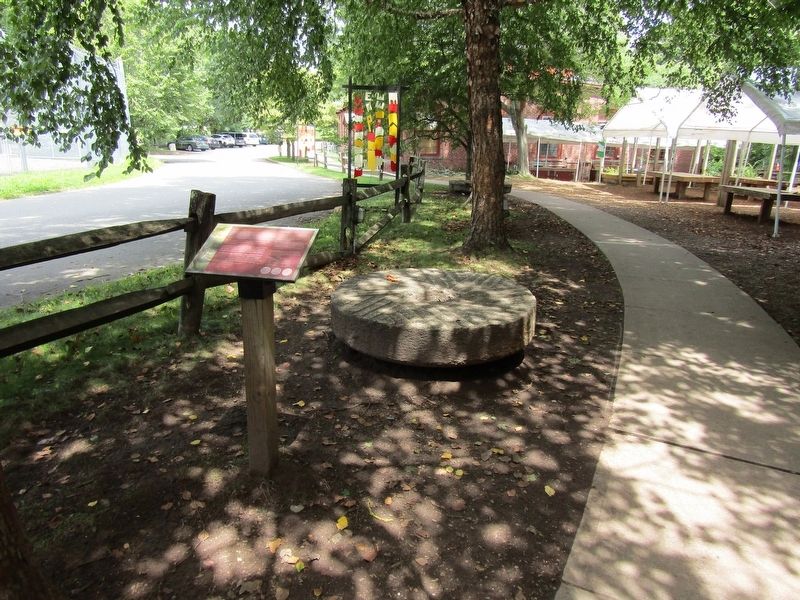
The far stone is the stationary bedstone. The pear stone is the runner. A shaft turned by a waterwheel came through the bedder to turn the runner on top. The Miller poured grain through the eye of the runner. The furrows carried the flour and chaff to the perimeter. At peak efficiency, these stones could mill 300 pounds of grain an hour.
The Regional Water Authority has loaned these stones to the Museum. The Stones are preserved as emblems of the resource and community stewardship that is the core of the RWA's mission.
Erected by Eli Whitney Museum and Workshop.
Topics. This historical marker is listed in these topic lists: Indigenous Peoples and Communities
Photographed by Conrad Ward, August 11, 2024
2. The Mill Stones Marker
Location. 41° 20.123′ N, 72° 54.647′ W. Marker is in Hamden in South Central Region, Connecticut. It is in Whitneyville. It is on Whitney Avenue south of Armory Street, on the left when traveling south. Located at the Eli Whitney Museum and Workshop. Touch for map. Marker is at or near this postal address: 915 Whitney Ave, Hamden CT 06517, United States of America. Touch for directions.

Regionally, this marker is in the Connecticut River Valley, on the Connecticut Shoreline, and in Greater New Haven. It is also in the American Northeast and in New England. Globally, it is in North America, the Western Hemisphere, the Western World, and the Anglosphere. Historically, it finds itself in what was once New Haven County and also one of the original Thirteen Colonies.
Other nearby markers. At least 8 other markers are within walking distance of this marker: Eli Whitney Armory (within shouting distance of this marker); Transition (within shouting distance of this marker); A. Frederick Oberlin Bridge (within shouting distance of this marker); The Town Bridge (within shouting distance of this marker); The Mill River (within shouting distance of this marker); The Painting (about 300 feet away, measured in a direct line); The Forge & Its Waterworks (about 300 feet away); The Barn (about 300 feet away). Touch for a list and map of all markers in Hamden.
Also see . . .
1. Eli Whitney Museum and Workshop. (Submitted on January 23, 2025.)
2. Eli Whitney Museum (Wikipedia). (Submitted on January 23, 2025.)
Credits. This page was last revised on May 19, 2026. It was originally submitted on January 22, 2025, by Conrad Ward of Guilford, Connecticut. This page has been viewed 167 times since then and 25 times this year. Photos: 1, 2. submitted on January 22, 2025, by Conrad Ward of Guilford, Connecticut. • Michael Herrick was the editor who published this page.
