Whitneyville in Hamden in South Central Region, Connecticut — The American Northeast (New England)
Transition
Photographed by Conrad Ward, August 11, 2024
1. Transition Marker
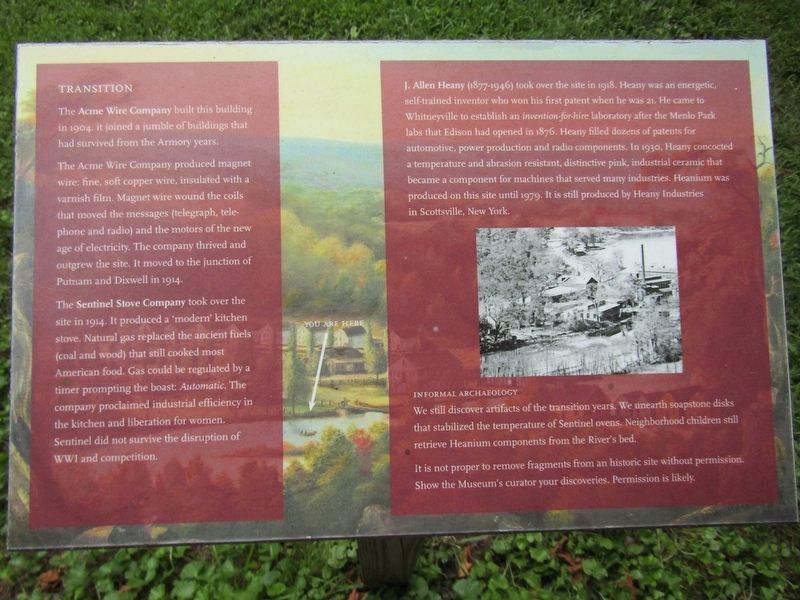
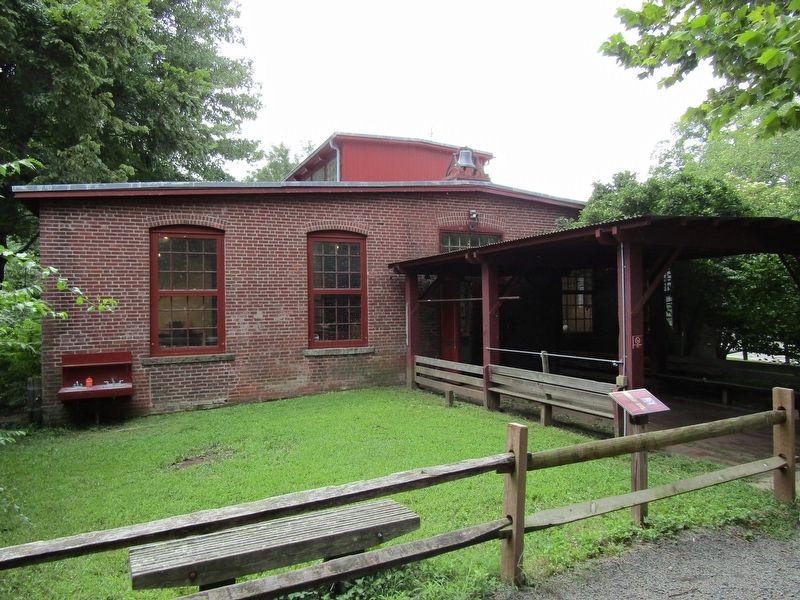
The Acme Wire Company built this building in 1904. it joined a jumble of buildings that had survived from the Armory years.
The Acme Wire Company produced magnet wire: fine, soft copper wire, insulated with a varnish film. Magnet wire wound the coils that moved the messages (telegraph, telephone and radio) and the motors of the new age of electricity. The company thrived and outgrew the site. It moved to the junction of Putnam and Dixwell in 1914.
The Sentinel Stove Company took over the site in 1914. It produced a 'modern' kitchen stove. Natural gas replaced the ancient fuels (coal and wood) that still cooked most American food. Gas could be regulated by a timer prompting the boast: Automatic. The company proclaimed industrial efficiency in the kitchen and liberation for women. Sentinel did not survive the disruption of WWI and competition.
J. Allen Heany (1877-1946) took over the site in 1918. Heany was an energetic, self-trained inventor who won his first patent when he was 21. He came to Whitneyville to establish an invention-for-hire laboratory after the Menlo Park labs that Edison had opened in
this page online
Informal Archaeology
We still discover artifacts of the transition years. We unearth soapstone disks that stabilized the temperature of Sentinel ovens. Neighborhood children still retrieve Heanium components from the River's bed.
It is not proper to remove fragments from an historic site without permission. Show the Museum's curator your discoveries. Permission is likely.
Erected by Eli Whitney Museum and Workshop.
Topics. This historical marker is listed in these topic lists: Anthropology & Archaeology • Industry & Commerce • Science & Medicine. A significant historical year for this entry is 1904.
Location. 41° 20.158′ N, 72° 54.637′ W. Marker is in Hamden in South Central Region, Connecticut. It is in Whitneyville. It can be reached from Whitney
Photographed by Conrad Ward, August 11, 2024
2. Transition Marker

Regionally, this marker is in the Connecticut River Valley, on the Connecticut Shoreline, and in Greater New Haven. It is also in the American Northeast and in New England. Globally, it is in North America, the Western Hemisphere, the Western World, and the Anglosphere. Historically, it finds itself in what was once New Haven County and also one of the original Thirteen Colonies.
Other nearby markers. At least 8 other markers are within walking distance of this marker: A. Frederick Oberlin Bridge (here, next to this marker); The Town Bridge (a few steps from this marker); The Painting (a few steps from this marker); Eli Whitney Armory (a few steps from this marker); The Mill River (within shouting distance of this marker); The Forge & Its Waterworks (within shouting distance of this marker); The Second Armory (within shouting distance of this marker); The Dam (within shouting distance of this marker). Touch for a list and map of all markers in Hamden.
Also see . . .
1. Eli Whitney Museum and Workshop. (Submitted on January 23, 2025.)
2. Eli Whitney Museum (Wikipedia). (Submitted on January 23, 2025.)
Credits. This page was last revised on May 19, 2026. It was originally submitted on January 22, 2025, by Conrad Ward of Guilford, Connecticut. This page has been viewed 137 times since then and 15 times this year. Photos: 1, 2. submitted on January 22, 2025, by Conrad Ward of Guilford, Connecticut. • Michael Herrick was the editor who published this page.
