Flatlands in Brooklyn in Kings County, New York — The American Northeast (Mid-Atlantic)
Amersfort Park
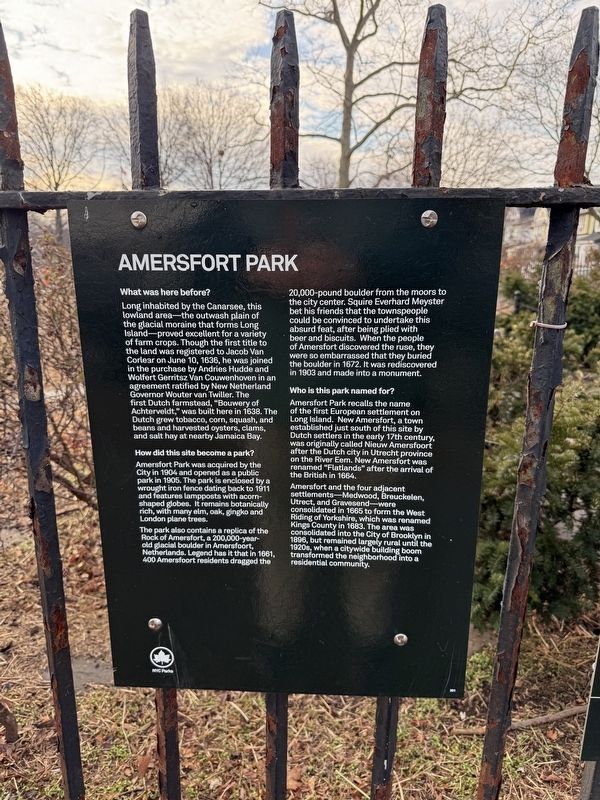
What was here before?
Long inhabited by the Canarsee, this lowland area—the outwash plain of the glacial moraine that forms Long Island—proved excellent for a variety of farm crops. Though the first title to the land was registered to Jacob Van Corlear on June 10, 1636, he was joined in the purchase by Andries Hudde and Wolfert Gerritsz Van Couwenhoven in an agreement ratified by New Netherland Governor Wouter van Twiller. The first Dutch farmstead, "Bouwery of Achterveldt," was built here in 1638. The Dutch grew tobacco, corn, squash, and beans and harvested oysters, clams, and salt hay at nearby Jamaica Bay.
How did this site become a park?
Amersfort Park was acquired by the City in 1904 and opened as a public park in 1905. The park is enclosed by a wrought iron fence dating back to 1911 and features lampposts with acorn-shaped globes. It remains botanically rich, with many elm, oak, gingko and London plane trees.
The park also contains a replica of the Rock of Amersfort, a 200,000-year-old glacial bolder in Amersfoort, Netherlands. Legend has it that in 1661, 400 Amersfoort residents dragged the 20,000-pound
this page online
Who is this park named for?
Amersfort Park recalls the name of the first European settlement on Long Island. New Amersfort, a town established just south of this site by Dutch settlers in the early 17th century, was originally called Nieuw Amersfoort after the Dutch city in Utrecht province on the River Eem. New Amersfort was renamed "Flatlands" after the arrival of the British in 1664.
Amersfort and the four adjacent settlements—Medwood, Breuckelen, Utrect, and Gravesend—were consolidated in 1665 to form the West Riding of Yorkshire, which was renamed Kings County in 1683. The area was consolidated into the City of Brooklyn in 1896, but remained largely rural until the 1920s, when a citywide building boom transformed the neighborhood into a residential community.
Erected by NYC
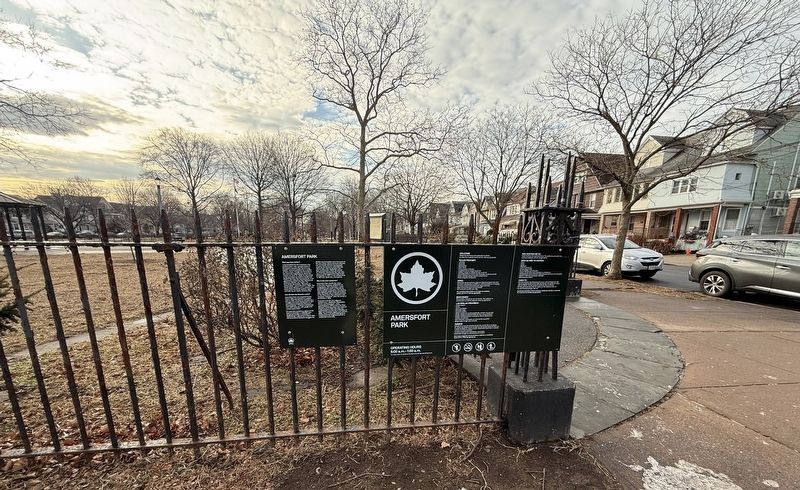
Topics and series. This historical marker is listed in these topic lists: Colonial Era • Parks & Recreational Areas • Political Subdivisions • Settlements & Settlers. In addition, it is included in the NYC Parks series list. A significant historical date for this entry is June 10, 1636.
Location. 40° 37.785′ N, 73° 56.366′ W. Marker is in Brooklyn, New York, in Kings County. It is in Flatlands. It is at the intersection of Avenue I and East 38th Street, on the right when traveling east on Avenue I. Touch for map. Marker is at or near this postal address: 3801 Avenue I, Brooklyn NY 11210, United States of America. Touch for directions.

Regionally, this marker is in New York City and on Long Island. It is also in the American Northeast, in the Mid-Atlantic, and on the Eastern Seaboard. Globally, it is in the North Atlantic Region, North America, the Western Hemisphere, the Western World, and the Anglosphere. Historically, it finds itself in what was once New Netherland and also one of the original Thirteen Colonies.
Other nearby markers. At least 8 other markers are within walking distance
By Devry Becker Jones (CC0), January 19, 2025
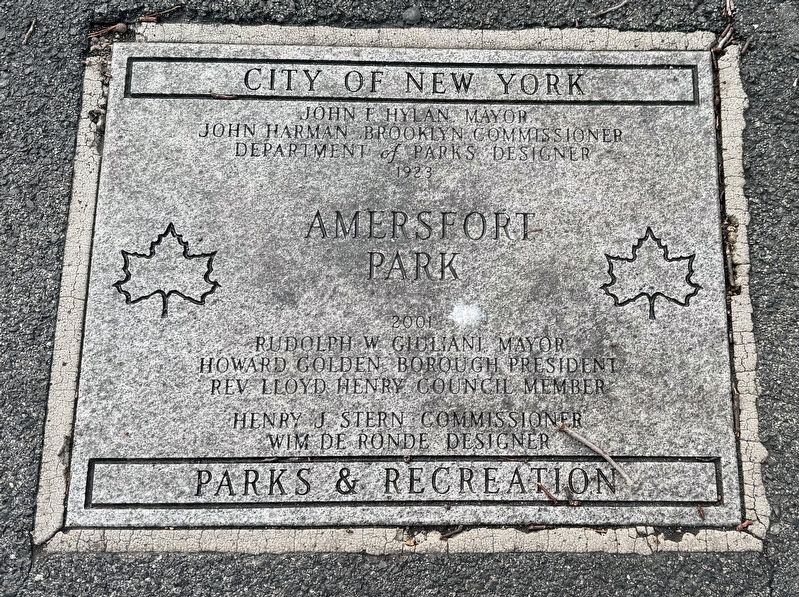
3. Rededication paver inside the park
John F. Hylan, Mayor
John Harman, Brooklyn Commissioner
Department of Parks Designer
1923
Amersfort
Park
2001
Rudolph W. Giuliani, Mayor
Howard Golden, Borough President
Rev. Lloyd Henry, Council Member
Henry J. Stern, Commissioner
Wim de Ronde, Designer
Credits. This page was last revised on July 15, 2025. It was originally submitted on January 23, 2025, by Devry Becker Jones of Washington, District of Columbia. This page has been viewed 204 times since then and 28 times this year. Photos: 1, 2, 3. submitted on January 23, 2025, by Devry Becker Jones of Washington, District of Columbia.
