Galewood in Chicago in Cook County, Illinois — The American Midwest (Great Lakes)
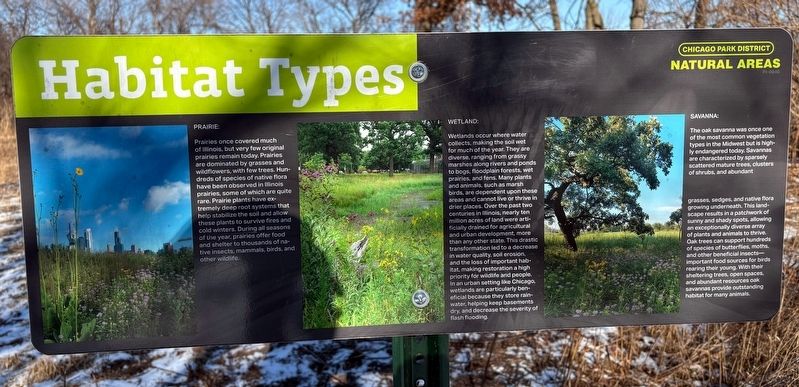
Habitat Types
Chicago Park District Natural Areas
Photographed by Sean P. Flynn, January 23, 2025
1. Habitat Types Marker
Prairie:
Prairies once covered much of Illinois, but very few original prairies remain today. Prairies are dominated by grasses and wildflowers, with few trees. Hundreds of species of native flora have been observed in Illinois prairies, some of which are quite rare. Prairie plants have extremely deep root systems that help stabilize the soil and allow these plants to survive fires and cold winters. During all seasons of the year, prairies offer food and shelter to thousands of native insects mammals, birds, and other wildlife.
Wetland:
Wetlands occur where water collects, making the soil wet for much of the year. They are diverse, ranging from grassy marshes along rivers and ponds to bogs, floodplain forests, wet prairies, and fens. Many plants and animals, such as marsh birds, are dependent upon these areas and cannot live or thrive in drier places. Over the past two centuries in Illinois, nearly ten million acres of land were artificially drained for agricultural and urban development, more than any other state. This drastic transformation led to a decrease in water quality, soil erosion, and the loss of important
this page online
Savanna:
The oak savanna was once one of the most common vegetation types in the Midwest but is highly endangered today. Savannas are characterized by sparsely scattered mature trees, clusters of shrubs, and abundant grasses, sedges, and native flora growing underneath. This landscape results in a patchwork of sunny and shady spots, allowing an exceptionally diverse array of plants and animals to thrive. Oak trees can support hundreds of species of butterflies, moths, and other beneficial insects—important food sources for birds rearing their young. With their sheltering trees, open spaces, and abundant resources oak savannas provide outstanding habitat for many animals.
Erected by Chicago Park District.
Topics. This historical marker is listed in these topic lists: Animals • Environment • Parks & Recreational Areas.
Location. 41° 55.188′ N, 87° 47.852′ W.

Photographed by Sean P. Flynn, January 23, 2025
2. Habitat Types Marker

Regionally, this marker is on Chicago’s West Side. It is also in the American Midwest. Globally, it is in North America, on the Great Lakes, in the Western Hemisphere, in the Western World, and in the Anglosphere. Historically, it finds itself in what was once the Viceroyalty of New France, the territory of the Mississippian Culture, and the Northwest Territory.
Other nearby markers. At least 8 other markers are within walking distance of this marker: Native Plants Reduce Flooding (within shouting distance of this marker); Rutherford Sayre Nature Garden and Natural Area (within shouting distance of this marker); A Historical Vision Realized (within shouting distance of this marker); Rutherford Sayre Natural Area (about 300 feet away, measured in a direct line); Montclare World War I Honor Roll

Photographed by Sean P. Flynn, January 23, 2025
3. Rutheford Sayre Natural Area
More about this marker. The sign is one of about a half-dozen at the natural area discussing the environment and its history.
Also see . . . Chicago Park District: Rutherford Sayre Natural Area. (Submitted on January 23, 2025, by Sean P. Flynn of Oak Park, Illinois.)
Credits. This page was last revised on January 23, 2025. It was originally submitted on January 23, 2025, by Sean P. Flynn of Oak Park, Illinois. This page has been viewed 107 times since then and 20 times this year. Photos: 1, 2, 3. submitted on January 23, 2025, by Sean P. Flynn of Oak Park, Illinois.
