Rione X Campitelli in Roma in Città metropolitana di Roma Capitale, Latium, Rome, Italy — Central Italy (Tyrrhenian Coast)
Orti Farnesiani
⎯⎯⎯
Farnese Gardens
Photographed by James Hulse, March 4, 2024
1. Orti Farnesiani / Farnese Gardens Marker

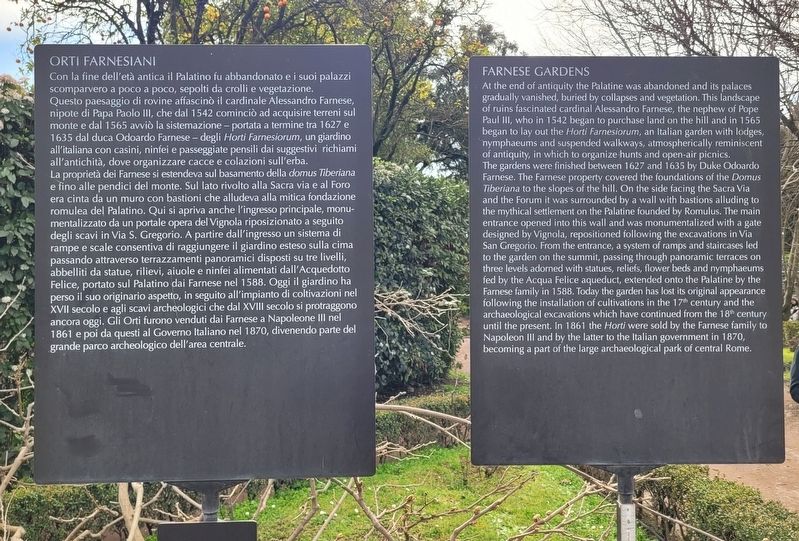
Con la fine dell'età antica il Palatino fu abbandonato e i suoi palazzi scomparvero a poco a poco, sepolti da crolli e vegetazione. Questo paesaggio di rovine affascinò il cardinale Alessandro Farnese, nipote di Papa Paolo III, che dal 1542 cominciò ad acquisire terreni sul monte e dal 1565 avviò la sistemazione – portata a termine tra 1627 e 1635 dal duca Odoardo Farnese - degli Horti Farnesiorum, un giardino all'italiana con casini, ninfei e passeggiate pensili dai suggestivi richiami all'antichità, dove organizzare cacce e colazioni sull'erba. La proprietà dei Farnese si estendeva sul basamento della domus Tiberiana e fino alle pendici del monte. Sul lato rivolto alla Sacra via e al Foro era cinta da un muro con bastioni che alludeva alla mitica fondazione romulea del Palatino. Qui si apriva anche l'ingresso principale, monu- mentalizzato da un portale opera del Vignola riposizionato a seguito degli scavi in Via S. Gregorio. A partire dall'ingresso un sistema di rampe e scale consentiva di raggiungere il giardino esteso sulla cima passando attraverso terrazzamenti panoramici disposti su tre livelli,
this page online
At the end of antiquity the Palatine was abandoned and its palaces gradually vanished, buried by collapses and vegetation. This landscape of ruins fascinated cardinal Alessandro Farnese, the nephew of Pope Paul III, who in 1542 began to purchase land on the hill and in 1565 began to lay out the Horti Farnesiorum, an Italian garden with lodges, nymphaeums and suspended walkways, atmospherically reminiscent of antiquity, in which to organize hunts and open-air picnics. The gardens were finished between 1627 and 1635 by Duke Odoardo Farnese. The Farnese property covered the foundations of the Domus Tiberiana to the slopes of the hill. On the side facing
Photographed by James Hulse, March 4, 2024
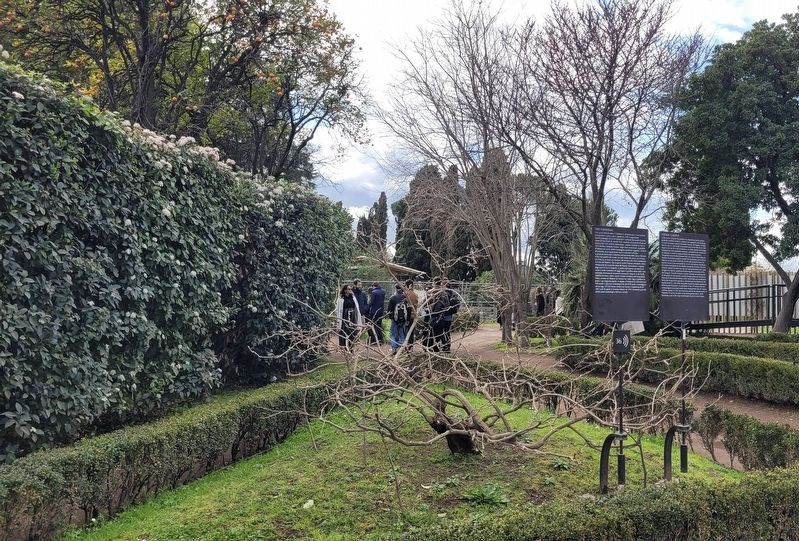
2. The view of the Farnese Gardens and Marker
Topics. This historical marker is listed in these topic lists: Anthropology & Archaeology • Parks & Recreational Areas. A significant historical year for this entry is 1542.
Location. 41° 53.421′ N,
Photographed by James Hulse, March 4, 2024
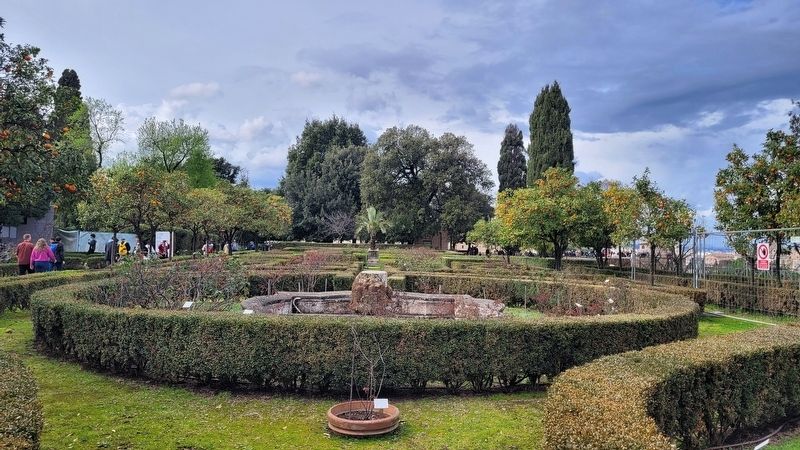
3. A view of the Farnese Gardens

Regionally, it is in Europe, the European Union, the Schengen Area, a coastal Mediterranean country, and the Western World. Historically, it finds itself in what was once the Roman Empire.
Other nearby markers. At least 8 other markers are within walking distance of this marker: Le Rose del Viridarium / The Roses of the Viridarium (within shouting distance of this marker); I colori dell'abitare / The colours of dwelling (within shouting distance of this marker); Le case aristocratiche del Palatino / The Aristocratic Houses of the Palatine Hill (within shouting distance of this marker); I giardini del XIX secolo / The gardens of the 19th century (within shouting distance of this marker); Giacomo Boni sul Palatino / Giacomo Boni on the Palatine (within shouting distance of this marker); Sostruzioni del Palazzo e Clivo della Vittoria / Palace Substructures and the Clivus Victoriae
Photographed by James Hulse, March 4, 2024
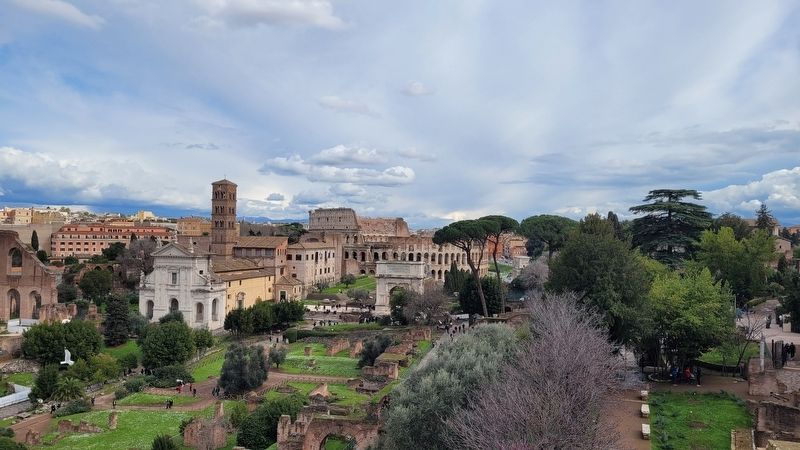
4. The view from the Farnese Gardens lookout
More about this marker. The marker is located in the Parco Archeologico del Colosseo (Roman Forum Archaeological Park) and it does require an entry fee to visit.
Also see . . .
1. Roma Turismo. Parco Archeologico del Colosseo (Submitted on January 26, 2025, by James Hulse of Medina, Texas.)
2. Farnese Gardens. Wikipedia
The Farnese Gardens, or "Gardens of Farnese upon the Palatine", are a garden in Rome, central Italy, created in 1550 on the northern portion of Palatine Hill, by Cardinal Alessandro Farnese. They were the first private botanical gardens in Europe; the first botanical gardens of any kind in Europe were started by Italian universities in the mid-16th century, only a short time before.(Submitted on January 26, 2025, by James Hulse of Medina, Texas.)
Credits. This page was last revised on January 26, 2025. It was originally submitted on January 26, 2025, by James Hulse of Medina, Texas. This page has been viewed 163 times since then and 62 times this year. Photos: 1, 2, 3, 4. submitted on January 26, 2025, by James Hulse of Medina, Texas.
