
Rione X Campitelli in Roma in Città metropolitana di Roma Capitale, Latium, Rome, Italy — Central Italy (Tyrrhenian Coast)
L'area della ex Vigna Barberini
⎯⎯⎯
Area of the Former Barberini Vineyard

Photographed by James Hulse, March 4, 2024
1. L'area della ex Vigna Barberini / Area of the Former Barberini Vineyard Marker

La grande area rettangolare denominata Vigna Barberini dal nome della famiglia che ne detenne il possesso fino al 1910, corrisponde ad un terrazzamento artificiale realizzato su quest'angolo del Palatino a partire dall'età neroniano-flavia (64-96 d.C.). Prima di questo intervento la zona era occupata da dimore aristocratiche, una delle quali, con peristilio e raffinate decorazioni, è stata messa in luce dagli scavi. Dopo l'incendio del 64 d.C. Nerone incluse nella proprietà imperiale l'intero spazio e lo adibì probabilmente a giardino tra cui erano lussuosi padiglioni, come la possente torre circolare messa recentemente in luce dagli scavi, forse una panoramica sala da pranzo (Cenatio rotunda).
I Flavi (69-96 d.C.) ricostruirono il giardino che fu circondato da un portico. Secondo alcuni studiosi qui sono da localizzarsi gli Adonaea, "il giardino di Adone" che gli autori antichi descrivono all'interno del palazzo imperiale. Il portico fu ricostruito dopo l'incendio del 191 d.C. e poi sotto il regno di Elagabalo (218-222 d.C.). Vi sorse al centro, allora, un grande tempio dedicato da Elagabalo ad un dio
this page online
The large rectangular area known as the Barberini Vineyard after the family who owned it until 1910 is an artificial terrace created in this corner of the Palatine hill in the Neronian-Flavian period (AD 64-96). Before this intervention the area was occupied by aristocratic residences, one of which, with a peristyle and refined decorations, has been brought to light by excavations. After the fire of AD 64, Nero incorporated the whole area into the imperial estate and probably used it as a garden with luxurious pavilions, like the massive circular tower recently uncovered by excavations, which may have been a panoramic dining room (Cenatio rotunda).
The Flavian emperors (AD 69-96) rebuilt the garden and surrounded it with a portico. According to some scholars this was the site of the Adonaea or "garden of Adonis" described by ancient authors as being inside the
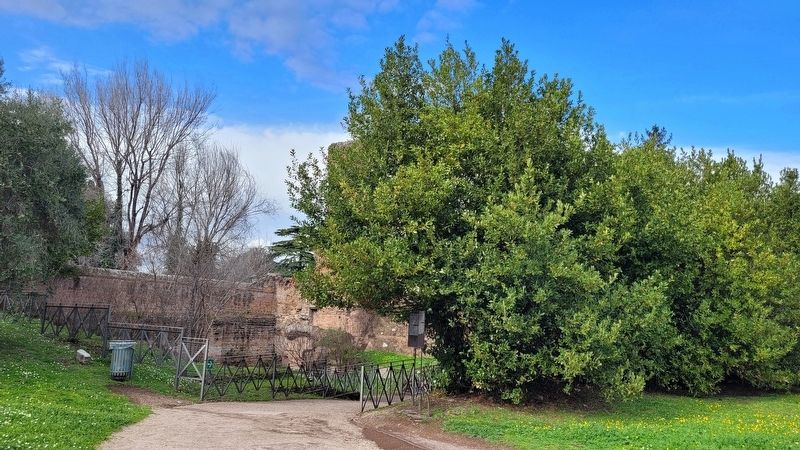
Photographed by James Hulse, March 4, 2024
2. L'area della ex Vigna Barberini / Area of the Former Barberini Vineyard Marker
Topics. This historical marker is listed in these topic lists: Anthropology & Archaeology • Parks & Recreational Areas. A significant historical year for this entry is 1910.
Location. 41° 53.365′ N, 12° 29.291′ E. Marker is in Roma, Lazio (Latium, Rome), in Città metropolitana di Roma Capitale. It is in Rione X Campitelli. It is on Via dei Fori Imperiali. The marker is located on the Palatine Hill. Touch for map. Marker is in this post office area: Roma, Lazio 00186, Italy. Touch for directions.

Regionally, it is in Europe, the European Union, the Schengen Area, a coastal Mediterranean country, and the Western World. Historically, it finds itself in what was once the Roman Empire.
Other nearby markers. At least 8 other markers are within walking distance of this marker: L'Olivo, Albero della Salute e della Prosperità / The Olive, Tree of Health and Prosperity (a few steps from this marker); Chiesa di San Sebastiano / Church of San Sebastiano (within shouting distance of this marker); Chiesa di San Bonaventura / Church of San Bonaventura (within shouting distance of this marker); Le Antiche Tecniche Produttive Dell'olio / Ancient Oil Production Techniques (within shouting distance of this marker); Basamento di un Tempio / Platform of a Temple (within shouting distance of this marker); Imperial Palace (within shouting distance of this marker); Domus Flavia, so-called Lararium / Cd. Larario (within shouting distance of this marker); Domus Flavia. Cd. Larario / Domus Flavia. So-called Larario (within shouting distance of this marker). Touch for a list and map of all markers in Roma.
More about this marker. The marker is located in the Parco Archeologico del Colosseo (Roman Forum Archaeological Park) and it does require an entry fee to visit.
Also see . . . Roma Turismo. Parco Archeologico del Colosseo (Submitted on January 26, 2025, by James Hulse of Medina, Texas.)
Credits. This page was last revised on January 26, 2025. It was originally submitted on January 26, 2025, by James Hulse of Medina, Texas. This page has been viewed 110 times since then and 13 times this year. Photos: 1, 2. submitted on January 26, 2025, by James Hulse of Medina, Texas.
