U Street Corridor in Northwest Washington in Washington, District of Columbia — The American Northeast (Mid-Atlantic)
Men of Color, To Arms!
National Mall and Memorial Parks
African American Civil War Memorial
| — | National Park Service, U.S. Department of the Interior | — |
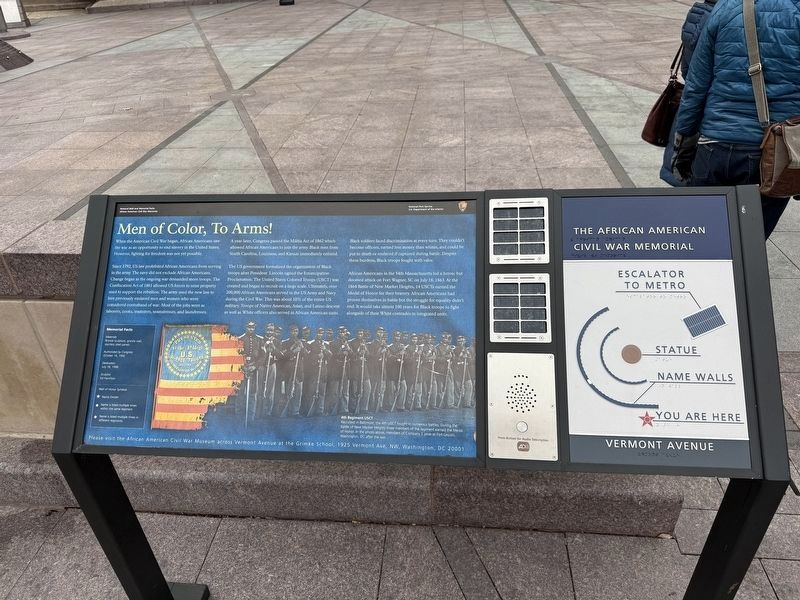
When the American Civil War began, African Americans saw the war as an opportunity to end slavery in the United States. However, fighting for freedom was not yet possible.
Since 1792, US law prohibited African Americans from serving in the army. The navy did not exclude African Americans. Change began as the ongoing war demanded more troops. The Confiscation Act of 1861 allowed US forces to seize property used to support the rebellion. The army used the new law to hire previously enslaved men and women who were considered contraband of war. Most of the jobs were as laborers, cooks, teamsters, seamstresses, and laundresses.
A year later, Congress passed the Militia Act of 1862 which allowed African Americans to join the army. Black men from South Carolina, Louisiana, and Kansas immediately enlisted.
The US government formalized the organization of Black troops after President Lincoln signed the Emancipation Proclamation. The United States Colored Troops (USCT) was created and began to recruit on a large scale. Ultimately, over 200,000 African Americans served in the US Army and Navy during the Civil War. This
this page online
Black soldiers face discrimination at every turn. They couldn't become officers, earned less money than whites, and could be put to death if captured during battle. Despite these burdens, Black troops fought with valor.
African Americans in the 54th Massachusetts led a heroic but doomed attack on Fort Wagner SC on July 18, 1863. At the 1864 Battle of New Market Heights, 14 USCTs earned the Medal of Honor for their bravery. African Americans had proven themselves in battle but the struggle for equality didn't end. It would take almost 100 years for Black troops to fight alongside of their White comrades in integrated units.
Materials
Bronze sculpture, granite wall, stainless steel panels
Authorized by Congress
October 14, 1992
Dedication
July 18, 1998
Sculptor
Ed Hamilton
Wall of Honor Symbols
★ Name Divider
● Name is listed multiple times within the same regiment
◆ Name is listed multiple times in different
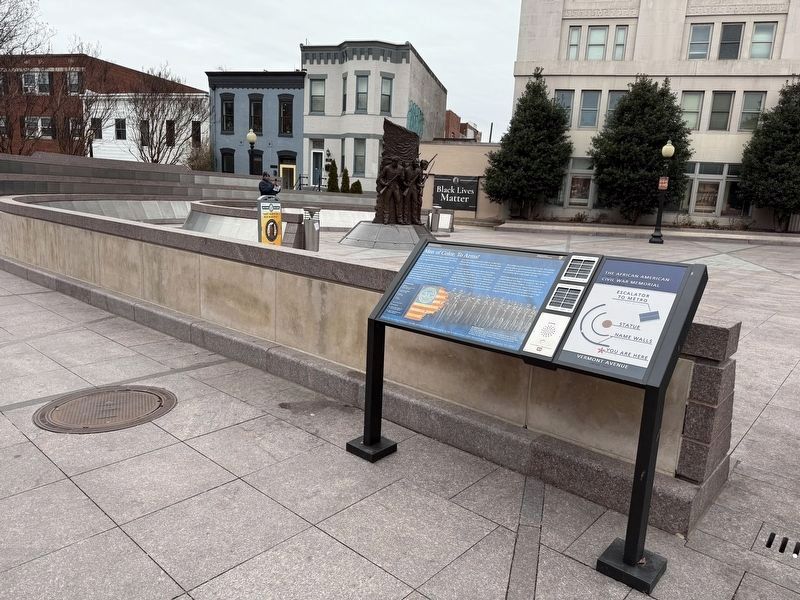
Please visit the African American Civil War Museum across Vermont Avenue at the Grimke School, 1925 Vermont Ave, NW, Washington, DC 20011
[Caption:]
4th Regiment USCT
Recruited in Baltimore, the 4th USCT fought in numerous battles. During the Battle of New Market Heights three members of the regiment earned the Medal of Honor. In the photo above, members of Company E pose at Fort Lincoln, Washington, DC after the war.
Erected by National Park Service, U.S. Department of the Interior.
Topics and series. This historical marker is listed in these topic lists: African Americans • Civil Rights • War, US Civil. In addition, it is included in the Medal of Honor Recipients series list. A significant historical date for this entry is July 18, 1863.
Location. 38° 54.992′ N, 77° 1.544′ W. Marker is in Northwest Washington in Washington, District of Columbia. It is in U Street Corridor. It is on Vermont Avenue Northwest south of U Street Northwest, on the right when traveling south. Touch for map. Marker is at or near this postal address: 1928 Vermont Avenue Northwest, Washington DC 20001, United States of America. Touch for directions.

Regionally, this marker is in the Washington Metropolitan Area. It is also in the American Northeast, in the Upper South, in the Mid-Atlantic, in the Tidewater, and in the Chesapeake Bay Region. Globally, it is in North America, the Western Hemisphere, the Western World, and the Anglosphere.
Other nearby markers. At least 8 other markers are within walking distance of this marker: African American Civil War Memorial (a few steps from this marker); President Abraham Lincoln Signing the Emancipation Proclamation (within shouting distance of this marker); a different marker also named African American Civil War Memorial (within shouting distance of this marker); Most Worshipful Prince Hall Grand Lodge of the District of Columbia (within shouting distance of this marker); Evans-Tibbs House (within shouting distance of this marker); "We had everything we needed right here." (about 400 feet away); New Negro Alliance's Sanitary Grocery Protest Site (about 400 feet away); Scurlock Studio Site (about 500 feet away). Touch for a list and map of all markers in Northwest Washington.
Other markers no longer nearby. Civil War Camp to Victorian Neighborhood (was within shouting distance of this marker but has been confirmed missing); Howard University Sets the Standard (was about 300 feet away, measured in a direct line but has been confirmed missing).
Credits. This page was last revised on February 2, 2025. It was originally submitted on February 2, 2025, by Devry Becker Jones of Washington, District of Columbia. This page has been viewed 168 times since then and 32 times this year. Photos: 1, 2. submitted on February 2, 2025, by Devry Becker Jones of Washington, District of Columbia.
