Remington in Baltimore, Maryland — The American Northeast (Mid-Atlantic)
28th St
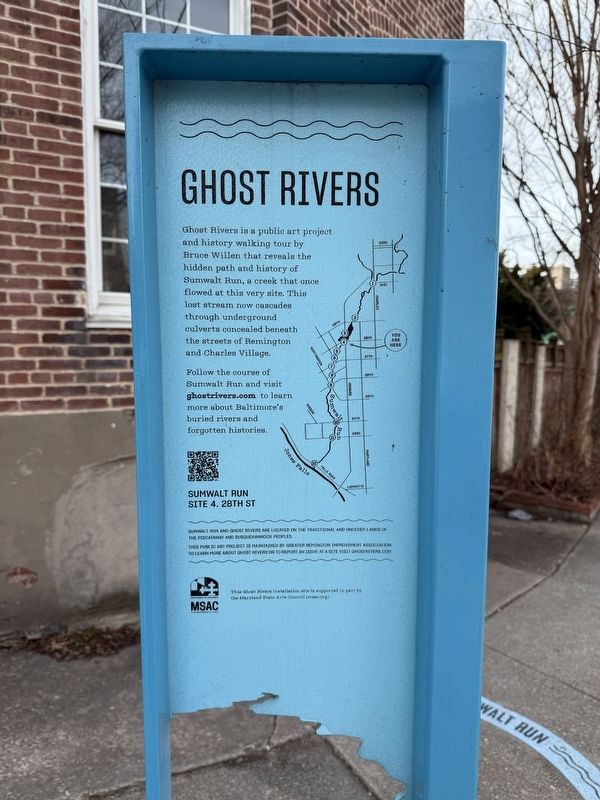
| — | Ghost Rivers | — |
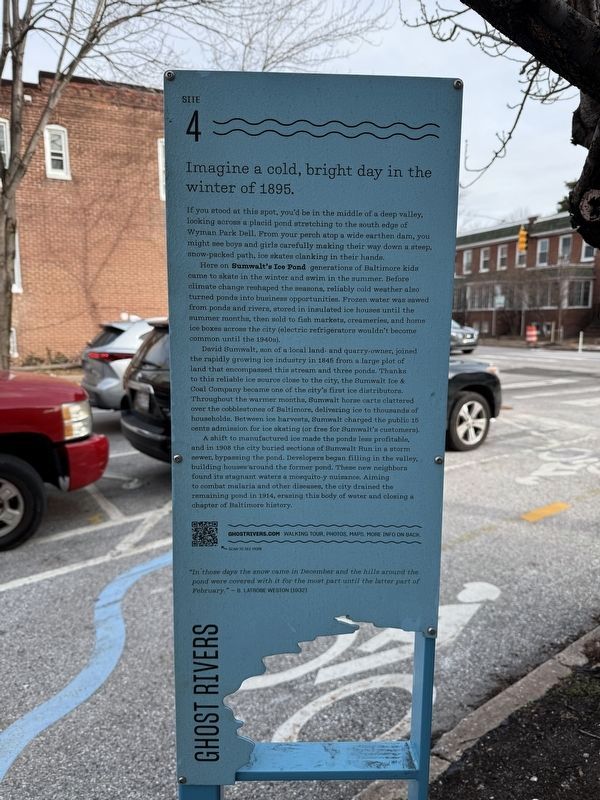
Imagine a cold, bright day in the winter of 1895.
If you stood at this spot, you'd be in the middle of a deep valley, looking across a placid pond stretching to the south edge of Wyman Park Dell. From your perch atop a wide earthen dam, you might see boys and girls carefully making their way down a steep, snow-packed path, ice skates clanking in the hands.
Here on Sumwalt's Ice Pond generations of Baltimore kids came to skate in the winter and swim in the summer. Before climate change reshaped the seasons, reliably cold weather also turned ponds into business opportunities. Frozen water was sawed from ponds and rivers, stored in insulated ice houses until the summer months, then sold to fish markets, creameries, and home ice boxes across the city (electric refrigerators wouldn't become common until the 1940s).
David Sumwalt, son of a local land- and quarry-owner, joined the rapidly growing ice industry in 1845 from a large plot of land that encompassed this stream and three ponds. Thanks to this reliable ice source close to the city, the Sumwalt Ice & Coal Company became one of the city's first ice distributors.
this page online
A shift to manufactured ice made the ponds less profitable, and in 1908 the city buried sections of Sumwalt Run in a storm sewer, bypassing the pond. Developers began filling in the valley, building houses around the former pond. These new neighbors found its stagnant waters a mosquito-y nuisance. Aiming to combat malaria and other diseases, the city drained the remaining pond in 1914, erasing this body of water and closing a chapter of Baltimore history.
"In those days the snow came in December and the hills around the pond were covered with it for the most part until the latter part of February." - B. Latrobe Weston (1932)
Erected by Greater Remington Improvement Association. (Marker Number 4.)
Topics. This historical marker is listed in these topic lists: Environment • Industry & Commerce • Waterways & Vessels. A significant historical year for this entry is 1895.
Location. 39° 19.306′ N,

Regionally, this marker is in Central Maryland. It is also in the American Mid-Atlantic, in the Chesapeake Bay Region, and on the Eastern Seaboard. Globally, it is in the North Atlantic Region, North America, the Western Hemisphere, the Western World, and the Anglosphere. Historically, it finds itself in what was once one of the original Thirteen Colonies and also the Antebellum South.
Other nearby markers. At least 8 other markers are within walking distance of this marker: Cresmont Ave (within shouting distance of this marker); Howard St (within shouting distance of this marker); Remington Ave (about 400 feet away, measured in a direct line); Remington (about 500 feet away); 27th St (about 700 feet away); Wyman Park Dell (about 700 feet away); Lorraine Ave (approx. 0.2
Another marker is no longer nearby. Wyman Park Dell at 29th St (was about 600 feet away but has been confirmed missing).
Credits. This page was last revised on February 2, 2025. It was originally submitted on February 2, 2025, by Devry Becker Jones of Washington, District of Columbia. This page has been viewed 112 times since then and 11 times this year. Photos: 1, 2, 3. submitted on February 2, 2025, by Devry Becker Jones of Washington, District of Columbia.
