Remington in Baltimore, Maryland — The American Northeast (Mid-Atlantic)
Remington Ave
| — | Ghost Rivers | — |
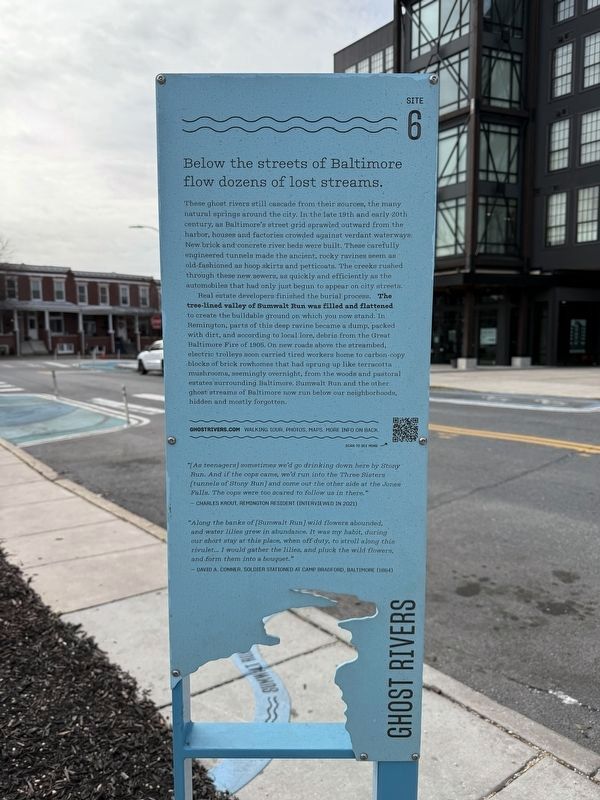
Below the streets of Baltimore flow dozens of lost streams.
These ghost Rivers still cascade from their sources, the many natural springs around the city. In the late 19th and early-20th century, as Baltimore's street grid sprawled outward from the harbor, houses and factories crowded against verdant waterways. New brick and concrete river beds were built. These carefully engineered tunnels made the ancient, rocky ravines seem as old-fashioned as Hooper skirts and petticoats. The creeks rushed through these new sewers, as quickly and efficiently as automobiles that had only just begun to appear on city streets.
Real estate developers finished the burial process. The tree-lined valley of Sumwalt Run was filled and flattened to create the buildable ground on which you now stand. In Remington, parts of this deep ravine became a dump, packed with dirt, and according to local lore, debris from the Great Baltimore Fire of 1905. On new roads above the stream bed, electric Trolleys soon carried tired workers home to carbon-copy blocks of brick rowhomes that had sprung up like terracotta mushrooms, seemingly overnight, from
this page online
"[As teenagers] sometimes we'd go drinking down here by Stony Run. And if the cops came, we'd run into the Three Sisters [tunnels of Stony Run] and come out the other side at the Jones Falls. The cops were too scared to follow us in there."
— Charles Krout, Remington resident (Interviewed in 2021)
"Along the banks of [Sumwalt Run] wild flowers abounded, and water lilies grew in abundance. It was my habit, during our short stay at this place, when off duty, to stroll along this rivulet… I would gather the lilies, and pluck the wild flowers, and form them into a bouquet."
— David A. Conner, soldier stationed at Camp Bradford, Baltimore (1864)
Erected by Greater Remington Improvement Association. (Marker Number 6.)
Topics. This historical marker is listed in these topic lists: Railroads & Streetcars • Roads & Vehicles • Settlements & Settlers • Waterways & Vessels. A significant historical year for this entry is 1905.
Location. 39° 19.246′ N, 76° 37.255′ W.


Regionally, this marker is in Central Maryland. It is also in the American Mid-Atlantic, in the Chesapeake Bay Region, and on the Eastern Seaboard. Globally, it is in the North Atlantic Region, North America, the Western Hemisphere, the Western World, and the Anglosphere. Historically, it finds itself in what was once one of the original Thirteen Colonies and also the Antebellum South.
Other nearby markers. At least 8 other markers are within walking distance of this marker: Remington (a few steps from this marker); Cresmont Ave (within shouting distance of this marker); 27th St (about 300 feet away, measured in a direct line); 28th St (about 400 feet away); Lorraine Ave (about 400 feet away); Howard St (about 600 feet away); 26th St (about 700 feet away); Wyman Park Dell (approx. 0.2 miles away). Touch for a list and map
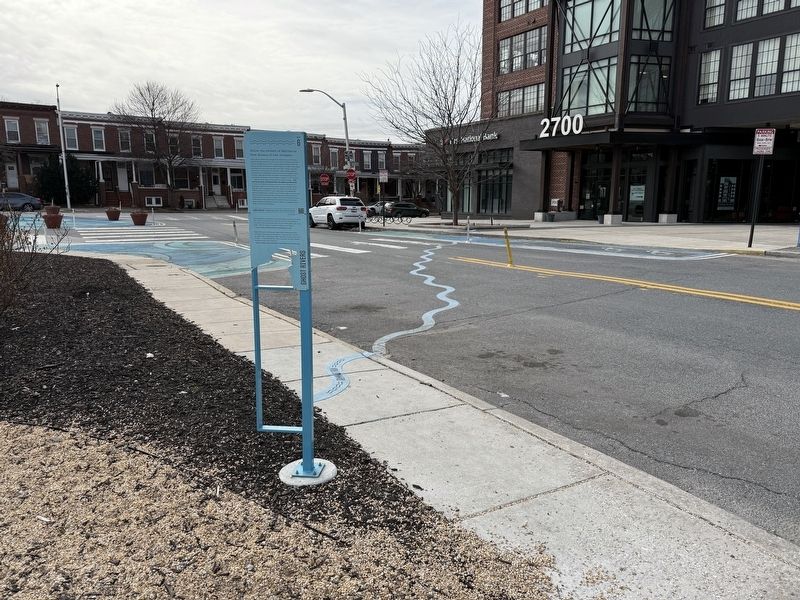
Another marker is no longer nearby. Wyman Park Dell at 29th St (was approx. 0.2 miles away but has been confirmed missing).
Credits. This page was last revised on February 2, 2025. It was originally submitted on February 2, 2025, by Devry Becker Jones of Washington, District of Columbia. This page has been viewed 99 times since then and 14 times this year. Photos: 1, 2, 3. submitted on February 2, 2025, by Devry Becker Jones of Washington, District of Columbia.
