Near Jackson in Cape Girardeau County, Missouri — The American Midwest (Upper Plains)
The Lewis and Clark Expedition Across Missouri
Photographed by Jason Voigt, February 1, 2025
1. The Lewis and Clark Expedition Across Missouri Marker
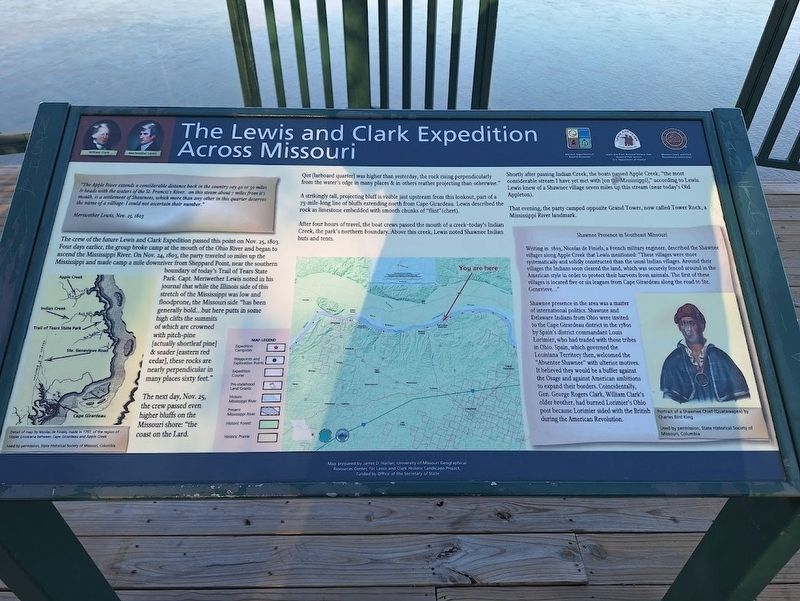
"The Apple River extends a considerable distance back in the country say 40 or 50 miles & heads with the waters of the St. Francis's River. On this steam about 7 miles from it's mouth, is a settlement of Shawnees, which more than any other in this quarter deserves the name of a villiage I could not ascertain their number."
Merriwether Lewis, Nov. 25, 1803
The crew of the future Lewis and Clark Expedition passed this point on Nov. 25, 1803. Four days earlier, the group broke camp at the month of the Ohio River and began to ascend the Mississippi River. On Nov. 24, 1803, the party traveled 20 miles up the Mississippi and made camp a mile downriver from Sheppard point, near the southern boundary of today's Trail of Tears State Park. Capt. Meriwether Lewis noted in his journal that while the Illinois side of this stretch of the Mississippi was low and floodprone, the Missouri side "has been generally bold…but here putts in some high clifts the summits of which are crowned with pitch-pine [actually shortleaf pine] & seader [eastern red cedar], these rocks are nearly perpendicular in many places sixty feet."
The next
this page online
A strikingly tall, projecting bluff is visible just upstream from this lookout, part of a 75-mile-long line of bluffs extending north from Cape Girardeau. Lewis described the rock a limestone embedded with smooth chunks of "flint" (chert).
After four hours of travel, the boat crews passed the mouth of a creek-today's Indian Creek, the park's northern boundary. Above this creek, Lewis noted Shawnee Indian huts and tents.
Shortly after passing Indian Creek, the boats passed Apple Creek, "the most considerable stream I have yet met with [on the Mississippi]," according to Lewis. Lewis knew of a Shawnee village seven miles up this stream (near today's Old Appleton).
That evening, the party camped opposite Grand Tower, now called Tower Rock, a Mississippi River landmark.
Shawnee Presence in Southeast Missouri
Writing in 1803, Nicolas de Finiels, a French military
Photographed by Jason Voigt, February 1, 2025
2. The Lewis and Clark Expedition Across Missouri Marker
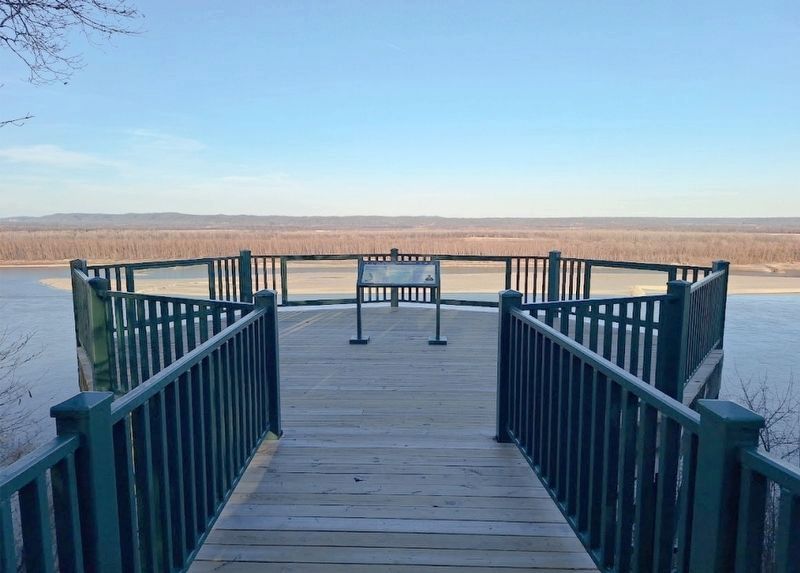
Located atop the scenic overlook deck, in front of the Mississippi River
Shawnee presence in the area was a matter of international politics. Shawnee and Delaware Indians from Ohio were invited to the Cape Girardeau district in the 1780s by Spain's district commandant Louis Lorimier, who had traded with those tribes in Ohio. Spain, which governed the Louisiana Territory then, welcomed the "Absentee Shawnee" with ulterior motives. It believed they would be a buffer against the Osage and against American ambitions to expand their borders. Coincidentally, Gen. George Rogers Clark, William Clark's older brother, had burned Lorimier's Ohio post because Lorimier sided with the British during the American Revolution.
Erected by Lewis and Clark National Historic
Photographed by Jason Voigt, February 1, 2025
3. The Lewis and Clark Expedition Across Missouri Marker
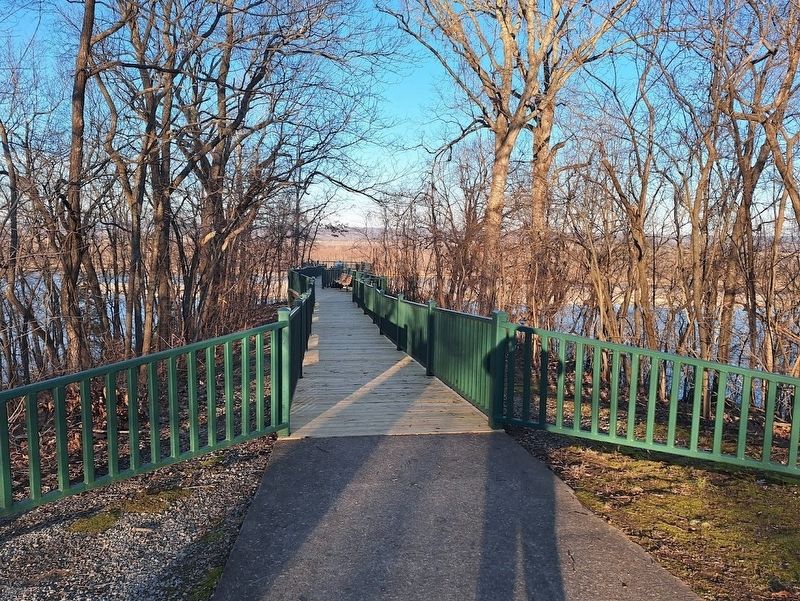
Marker is located near the end of Overlook Road. This is the entrance to the scenic overlook deck (where the marker is)
Topics and series. This historical marker is listed in these topic lists: Exploration • Indigenous Peoples and Communities • Waterways & Vessels. In addition, it is included in the Lewis & Clark Expedition series list. A significant historical date for this entry is October 25, 1803.
Location. 37° 27.902′ N, 89° 28.44′ W. Marker is near Jackson, Missouri, in Cape Girardeau County. It can be reached from Overlook Road 2 miles east of Hill Road. Marker is located at Trail of Tears State Park. It is at the end of Overlook Road, sitting atop the scenic overlook deck. Touch for map. Marker is at or near this postal address: Overlook Rd, Jackson MO 63755, United States of America. Touch for directions.

Regionally, this marker is in Southeast Missouri. It is also in the American Ozarks, in the Lewis & Clark Corridor, in the Corn Belt, and in the Great River Road Region. Globally, it is in North America, the Western Hemisphere, the Western World, and the Anglosphere. Historically, it finds itself in what was once the territory of the Mississippian Culture, the Louisiana Purchase, and the Antebellum South.
Other nearby markers. At least 8 other markers are within 10 miles of this marker, measured as the crow flies: Father Jacques Marquette (about 300 feet away, measured in a direct line); They Passed This Way (approx. 1.2 miles away); Bushyhead Memorial (approx. 1.4 miles away); Veterans Memorial (approx. 3.2 miles away in Illinois); Lewis and Clark in Illinois (approx. 4½ miles away in Illinois); Scientific Mission (approx. 4½ miles away in Illinois); Anna-Jonesboro (approx. 8.1 miles away in Illinois); In Memory of Wayland R. Presley (approx. 9.2 miles away in Illinois). Touch for a list and map of all markers in Jackson.
Also see . . . Lewis & Clark National Historic Trail (National Park Service). (Submitted on November 9, 2025, by Jason Voigt of Glen Carbon, Illinois.)
Credits. This page was last revised on November 9, 2025. It was originally submitted on February 2, 2025, by Jason Voigt of Glen Carbon, Illinois. This page has been viewed 195 times since then and 35 times this year. Photos: 1, 2, 3. submitted on February 2, 2025, by Jason Voigt of Glen Carbon, Illinois.
