Johns Hopkins Homewood in Baltimore, Maryland — The American Northeast (Mid-Atlantic)
Wyman Park Dell at 29th St
| — | Ghost Runs | — |

1. Photo Wanted
In the late 1800s, the sharp corners of a booming city elbowed into the soft edges of streams and rolling fields.
New housing blocks and factories sprawled chaotically across Baltimore’s pastoral fringes. In the face of this relentless development, the Citizens’ Improvement Association of North Baltimore and landowner William Wyman petitioned to preserve a portion of the Sumwalt Run valley here north of 29th Street for use as a public park.
In 1902 Baltimore hired pioneering landscape architects Olmsted Brothers Co. to plan a network of greenways and parks throughout the growing city. The Olmsteds specialized in designing public green spaces woven into the urban grid, a radical idea at the time. Firm founder Frederick Law Olmsted, Sr. advocated that “exposure to natural scenery” improved people’s mental and physical health, a theory now confirmed by modern research.
Part of the Olmsted plan recommended preserving Baltimore’s stream valleys, including parts of Sumwalt Run, as links in a green necklace of parks draped across the city. Early sketches for Wyman Park Dell show wooded paths and footbridges crossing
this page online
"There, at Saint Paul and Thirtieth Streets, as I very well remember, stood a steep bank, on the southern side of the run, overgrown with beech trees and very beautiful."
— William B. Marye, 1959
Erected by Greater Remington Improvement Association. (Marker Number 2.)
Topics. This historical marker is listed in these topic lists: Architecture • Industry & Commerce • Parks & Recreational Areas • Waterways & Vessels. A significant historical year for this entry is 1902.
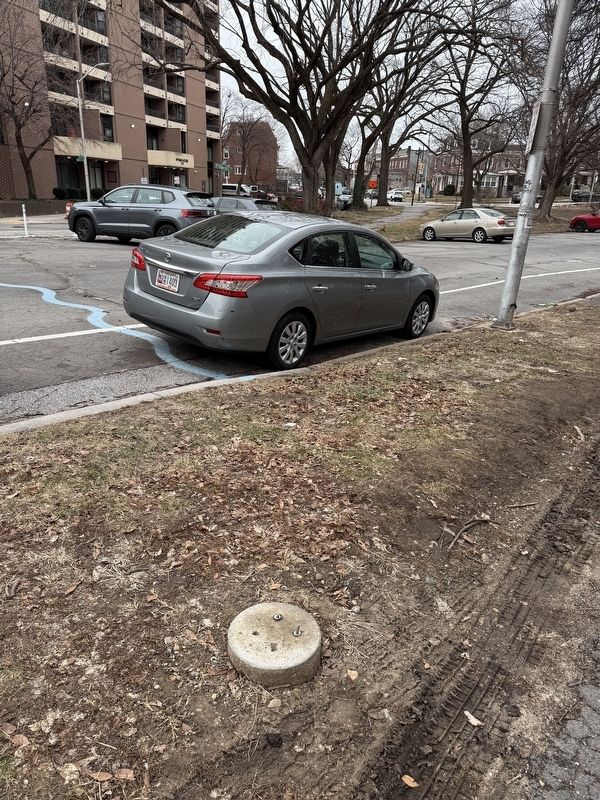
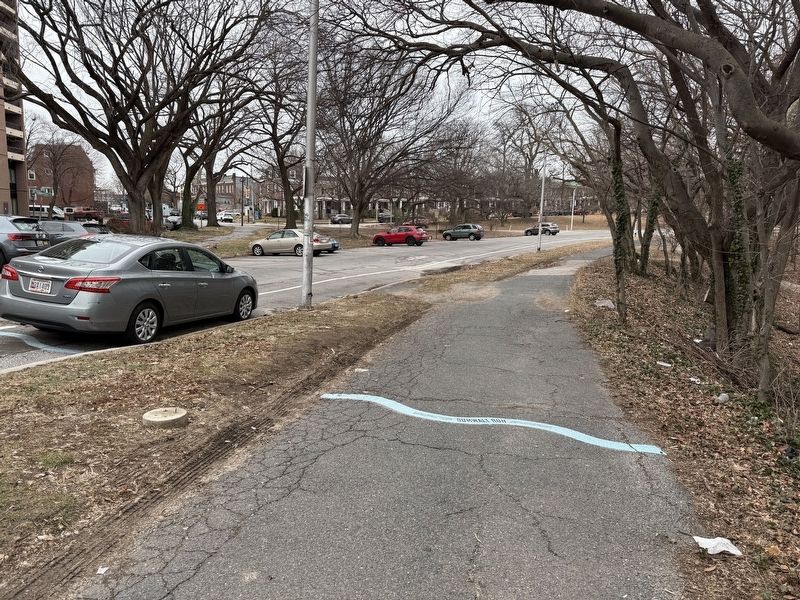
Location. Marker is missing. It was located near 39° 19.4′ N, 76° 37.149′ W. Marker was in Baltimore, Maryland. It was
Photographed by Devry Becker Jones (CC0), February 2, 2025
2. Wyman Park Dell at 29th St Marker Location
The marker is missing.

Regionally, this marker was in Central Maryland. It was also in the American Mid-Atlantic, in the Chesapeake Bay Region, and on the Eastern Seaboard. Globally, it was in the North Atlantic Region, North America, the Western Hemisphere, the Western World, and the Anglosphere. Historically, it found itself in what was once one of the original Thirteen Colonies and also the Antebellum South.
Other nearby markers. At least 8 other markers are within walking distance of this location: Wyman Park Dell (within shouting distance of this marker); Union Soldiers and Sailors Monument (about 400 feet away, measured in a direct line); Robert E. Lee and Thomas. J. “Stonewall” Jackson Monument (about 400 feet away); Howard St (about 400 feet away); Harriet Tubman Grove (about 400 feet away); a different marker also named Wyman Park Dell (about 500 feet away); Joseph Beuys Tree Partnership (about 500 feet away); 28th St (about 600 feet away).
Photographed by Devry Becker Jones (CC0), February 2, 2025
3. Wyman Park Dell at 29th St Marker Location
Another marker is no longer nearby. Lee Jackson Monument (was about 400 feet away but has been replaced with another marker now near it).
Additional keywords. landscape architecture
Credits. This page was last revised on February 2, 2025. It was originally submitted on February 2, 2025, by Devry Becker Jones of Washington, District of Columbia. This page has been viewed 143 times since then and 14 times this year. Photos: 1. submitted on February 2, 2025. 2, 3. submitted on February 2, 2025, by Devry Becker Jones of Washington, District of Columbia.
