Winchester, Virginia — The American South (Mid-Atlantic)
Frederick County Courthouse
Witness to War
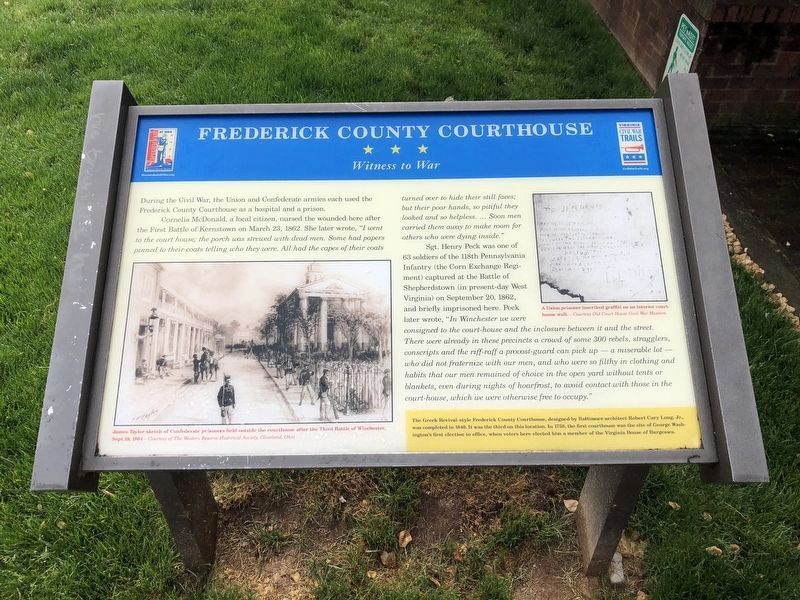
During the Civil War, the Union and Confederate armies each used the Frederick County Courthouse as a hospital and a prison.
Cornelia McDonald, a local citizen, nursed the wounded here after the First Battle of Kernstown on March 23, 1862. She later wrote, “I went to the court house; the porch was strewed with dead men. Some had papers pinned to their coats telling who they were. All had the capes of their coats turned over to hide their still faces; but their poor hands, so pitiful they looked and so helpless. ... Soon men carried them away to make room for others who were dying inside.”
Sgt. Henry Peck was one of 63 soldiers of the 118th Pennsylvania Infantry (The Corn Exchange Regiment) captured at the Battle of Shepherdstown (in present-day West Virginia) on September 20, 1862, and briefly imprisoned here. Peck later wrote, “In Winchester we were consigned to the court-house and the inclosure between it and the street. There were already in the these precincts a crowd of some 300 rebels, stragglers, conscripts and the riff-raff a provost-guard can pick up—a miserable lot—who did not fraternize with our men, and who were so filthy in clothing and habits that our men remained of choice in the open yard without tents or blankets, even during the nights of hoarfrost, to avoid contact with those in the court-house, which we were otherwise free to occupy.”
(Sidebar): The
this page online
Erected by Civil War Trails.
Topics and series. This historical marker is listed in this topic list: War, US Civil. In addition, it is included in the Northern Virginia Civil War Graffiti Trail, and the Virginia Civil War Trails series lists. A significant historical month for this entry is March 1756.
Location. This marker has been replaced by another marker nearby. It was located near 39° 11.066′ N, 78° 9.922′ W. Marker was in Winchester, Virginia. It was on Loudoun Street, on the right when traveling north. Located on the Old Town Mall, which is blocked off to vehicles. Touch for map. Marker was at or near this postal address: 20 North Loudoun Street, Winchester VA 22601, United States of America. Touch for directions.

Regionally, this marker was in Virginia’s Shenandoah Valley. It was also in the American
Photographed by Allen C. Browne, October 18, 2015
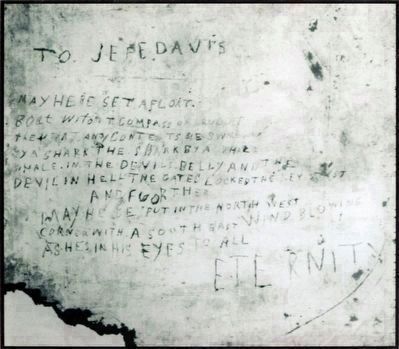
2. Union Graffiti
On an interior Courthouse wall.
On an interior Courthouse wall.
“To Jeff Davis
May he be set afloat
Boat without compass or rudder
Then that any contents be swallowed
By a shark the shark by a whale
Whale in the Devil's Belly and the
Devil in Hell the gates locked the key lost
And further
May he be put in the North West
Corner with a South East wind blowing
Ashe's in his eyes to all
Eternity. ”Close-up of photo on marker
May he be set afloat
Boat without compass or rudder
Then that any contents be swallowed
By a shark the shark by a whale
Whale in the Devil's Belly and the
Devil in Hell the gates locked the key lost
And further
May he be put in the North West
Corner with a South East wind blowing
Ashe's in his eyes to all
Eternity. ”
Other nearby markers. At least 10 other markers are within walking distance of this location: History of the Courthouse (here, next to this marker); Confederate Memorial (here, next to this marker); Lord Fairfax (within shouting distance of this marker); The Wilbur M. Feltner Building (within shouting distance of this marker); Colonel James Wood (within shouting distance of this marker); Winchester During the Civil War (within shouting distance of this marker); A View of Winchester in 1745 - The Four Public Lots (within shouting distance of this marker); George Washington's Political Career Began on This Site (within shouting distance of this marker); Miller Drug Store (within shouting distance of this marker); Taylor Hotel (within shouting distance of this marker).
Photographed by Craig Swain, August 26, 2007
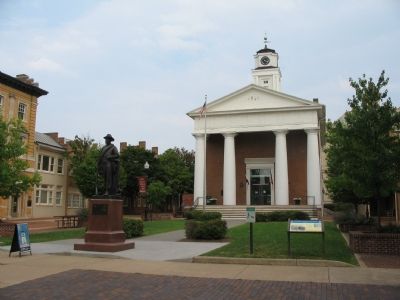
3. Frederick County Courthouse
More about this marker. A drawing on the left is captioned, “James Taylor sketch of Confederate prisoners held outside the courthouse after the Third Battle of Winchester, Sept. 19, 1864.” On the right is a picture showing where, “A Union prisoner inscribed graffiti on an interior courthouse wall.”
Related marker. Click here for another marker that is related to this marker. New Marker At This Location titled "History of the Courthouse".
Also see . . .
1. Old Court House Civil War Museum. The courthouse now houses the Winchester-Frederick County Civil War Museum. (Submitted on September 23, 2007, by Craig Swain of Leesburg, Virginia.)
2. Frederick County Courthouse. Virginia Department of Historic Resources website entry (Submitted on January 26, 2016, by Allen C. Browne of Silver Spring, Maryland.)
Photographed by Allen C. Browne, October 18, 2015
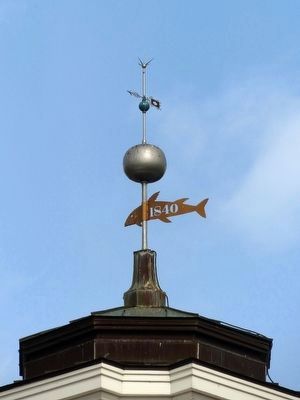
4. Frederick County Courthouse Weathervane
“The metal fish with inscription of 1840 that has been on the courthouse weathervane at least since 1862 may have topped the second courthouse or was created for the new courthouse. It is clearly depicted in the earliest image of the courthouse, a drawing done by James E. Taylor in 1862. ” -- National Register Form.
Credits. This page was last revised on December 17, 2025. It was originally submitted on September 23, 2007, by Craig Swain of Leesburg, Virginia. This page has been viewed 3,260 times since then and 31 times this year. Photos: 1. submitted on May 28, 2020, by Devry Becker Jones of Washington, District of Columbia. 2. submitted on January 26, 2016, by Allen C. Browne of Silver Spring, Maryland. 3. submitted on September 23, 2007, by Craig Swain of Leesburg, Virginia. 4. submitted on January 26, 2016, by Allen C. Browne of Silver Spring, Maryland. • J. J. Prats was the editor who published this page.
