
Old Town in Alexandria, Virginia — The American South (Mid-Atlantic)
The Historic Lyceum
| — | City of Alexandria, Virginia | — |
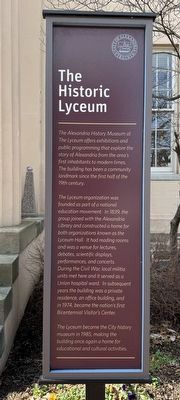
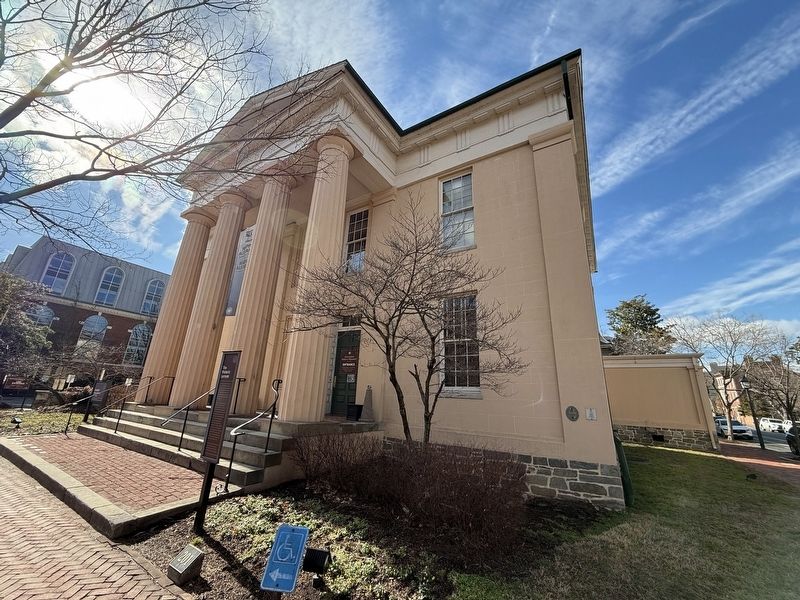
The Alexandria History Museum at The Lyceum offers exhibitions and public programming that explore the story of Alexandria from the area's first inhabitants to modern times. the building has been a community landmark since the first half of the 19th century.
The Lyceum organization was founded as part of a national education movement. In 1839, the group joined with the Alexandria Library and constructed a home for both organizations known as the Lyceum Hall. It had reading rooms and was a venue for lectures, debates, scientific displays, performances, and concerts. During the Civil War, local militia units met here and it served as a Union hospital war. In subsequent years the building was a private residence, an office building, and in 1974, became the nation's first Bicentennial Visitor's Center.
The Lyceum became the City history museum in 1985, making the building once again a home for educational and cultural activities.
Erected by City of Alexandria, Virginia.
Topics and series. This historical marker is listed in these topic lists: Charity & Public Work • Education • Science & Medicine • War, US Civil. In addition, it is included in the Virginia, The City of Alexandria series list. A significant historical year for this entry is 1839.
Location. 38° 48.228′ N, 77° 2.846′ W. Marker is in Alexandria, Virginia. It is in Old Town. It is on Washington Street just south of Prince Street, on the right when traveling south. Touch for map. Marker is at or near this postal address: 201 Washington STreet, Alexandria VA 22314, United States of America. Touch for directions.

Regionally, this marker is in the Washington Metropolitan Area and in Northern Virginia. It is also in the American South, specifically in the Upper South, in the Mid-Atlantic, and on the Eastern Seaboard. Globally,
this page online
Other nearby markers. At least 8 other markers are within walking distance of this marker: The Lyceum (here, next to this marker); The Patton-Fowle House (within shouting distance of this marker); a different marker also named Swann-Daingerfield House (within shouting distance of this marker); The Methodist Episcopal Congregation of Alexandria (within shouting distance of this marker); Trinity United Methodist Church (within shouting distance of this marker); Suffragists and a Courtroom Decision in Alexandria (about 400 feet away, measured in a direct line); Elton B. Hummer (about 400 feet away); The Alexandria Lyceum (about 400 feet away). Touch for a list and map of all markers in Alexandria.
Other markers no longer nearby. The Confederate Statue (was a few steps from this marker but has been permanently removed);
Photographed by Devry Becker Jones (CC0), February 9, 2025
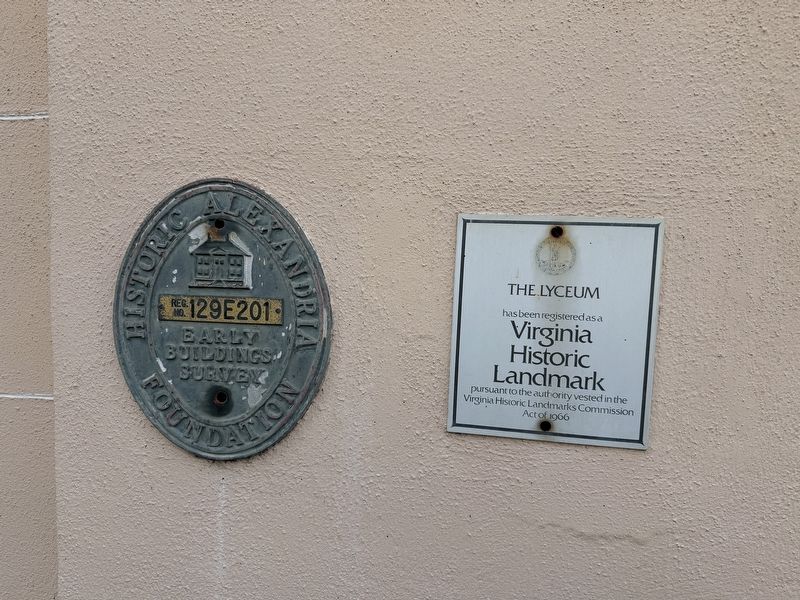
3. Historic Alexandria Foundation and Virginia Historic Landmark plaques for the Lyceum
Credits. This page was last revised on February 9, 2025. It was originally submitted on February 9, 2025, by Devry Becker Jones of Washington, District of Columbia. This page has been viewed 176 times since then and 39 times this year. Photos: 1, 2, 3. submitted on February 9, 2025, by Devry Becker Jones of Washington, District of Columbia.
