Union Station in Denver in Denver County, Colorado — The American Mountains (Southwest)
Little Raven
Peace Chief of the Southern Arapahoe

Photographed by Conrad Ward, August 26, 2024
1. Little Raven Panel
The Arapahoe Indians were one of the last indigenous people to call the South Platte River Valley home. The story of Arapaho Chief Little Raven spotlights the losses of freedom, land and life endured by Plains Indians in the late 19th Century.
The Tattooed People
Many members of the Arapaho Tribe had light skin, prominent noses and tattoos. The "Tattooed People," as some called the tribe, scratched their bodies with a yucca leaf and rubbed wood ashes into the wound to make an indelible mark.
At first, the Arapaho were friendly to the "spider people," as they called the white settlers. But they learned too late the meaning of the maps, survey lines and stakes the whites were using to measure and seize the land.
"Take The Gold!"
At the dawn of the Gold Rush in 1858, the Arapaho and Southern Cheyenne tribes dominated northeastern Colorado. As many as 1,500 Arapaho people camped near the confluence of the South Platte River and Cherry Creek. They named Cherry Creek for the wild chokecherries that grew along its banks.
While the Arapahos welcomed the early prospectors to their homeland, their Chief Little Raven
this page online
But gold fever brought an onslaught of settlers who claimed the land for themselves. Little Raven and the other Peace Chiefs tried to find ways to coexist with the newcomers. Their peacemaking efforts were repaid in 1864 with human slaughter at Sand Creek and bitter exile for those who survived the massacre.
A Hell Of A Deal
Little Raven, White Antelope, Left Hand, Lone Bear, Black Kettle. These were among the Arapaho and Cheyenne leaders who became known as the "Great Peace Chiefs." But their attempts to cooperate with the United States government were met with dishonesty, betrayal and murder.
On February 18, 1861, Indian Agent, Albert Boone, grandson of the famous Daniel Boone, met with leaders of the Southern Arapaho and a few Southern Cheyenne bands. Most of the Cheyenne Tribe, as well the Northern Arapaho, refused to attend the meeting. According to the resulting Ft. Wise Treaty, the tribes traded their lands between the North Platte and Arkansas Rivers for a dry, desolate reservation on Colorado's
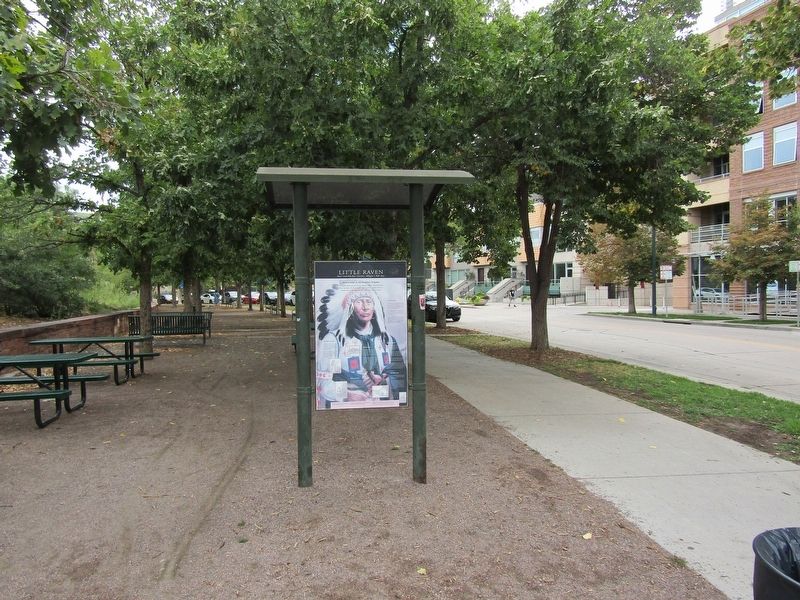
Photographed by Conrad Ward, August 26, 2024
2. Little Raven Panel
"Too Bad To Stand"
After a series of violent clashes between Cheyennes and whites, the Peace Chiefs again met with government officials at Camp Weld in the fall of 1864. There they agreed to immediately move their people to the Sand Creek site under U.S. military protection.
In the early morning of November 29, 1864, about 500 Indians slept at the Sand Creek encampment. Black Kettle's Cheyenne people occupied 100 lodges. Left Hand had recently arrived with eight. The main body of the Arapaho were still several miles away in a large camp with Little Raven.
Just before dawn, Colonel John Chivington led a group of Colorado militia in a surprise attack on the camp. More than 100 people, mostly women and children, were killed. Left Hand was among them.
After the battle, Chivington pursued Little Raven and his band. But the surviving Arapahos retreated to Kiowa-Comanche country further south. The Cheyenne, especially the fearsome Dog Soldiers, launched an all-out war against the whites. Soon most Arapaho men joined them. Even peace-loving Little Raven declared: "The massacre was too bad to stand."
Life After Death
After Sand Creek, the surviving Cheyenne and Arapaho were forced onto reservations in Kansas. Oklahoma, Wyoming and Montana.
Preparing to leave, Little Raven looked back on the tragedy: The fool band of soldiers cleared out our lodges and killed our women and children. There, at Sand Creek. Left Hand, White Antelope and many chiefs lie there, and our horses were taken from us there. Our friends are buried there, and we hate to leave these grounds."
Oklahoma Ending
The U.S. government moved the Southern Arapaho people several times before they settled on a reservation shared with the Southern Cheyenne in Oklahoma Territory. Little Raven remained chief of the Southern Arapaho and continued to work towards peaceful coexistence with whites until he died of natural causes in 1889.
Erected by Mayor's South Platte River Commission.
Topics. This historical marker is listed in these topic lists: Indigenous Peoples and Communities • Wars, US Indian. A significant historical date for this entry is February 18, 1861.
Location. 39° 45.32′ N, 105° 0.294′ W. Marker is in Denver, Colorado, in Denver County. It is in Union Station. It is at the intersection of Little Raven Street and 16th Street on Little Raven Street. Located in Commons Park. Touch for map. Marker is in this post office area: Denver CO 80202, United States of America. Touch for directions.

Regionally, this marker is in the Front Range. It is also in the American Mountain West. Globally, it is in North America, the Rocky Mountains, the Western Hemisphere, the Western World, and the Anglosphere. Historically, it finds itself in what was once the Louisiana Purchase.
Other nearby markers. At least 8 other markers are within walking distance of this marker: Cheyenne Dog Soldiers (here, next to this marker); Riverfront Park (within shouting distance of this marker); Union Station (within shouting distance of this marker); Commons Park (about 700 feet away, measured in a direct line); Confluence Park: Reclaiming Denver's Birthplace (approx. ¼ mile away); Trolley Town (approx. ¼ mile away); Denver Tramway Power Plant (approx. ¼ mile away); When the Depot Became a Station (approx. ¼ mile away). Touch for a list and map of all markers in Denver.
Credits. This page was last revised on June 29, 2025. It was originally submitted on February 15, 2025, by Conrad Ward of Guilford, Connecticut. This page has been viewed 414 times since then and 122 times this year. Photos: 1, 2. submitted on February 15, 2025, by Conrad Ward of Guilford, Connecticut. • Andrew Ruppenstein was the editor who published this page.
