Norwood Park in Chicago in Cook County, Illinois — The American Midwest (Great Lakes)
Land Acknowledgement
Statement

Photographed by Sean P. Flynn, February 15, 2025
1. Land Acknowledgement Marker
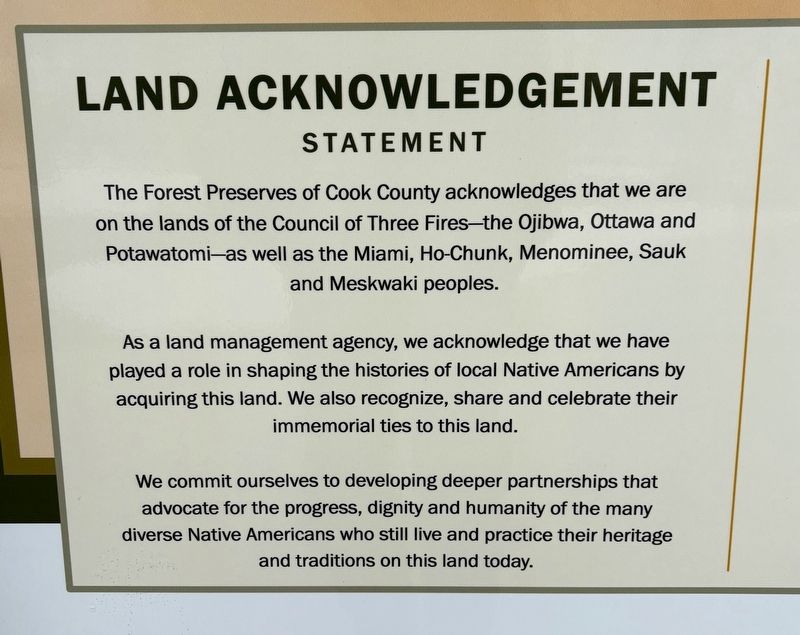
As a land management agency, we acknowledge that we have played a role in shaping the histories of local Native Americans by acquiring this land. We also recognize, share and celebrate their immemorial ties to this land.
We commit ourselves to developing deeper partnerships that advocate for the progress, dignity and humanity of the many diverse Native Americans who still live and practice their heritage and traditions on this land today.
Erected 2024 by Forest Preserves of Cook County.
Topics. This historical marker is listed in these topic lists: Indigenous Peoples and Communities • Parks & Recreational Areas.
Location. 41° 59.871′ N, 87° 47.201′ W. Marker is in Chicago, Illinois, in Cook County. It is in Norwood Park. It is on Devon Avenue east of Milwaukee Avenue, on the right when traveling west. The marker is in front of the Caldwell Woods Wellness
this page online

Regionally, this marker is on Chicago’s North Side. It is also in the American Midwest. Globally, it is in North America, on the Great Lakes, in the Western Hemisphere, in the Western World, and in the Anglosphere. Historically, it finds itself in what was once the Viceroyalty of New France, the territory of the Mississippian Culture, and the Northwest Territory.
Other nearby markers. At least 8 other markers are within one mile of this marker, measured as the crow flies: Katyń Massacre Memorial (approx. 0.7 miles away); Smolensk Airplane Crash Memorial (approx. 0.7 miles away); St. Adalbert Cemetery (approx. ¾ mile away); St. Adalbert's Cemetery Veterans Shrine (approx. ¾ mile away); Norwood Park Vietnam Veterans Memorial (approx. 0.8 miles away); Mary Berkemeier Quinn Park-of-Trees (approx. 0.8 miles away); The Bells of the Leaning Tower of Niles (approx. one mile away); Leaning Tower of Niles (approx. one mile away). Touch for a list and map
Photographed by Sean P. Flynn, February 15, 2025
2. Close-up of the Land Acknowledgement text
More about this marker. The statement is on one of the panels in a kiosk near the Wellness Center. The other panels include a map and details of what to do in the forest preserve.
Regarding Land Acknowledgement. Caldwell Woods is named after Billy Caldwell, a Potawatomi chief credited with saving the lives of the Kinzie family during the Battle of Fort Dearborn (sometimes called the Fort Dearborn Massacre) in Chicago in 1812. (Billy Caldwell is sometimes referenced by his nickname "Sauganash"; that name is used for a far north side neighborhood a short distance from these woods.) Caldwell was rewarded for his help with land along the North Branch of the Chicago River north of the "Indian Boundary Line" that had been established by the 1816 Treaty of St. Louis; much of this land today is the forest preserve that bears his name. After the signing of the 1833 Treaty of Chicago, by which all Native Americans were to move west of the Mississippi, Caldwell sold his land holdings here and moved to Iowa, where he died in 1841.
Also see . . .
1. Indigenous Tribes of Chicago. (Submitted on February 15, 2025, by Sean P. Flynn of Oak Park, Illinois.)
2. Chicago magazine: The Chicago Legacy of Billy Caldwell.

Photographed by Sean P. Flynn, February 15, 2025
3. Land Acknowledgement text on the kiosk at Caldwell Woods
Excerpt: "After negotiating the final treaty, Caldwell began selling off his land along the Chicago River, then moved west with the Potawatomi, settling near present-day Council Bluffs, Iowa, where he died in 1841. His name lives on in Chicago, at the Billy Caldwell Golf Course and Caldwell Woods, and in the neighborhood of Sauganash — a name that is not quite as much of an honor as it sounds."(Submitted on February 15, 2025, by Sean P. Flynn of Oak Park, Illinois.)

Photographed by Sean P. Flynn, February 15, 2025
4. Caldwell Woods kiosk
In this rear view of the sign, Devon Avenue is in the background. In the far distance are Maurie and Flaurie, the mascots of the famed Superdawg drive-in on Milwaukee Avenue.
Credits. This page was last revised on February 15, 2025. It was originally submitted on February 15, 2025, by Sean P. Flynn of Oak Park, Illinois. This page has been viewed 206 times since then and 33 times this year. Photos: 1, 2, 3, 4. submitted on February 15, 2025, by Sean P. Flynn of Oak Park, Illinois.
