South Lake Union in Seattle in King County, Washington — The American West (Northwest)
Native — This Indian Lake

Photographed by Douglass Halvorsen, August 22, 2024
1. Native — This Indian Lake Marker
Canoe Culture
Native canoes, carved the great respect and skill from the living wood, continue to express a vital connection between Indian people and the natural world. Traditionally, these beautiful freshwater vessels were carved here at south Lake Union for use in fishing, transportation and trade.
Caption
(Photo) Cheshiahud — also known as Lake Union John — lived for decades on Lake Union’s Portage Bay. Here, in about 1885, he and his family paused their heavily-laden, Coast Salish style canoe near the lakeshore.
Side 2:
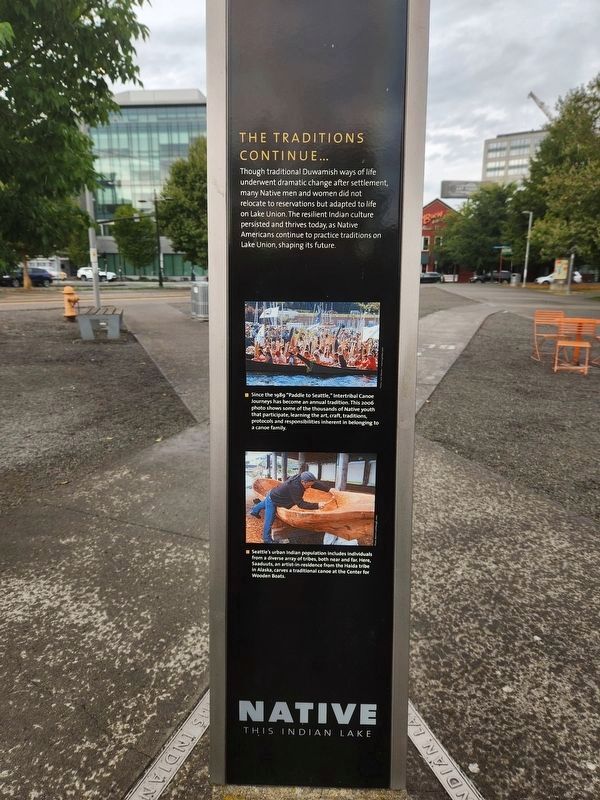
The Traditions Continue... Though traditional Duwamish ways of life underwent dramatic change after settlement, many Native men and women did not relocate to reservations but adapted to life on Lake Union. The resilient Indian culture persisted and thrives today, as Native Americans continue to practice traditions on Lake Union, shaping its future.
Captions
(Photo #1) Since the 1989 “Paddle to Seattle,” Intertribal Canoe Journeys has become an annual tradition. This 2006 photo shows some of the thousands of Native youth that participate, learning the art, craft, traditions, protocols and responsibilities inherent in belonging to a canoe family.
(Photo #2) Seattle’s urban Indian population includes Individuals from a diverse array of tribes, both near and far. Here, Seaduuts, an artist-in-residence from the Haida tribe in Alaska, carves a traditional canoe at the Center for Wooden Boats.
Side
this page online
Meeting Place
When newcomers first settled at Lake Union in the 1850s, they encountered a vibrant Native culture. This lake was called Xa'Xu7cHoo, or Little Lake, by the Duwamish people who had long lived here on the lakeshore. Indian pathways threaded through the timber, connecting the lake village with Suquamish, Snoqualmie, Snohomish and other tribal settlements throughout the region.
Caption
(Map) This map of Lake Union and its place-names provides a glimpse of the vast Native knowledge of this area.
Spirit Canoe Power butudáqt
Serviceberry QWulástab
Outlet gWáXWap ('leak [at] bottom end')
Thrashed Waters CHaxw7álqoo or Covered Water scHooxW7álqoo
Extended from the Ridge sTácHeecH
Small Lake XáXu7cHoo ('small great-amount-of-water')
Prairie báqWab
Croaking waQééQab ('doing like a frog')
Lowered Promontory sKWiTSaqs
Carry a Canoe sxWátSadweehL
Marsh spáhLaXad
Jumping over Driftwood saxWabábaks
Deep situp
Trail to the Beach scktákWsklud (the foot end of the beach')
Deep for Canoes tkupéékpweehL
Aerial Duck Net Láqap ('blocked at the bottom')
Side 4:
“ẊÁẊÁČUל (Little Lake, “Lake

Photographed by Douglass Halvorsen, August 22, 2024
2. Native — This Indian Lake Marker - Side 1
Our Duwamish people lived here on this lake for thousands of years, until 1905. This lake was heavily forested, providing old growth western red cedar trees for our dug-out canoes and longhouses and other forms of indigenous technology.
This lake was bountiful with waterfowl, fish, deer, camas, wapato, and many other food and medicinal resources. Seattle’s first people, the Duwamish, are still here, ẊÁẊÁČUל is still here, and we want to preserve it for the future generations to treasure and enjoy, as we do today.” — The Honorable Cecile Hansen, Duwamish Tribal Chairperson, Great Great Grandneice of Chief Seattle
Topics. This historical marker is listed in these topic lists: Indigenous Peoples and Communities • Waterways & Vessels. A significant historical year for this entry is 1850.
Location. 47° 37.566′ N,
Photographed by Douglass Halvorsen, August 22, 2024
3. Native — This Indian Lake Marker - Side 2

Regionally, this marker is in the Puget Sound Region. It is also on the American Pacific Coast, in the Pacific Northwest, and in the Lewis & Clark Corridor. Globally, it is in North America, in the Cascade Range, in the Inside Passage, on the Ring of Fire, on the Pacific Rim, in the Western Hemisphere, in the Western World, and in the Anglosphere.
Other nearby markers. At least 8 other markers are within walking distance of this marker: Paths — The Union of Pathways (a few steps from this marker); Play — Having Fun on the Lake (within shouting distance of this marker); Lake — A Lake at the Heart of the City (within shouting distance of this marker); Work — At Work on Lake Union (within shouting distance of this marker); Pocock Shells (about 500 feet away, measured in a direct line); U.S. Naval Reserve Armory (about 500 feet away);

Photographed by Douglass Halvorsen, August 22, 2024
4. Native — This Indian Lake Marker - Side 3

Photographed by Douglass Halvorsen, August 22, 2024
5. Native — This Indian Lake Marker - Side 4

Photographed by Douglass Halvorsen, August 22, 2024
6. Native — This Indian Lake Marker
Credits. This page was last revised on February 18, 2025. It was originally submitted on February 16, 2025, by Douglass Halvorsen of Klamath Falls, Oregon. This page has been viewed 185 times since then and 45 times this year. Photos: 1, 2, 3, 4, 5, 6. submitted on February 16, 2025, by Douglass Halvorsen of Klamath Falls, Oregon. • James Hulse was the editor who published this page.
