Riverfront in Chattanooga in Hamilton County, Tennessee — The American South (East South Central)
Tennesee River Flooding and the First Chattanooga Bridges
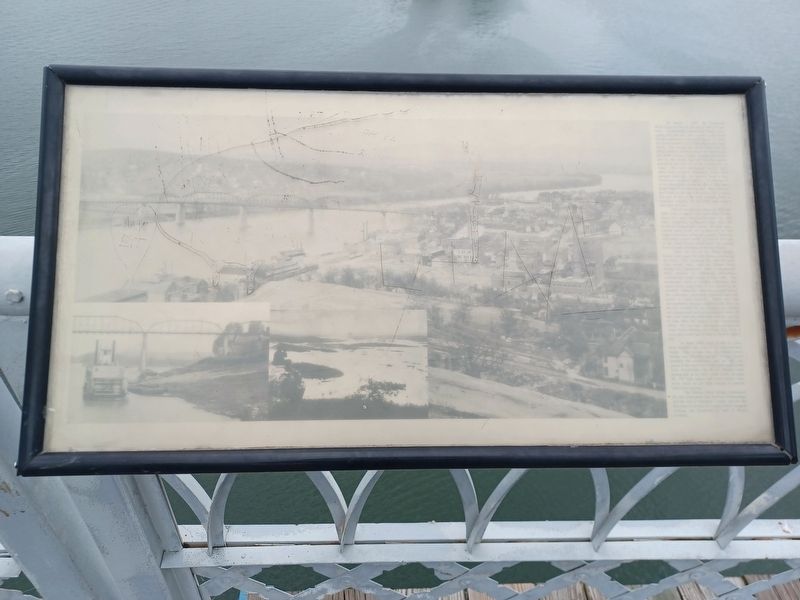
Photographed by Joel Seewald, April 29, 2024
1. Tennesee River Flooding and the First Chattanooga Bridges Marker
On March 7, 1867, the Tennessee River began to rise at the rate of one foot per hour. Chattanooga experienced floods every spring, but this one, later known at the Great Flood, continued to rise until March 11, when the waters crested 57.9 feet above low water levels. The second day of the flood sent the Meigs Military Bridge (minus the stones from the Bluff Furnace walls) floating downriver, and by the fourth day, all but the highest ground in the city was under several feet of water. The inset photograph on the right, taken from Lookout Mountain, shows Chattanooga under this, the greatest flood in East Tennessee's history. The bottom left of the photograph shows the part of Moccasin Bend which stood above water. Above that (to the North) is the top of Cameron Hill, and to the east of this is the high ground which is bounded, roughly, by the bluff and today's McCallie Avenue.
This flood (and two others in 1875 and 1886, both of which were more than 50 feet above low water levels) convinced the city, when rebuilding, to significantly raise the levels of Chattanooga's streets. In some cased, current street levels are
this page online
After the loss of the Meigs Bridge, ferries were again the only means of crossing the river. This remained the case for more than twenty years, until the Walnut Street Bridge was constructed. After a considerable delay because of contracting difficulties, construction finally began in July, 1889. The contractors built a wooden cofferdam that stood above water when it was placed on the riverbed. When the water was pumped out of the cofferdam, excavators removed sand and gravel to reach bedrock. When this was accomplished, masons constructed the piers on the dry riverbed. In one location, the contractor's pumps were not strong enough to draw all the water from the cofferdam and the city had to loan their fire engine to the construction effort. For two days the engine pumped out water while floating on a barge that, were it necessary, could take it back to shore to fight a fire.
In June, 1890, four of the six piers were finished, and

Photographed by Joel Seewald, April 29, 2024
2. Tennesee River Flooding and the First Chattanooga Bridges Marker
View of the marker (on the right).
The Walnut Street Bridge established the first permanent link between Chattanooga and the rest of Hamilton County, and for the first time in seventy-five years, ferries stopped crossing the Tennessee to land at Ross's Landing.
Topics. This historical marker is listed in these topic lists: Bridges & Viaducts • Waterways & Vessels. A significant historical date for this entry is March 7, 1867.
Location. 35° 3.471′ N, 85° 18.439′ W. Marker is in Chattanooga, Tennessee, in Hamilton County. It is in Riverfront. It can be reached from Walnut Street. Marker can be reached from Walnut Street at the south and Forest Street at the north. Marker is on the east side of the Walnut Street [pedestrian] Bridge, between the third and fourth truss spans from the south. Touch for map. Marker is in this post office area: Chattanooga TN 37402, United States of America. Touch for directions.

Regionally, this marker is in the American South, specifically in the Upper South, in Appalachia, and specifically in Southern Appalachia. Globally, it is in North America, the Western Hemisphere, the Western World, and the Anglosphere. Historically, it finds itself in what was once the original Cherokee Nation, the territory of the Mississippian Culture, one of the Confederate States of America, and the Antebellum South.
Other nearby markers. At least 8 other markers are within walking distance of this marker: Tennessee River Traffic (about 300 feet away, measured in a direct line); Early Improvements to Tennessee River Navigation (about 300 feet away); The Civil War in Chattanooga (about 300 feet away); Market Street Bridge (about 300 feet away); Late 1800s and Early 1900s Industry in Chattanooga (about 300 feet away); Ross's Landing: River Crossing and Port (about 500 feet away); Chattanooga's Early Industry (about 500 feet away); The Cherokee, the Chickamauga, and John Ross (about 500 feet away). Touch for a list and map of all markers in Chattanooga.
Credits. This page was last revised on February 16, 2025. It was originally submitted on August 17, 2024, by Joel Seewald of Madison Heights, Michigan. This page has been viewed 607 times since then and 112 times this year. Last updated on February 16, 2025, by Daniel Manns of Chattanooga. Photos: 1, 2. submitted on August 17, 2024, by Joel Seewald of Madison Heights, Michigan. • J. Makali Bruton was the editor who published this page.
