Greenville in Greenville County, South Carolina — The American South (South Atlantic)
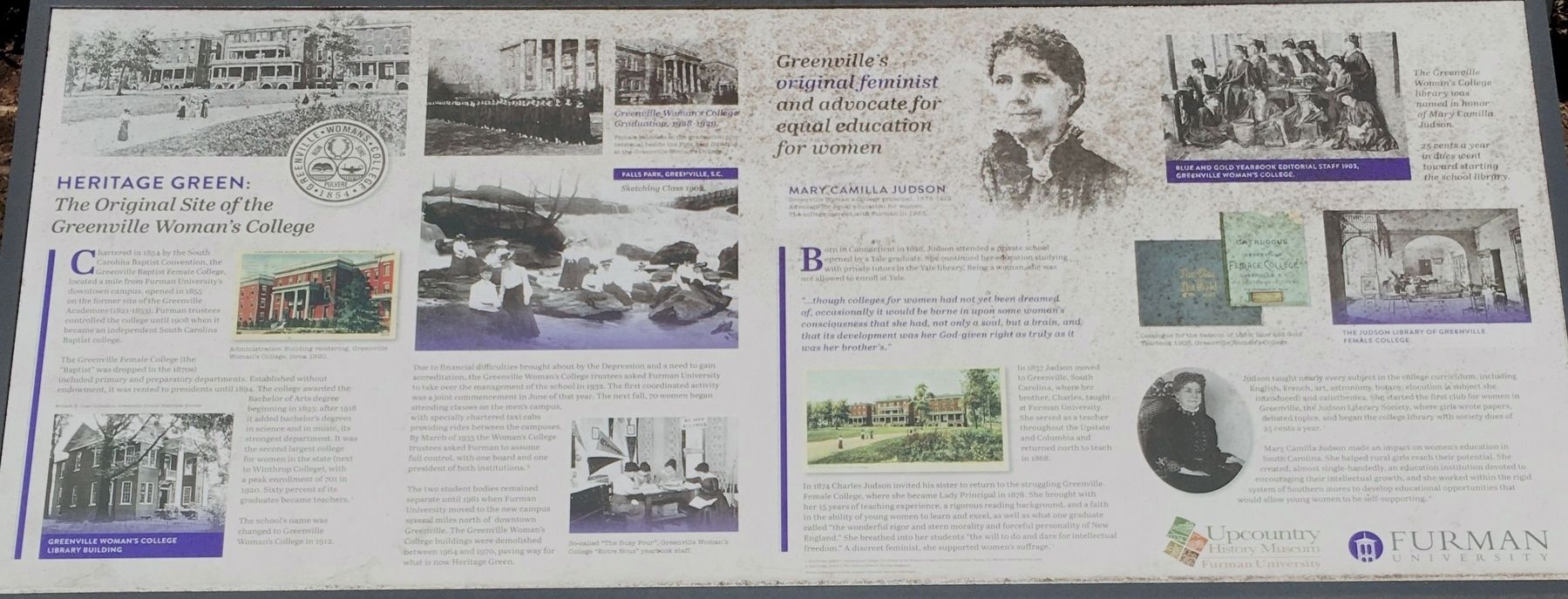
Heritage Green
The Original Site of the Greenville Woman’s College
Photographed by Brandon D Cross
1. Heritage Green Marker
The Greenville Female College (the "Baptist" was dropped in the 1870s) included primary and preparatory departments. Established without endowment, it was rented to presidents until 1894. The college awarded the Bachelor of Arts degree beginning in 1893; after 1918 it added bachelor's degrees in science and in music, its strongest department. It was the second largest college for women in the state (next to Winthrop College), with a peak enrollment of 701 in 1920. Sixty percent of its graduates became teachers. 1
The school's name was changed to Greenville Woman's College in 1912. Due to financial difficulties brought about by the Depression and a need to gain accreditation, the Greenville Woman's College trustees asked Furman University to take over the management of the
this page online
Due to financial difficulties brought about by the Depression and a need to gain accreditation, the Greenville Woman's College trustees asked Furman University to take over the management of the school in 1932. The first coordinated activity was a joint commencement in June of that year. The next fall, 70 women began attending classes on the men's campus, with specially chartered taxi cabs providing rides between the campuses. By March of 1933 the Woman's College trustees asked Furman to assume full control, with one board and one president of both institutions. 2
The two student bodies remained separate until 1961 when Furman University moved to the new campus several miles north of downtown Greenville. The Greenville Woman's College buildings were demolished between 1964 and 1970, paving way for what is now Heritage Green.
[Mary Camilla Judson] Greenville's original feminist and advocate for equal education for women

Photographed by Brandon D Cross
2. Heritage Green Marker
Born in Connecticut in 1828, Judson attended a private school opened by a Yale graduate. She continued her education studying with private tutors in the Yale library. Being a woman, she was not allowed to enroll at Yale.
“ … though colleges for women had not yet been dreamed of, occasionally it would be borne in upon some woman's consciousness that she had, not only a soul, but a brain, and that its development was her God-given right as truly as it was her brother's."
In 1857 Judson moved to Greenville, South Carolina, where her brother, Charles, taught at Furman University. She served as a teacher throughout the Upstate and Columbia and returned north to teach in 1868.
In 1874 Charles Judson invited his sister to return to the struggling Greenville Female College, where she became Lady Principal in 1878. She brought with her 15 years of teaching experience, a rigorous reading background, and a faith in the ability of young women to learn and excel, as well as what one graduate called "the wonderful rigor and stern morality and forceful personality of New England." She breathed into her students "the will to
William B. Coxe Collection, Greenville County Historical Society
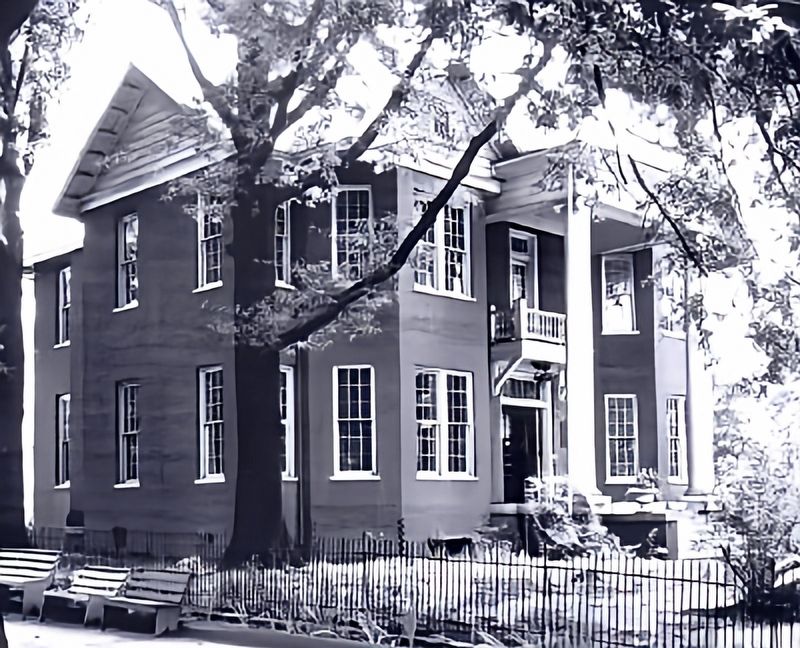
3. Greenville Woman's College - College Library
Judson taught nearly every subject in the college curriculum, including English, French, art, astronomy, botany, elocution (a subject she introduced) and calisthenics. She started the first club for women in Greenville, the Judson Literary Society, where girls wrote papers, debated topics, and began the college library with society dues of 25 cents a year. 1
Mary Camilla Judson made an impact on women's education in South Carolina. She helped rural girls reach their potential. She created, almost single-handedly, an education institution devoted to encouraging their intellectual growth, and she worked within the rigid system of Southern mores to develop educational opportunities that would allow young women to be self-supporting. 2
(footnotes)
1. Bainbridge, Judith T. Academy and College: The History of the Women’s College of Furman University, Macon, Ga: Mercer University Press, 200.
2. Bainbridge, Judith T. The Discreet Feminist, Furman Magazine.
Photos and images courtesy Furman University Special Collections
(captions)
Administration Building rendering, Greenville Woman’s College. circa 1920.
Greenville Woman’s College Library Building
Greenville Woman's College Graduation, 1928-1929.
Female students in the graduation processional beside the Fine Arts Building at the Greenville Woman’s College.
Falls Park, Greenville, S.C. Sketching Class 1902
So-called "The Busy Four", Greenville Woman's College "Entre Nous" yearbook staff.
Mary Camilla Judson
Greenville Women's College principal, 1878-1912.
Advocate for equal education for women.
The college merged, with Furman in 1933.
Blue and Gold Yearbook Editorial Staff 1903, Greenville Woman’s College
The Greenville Woman's College library was named in honor of Mary Camilla Judson.
25 cents a year in dues went toward starting the school library.
The Judson Library of Greenville Female College
Catalogue for the Session of 1889; Blue and Gold Yearbook 1903, Greenville Woman's College.
Erected by Upcountry History Museum, Forman University.
Topics. This historical marker is listed in these topic lists: Civil Rights • Education • Women. A significant historical year for this entry is 1854.
Location. 34° 51.404′ N, 82° 24.162′ W. Marker is in Greenville, South Carolina, in Greenville County. It is at the intersection of Buncombe Street and Atwood Street, on the right when traveling west on Buncombe Street. Touch for map. Marker is at or near this postal address: 516 Buncombe St, Greenville SC 29601, United States of America. Touch for directions.

Regionally, this marker is in Upstate. It is also in the American South, specifically in the Deep South, in Appalachia, and specifically in Southern Appalachia. Globally, it is in North America, the Western Hemisphere, the Western World, and the Anglosphere. Historically, it finds itself in what was once the original Cherokee Nation, the territory of the Mississippian Culture, one of the original Thirteen Colonies, one of the Confederate States of America, and the Antebellum South.
Other nearby markers. At least 8 other markers are within walking distance of this marker: General Nathanael Greene (a few steps from this marker); Soldier's Rest (about 400 feet away, measured in a direct line); Hampton-Pinckney Neighborhood (about 600 feet away); Greenville Woman's College (about 600 feet away); Lawrence Peter Hollis (approx. ¼ mile away); John Street School (approx. ¼ mile away); Mattoon Presbyterian Church (approx. ¼ mile away); The Buncombe Road (approx. 0.3 miles away). Touch for a list and map of all markers in Greenville.
Also see . . .
1. Heritage Green evolved since 1819 donation. Greenville Online website entry (Submitted on February 19, 2025, by Brandon D Cross of Flagler Beach, Florida.)
2. Upcountry History Museum. Grenville website entry (Submitted on February 19, 2025, by Brandon D Cross of Flagler Beach, Florida.)
Credits. This page was last revised on February 22, 2025. It was originally submitted on February 19, 2025, by Brandon D Cross of Flagler Beach, Florida. This page has been viewed 154 times since then and 33 times this year. Photos: 1, 2, 3. submitted on February 19, 2025, by Brandon D Cross of Flagler Beach, Florida. • J. J. Prats was the editor who published this page.
