Malden in Kanawha County, West Virginia — The American South (Appalachia)
Necessary Ingredient
Malden's Salt Works
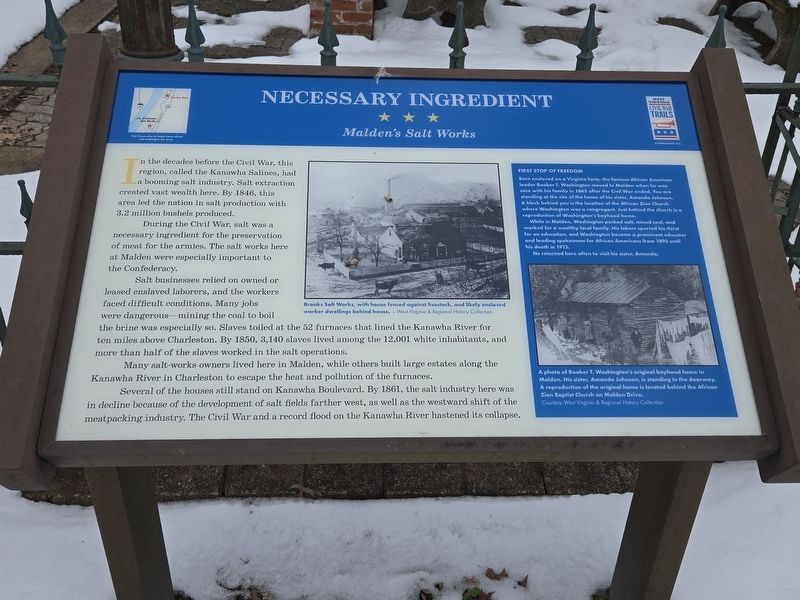
Photographed by Mark Parker, January 14, 2025
1. Necessary Ingredient Marker
In the decades before the Civil War, this region, called the Kanawha Salines, had a booming salt industry. Salt extraction created vast wealth here. By 1846, this area led the nation in salt production with 3.2 million bushels produced.
During the Civil War, salt was a necessary ingredient for the preservation of meat for the armies. The salt works here at Malden were especially important to the Confederacy.
Salt businesses relied on owned or leased enslaved laborers, and the workers faced difficult conditions. Many jobs were dangerous—mining the coal to boil the brine was especially so. Slaves toiled at the 52 furnaces that lined the Kanawha River for ten miles above Charleston. By 1850, 3,140 slaves lived among the 12,001 white inhabitants, and more than half of the slaves worked in the salt operations.
Many salt-works owners lived here in Malden, while others built large estates along the Kanawha River in Charleston to escape the heat and pollution of the furnaces.
Several of the houses still stand on Kanawha Boulevard. By 1861, the salt industry here was in decline because of the development of salt fields
this page online
(Sidebar)
First Stop of Freedom
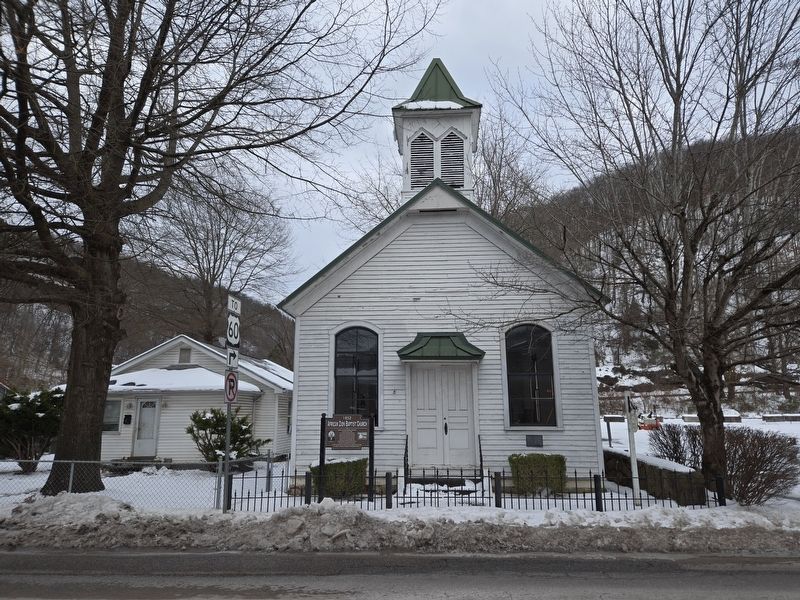
Born enslaved on a Virginia farm, the famous African American leader Booker T. Washington moved to Malden when he was nine with his family in 1865 after the Civil War ended. You are standing at the site of the home of his sister, Amanda Johnson. A block behind you is the location of the African Zion Church where Washington was a congregant. Just behind the church is a reproduction Of Washington's boyhood home.
While in Malden, Washington packed salt, mined coal, and worked for a wealthy local family. His labors spurred his thirst for an education, and Washington became a prominent educator and leading spokesman for African Americans from 1895 until his death in 1915.
He returned here often to visit his sister, Amanda.
A photo of Booker T. Washington's original boyhood in Malden. His sister, Amanda Johnsen, is standing in the doorway. A reproduction of the original home is located behind the African Zion Baptist Church on Malden Drive Courtesy West Virginia & Regional History Collection
(Photo captions)
Visit these sites to learn more about salt making in the area
Brooks Salt Works, with house fenced against livestock, and likely enslaved worker dwellings behind house. - West Virginia & Regional History Collection
Erected by West
Photographed by Mark Parker, January 14, 2025
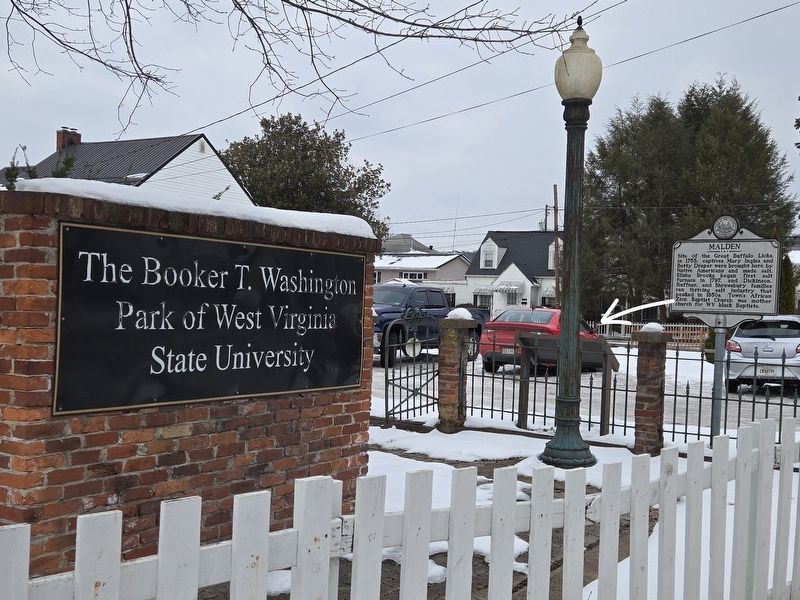
2. Rear view of Necessary Ingredient Marker from Booker T Washington Park
Topics and series. This historical marker is listed in these topic lists: African Americans • Civil Rights • Industry & Commerce • War, US Civil. In addition, it is included in the West Virginia Civil War Trails series list. A significant historical year for this entry is 1846.
Location. 38° 17.93′ N, 81° 33.463′ W. Marker is in Malden, West Virginia, in Kanawha County. It is on Malden Drive (County Route 60/6) south of Commerce Drive when traveling south. The marker is located at the Booker T. Washington Park of West Virginia State University. Touch for map. Marker is at or near this postal address: 4203 Malden Dr, Charleston WV 25306, United States of America. Touch for directions.

Regionally, this marker is in Greater Charleston Area. It is also in the American South, specifically in the Upper South, in Appalachia, and specifically in Southern Appalachia. Globally, it is in North America, the Western Hemisphere, the Western World, and the Anglosphere. Historically, it finds itself in what was once the territory of the Mississippian Culture.
Other nearby markers. At least 8 other
Photographed by Mark Parker, January 14, 2025
3. African Zion Baptist Church, just north of the marker
Other markers no longer nearby. The Necessary Ingredient (was here, next to this marker but has been replaced with another marker now near it); Malden / Booker T. Washington Homeplace (was here, next to this marker but has been replaced with another marker now near it).
Related marker. Click here for another marker that is related to this marker. Old CWT Marker At This Location titled "The Necessary Ingredient".
Credits. This page was last revised on July 26, 2025. It was originally submitted on February 20, 2025, by Mark Parker of Hickory, North Carolina. This page has been viewed 190 times since then and 40 times this year. Photos: 1, 2, 3. submitted on February 20, 2025, by Mark Parker of Hickory, North Carolina. • Bernard Fisher was the editor who published this page.
