Igel in Trier-Saarburg, Rhineland-Palatinate, Germany — Central Europe
Goetheplatz
⎯⎯⎯
Goethe Square
Photographed by Andrew Ruppenstein, February 4, 2025
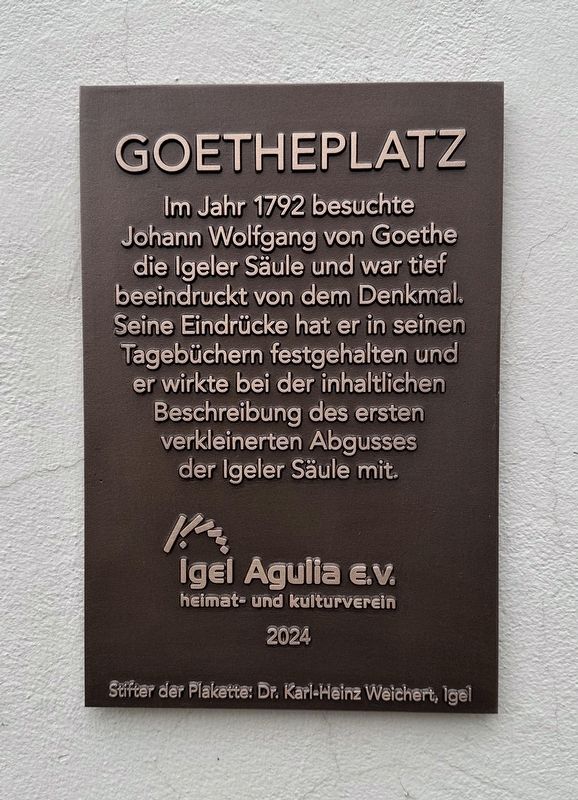
1. Goetheplatz / Goethe Square Marker

Im Jahr 1792 besuchte Johann Wolfgang von Goethe die Igeler Säule und war tief beeindruckt von dem Denkmal. Seine Eindrücke hat er in seinen Tagebüchern festgehalten und er wirkte bei der inhaltlichen Beschreibung des ersten verkleinerten Abgusses der Igeler Säule mit.
In 1792, Johann Wolfgang von Goethe visited the Igel Column and was deeply impressed by the monument. He recorded his impressions in his diaries and helped to describe the content of the first reduced cast of the Igel Column.
Erected 2024 by Igel Agulia e.V.
Topics. This historical marker is listed in these topic lists: Arts, Letters, Music • Cemeteries & Burial Sites • Man-Made Features. A significant historical date for this entry is August 26, 1792.
Location. 49° 42.546′ N, 6° 32.967′ E. Marker is in Igel, Rheinland-Pfalz (Rhineland-Palatinate), in Trier-Saarburg. It is on Trierer Straße, on the right when traveling west. Touch for map. Marker is at or near this postal address: Trierer Straße 39, Igel RP 54298, Germany. Touch for directions.

Regionally, this marker is in the German Rhineland and in the Moselle
this page online
Other nearby markers. At least 8 other markers are within 8 kilometers of this marker, measured as the crow flies: Igeler Säule / Igel Column (here, next to this marker); Igel (here, next to this marker); a different marker also named Igeler Säule / Igel Column (a few steps from this marker); Umfeldgestaltung Igeler Säule / Design of the Igel Column Surroundings (within shouting distance of this marker); Burghaus/Gasthaus “zum Löwen” / Castle House/Inn “zum Löwen” (about 120 meters away, measured in a direct line); Otto Rienermann (approx. 3.4 kilometers away in Luxembourg); Wartime Refuge Memorial (approx. 3.7 kilometers away in Luxembourg); Karl Marx (approx. 8 kilometers away). Touch for a list and map of all markers in Igel.
Also see . . .
1. Igel Column (Wikipedia). (Submitted on February 23, 2025.)
2. Johann Wolfgang von Goethe (Wikipedia).
Photographed by Andrew Ruppenstein, February 4, 2025
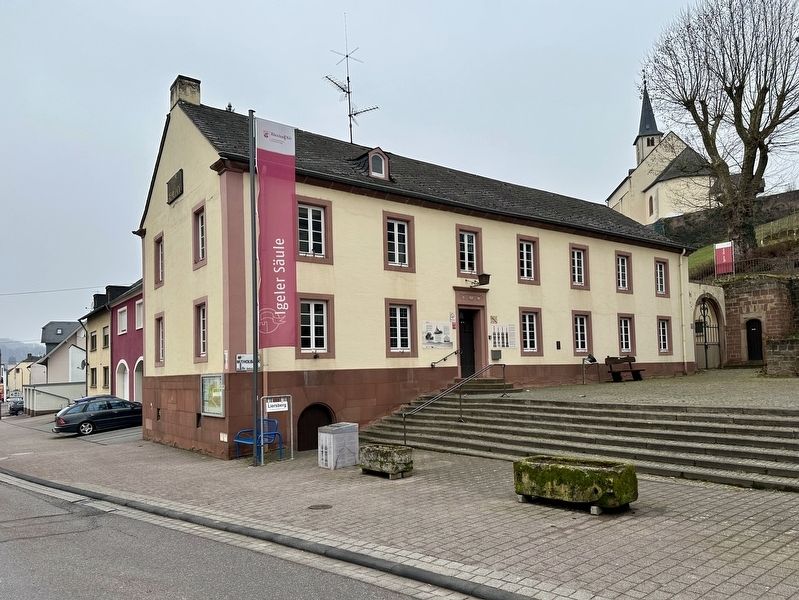
2. Goetheplatz / Goethe Square Marker - wide view
The marker is visible here between the building entrance and the bench on the east side of the Igel Town Hall.
Johann Wolfgang von Goethe (28 August 1749 – 22 March 1832) was a German polymath, who is widely regarded as the greatest and most influential writer in the German language. His work has had a profound and wide-ranging influence on Western literary, political, and philosophical thought from the late 18th century to the present day. A poet, playwright, novelist, scientist, statesman, theatre director, and critic, his works include plays, poetry and aesthetic criticism, as well as treatises on botany, anatomy, and color.(Submitted on February 23, 2025.)
3. Goetheplatz (Igel Agulia e.V.). Igel Agulia, the local cultural/historical society presents a short excerpt from Goethe‘s writings on the Igel Column. In German. (Submitted on February 23, 2025.)
Photographed by Andrew Ruppenstein, February 4, 2025
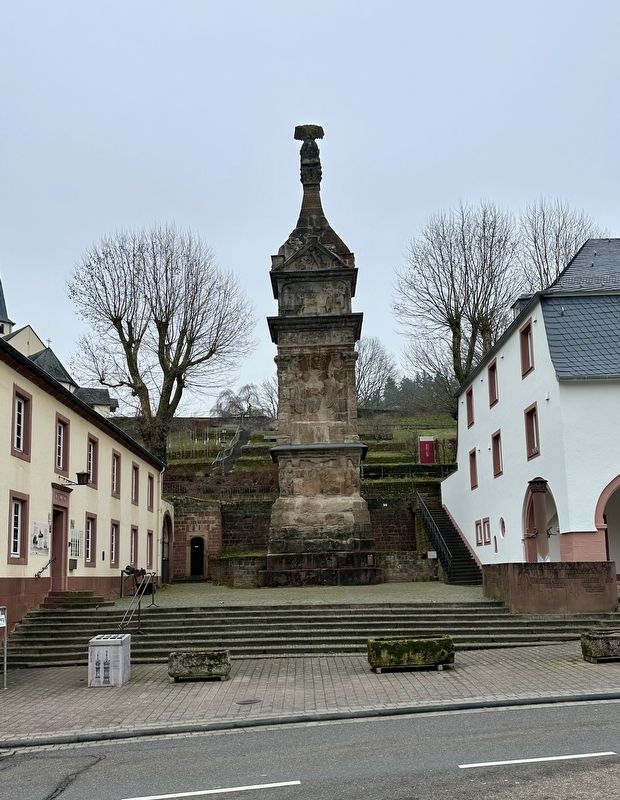
3. Goethe Square, with Igel Town Hall (left) and Igel Column
Photographed by Ludwig Feist, Mainz, circa 1905
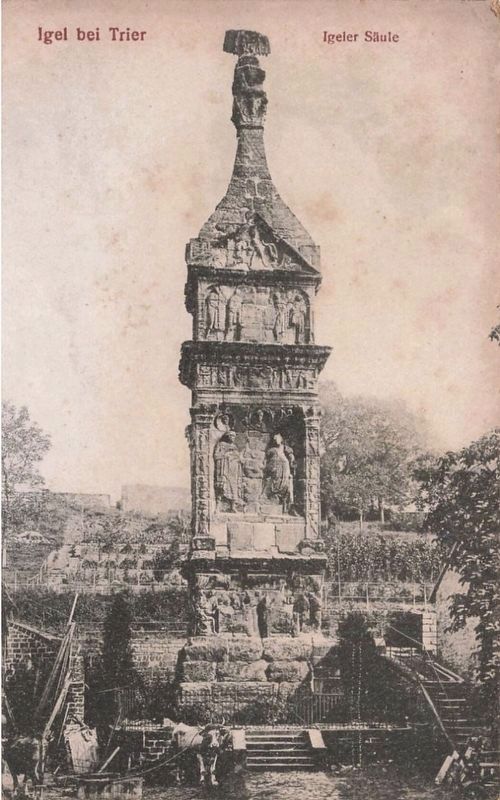
4. The Igel Column
The Igel Column (German: Igeler Säule) is a multi-storeyed Roman sandstone column in the municipality of Igel, Trier, Germany, dated to c. 250 AD. The column is the burial monument of the Secundinii cloth merchant family, and was built by two of the family members, Lucius Secundinius Aventinus and Lucius Secundinus Securus. - Wikipedia
Credits. This page was last revised on February 23, 2025. It was originally submitted on February 23, 2025, by Andrew Ruppenstein of Lamorinda, California. This page has been viewed 95 times since then and 14 times this year. Photos: 1, 2, 3, 4. submitted on February 23, 2025, by Andrew Ruppenstein of Lamorinda, California.
