Willow Springs in Cook County, Illinois — The American Midwest (Great Lakes)
Original Illinois & Michigan Canal
Forest Preserve
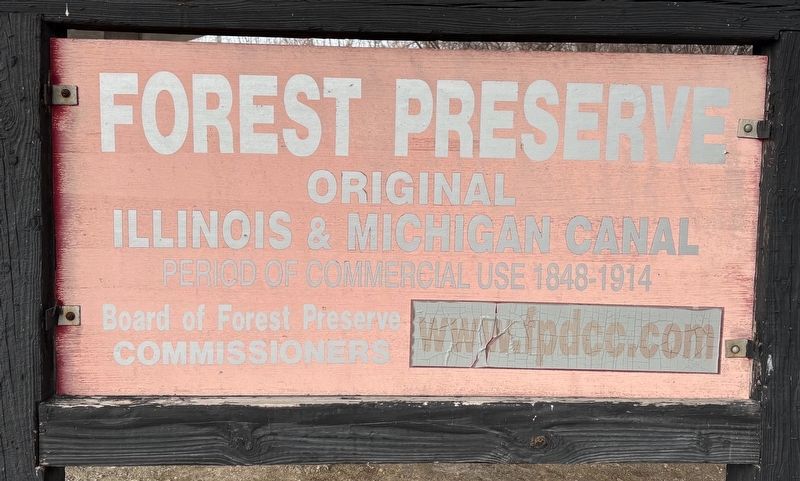
Photographed by Sean P. Flynn, February 23, 2025
1. Original Illinois & Michigan Canal Marker
Erected by Forest Preserves of Cook County.
Topics and series. This historical marker is listed in these topic lists: Parks & Recreational Areas • Waterways & Vessels. In addition, it is included in the Illinois & Michigan Canal series list. A significant historical year for this entry is 1848.
Location. 41° 44.023′ N, 87° 52.756′ W. Marker is in Willow Springs, Illinois, in Cook County. It is on Willow Boulevard 0.3 miles north of Archer Avenue (Illinois Route 171), on the right when traveling north. The marker is near the entrance to the John Husac I&M Bicycle Trail. It is beneath Willow Springs Road, which flies over the I&M Canal and other nearby waterways. Touch for map. Marker is at or near this postal address: 116 Willow Boulevard, Willow Springs IL 60480, United States of America. Touch for directions.

Regionally, this marker is in Greater Chicago. It is also in the American Midwest. Globally, it is in North America, on the Great Lakes, in the Western Hemisphere, in the Western World, and in the Anglosphere. Historically, it finds itself in what was once the
this page online
Other nearby markers. At least 8 other markers are within walking distance of this marker: Old Towpath (about 300 feet away, measured in a direct line); Willow Springs Honor Roll (approx. 0.2 miles away); "The Worker" (approx. 0.2 miles away); The Civilian Conservation Corps (CCC) (approx. 0.2 miles away); Willow Springs Civilian Conservation Corps Camp #612 (approx. 0.2 miles away); Willow Springs Civilian Conservation Corps Camp #612 (con’t…) (approx. 0.2 miles away); ...And It Came to Be (approx. 0.2 miles away); Land of the Healing Waters (approx. 0.6 miles away). Touch for a list and map of all markers in Willow Springs.
Regarding Original Illinois & Michigan Canal. Although this marker says commercial use ended in 1914, most sources say the I&M Canal officially closed for business in 1930. That said, the canal's use had already been severely diminished for years, first due to railroads that ran parallel and then in 1900 when the Chicago Sanitary and Ship Canal opened. The 96-mile I&M Canal was designated a National Heritage
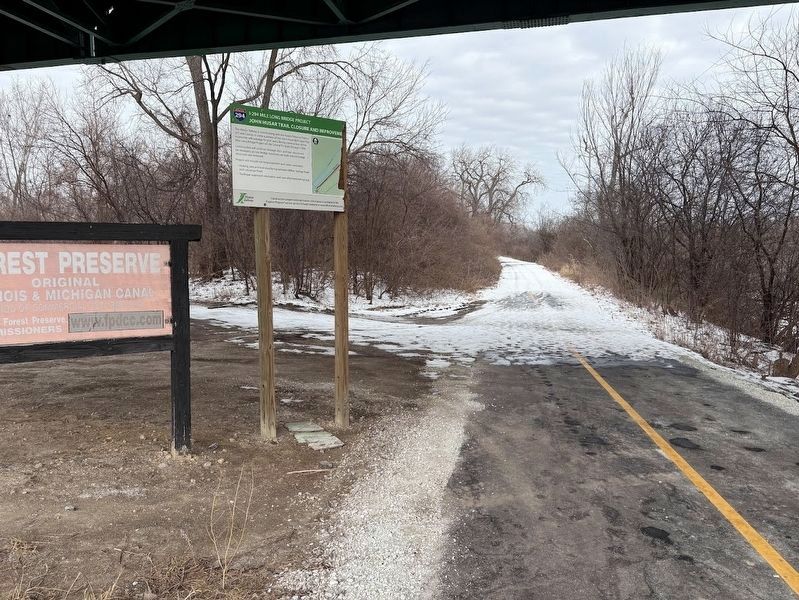
Photographed by Sean P. Flynn, February 23, 2025
2. Original Illinois & Michigan Canal Marker
This photo faces northeast; the canal is on the far right. A part of the Willow Springs Road bridge can be seen on the very top of the photo.
Also see . . .
1. I&M Canal History.
Excerpt: "The canal also played a key component in countless historical events. For one, it was a major element in westward expansion. For instance, those who traveled to California in the 1849 Gold Rush usually spent part of their journey on an I&M Canal Boat. The canal also played a factor in the Civil War. Though early proponents of the canal hoped it would help make the different regions of the country more economically interdependent (and thus stave off conflict), when war did finally erupt, the canal was crucial in transporting government grain and oats toll free to Union soldiers."(Submitted on February 24, 2025, by Sean P. Flynn of Oak Park, Illinois.)
2. Encyclopedia of Chicago: Illinois and Michigan Canal.
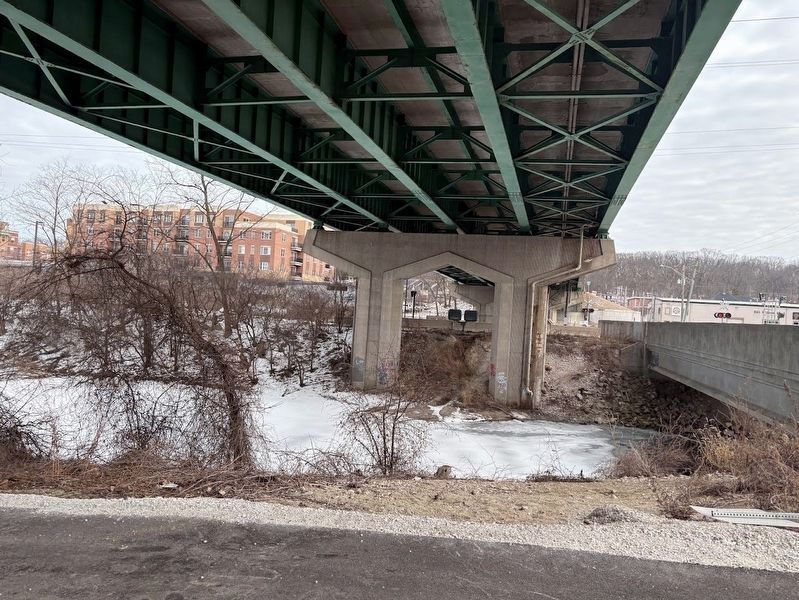
Excerpt: "In 1935 the Civilian Conservation Corps in conjunction with the National Park Service restored some of the locks and started other projects for historic preservation and recreation. Although this work ended with World War II, efforts to reuse the old canal right-of-way for this purpose were later revived, culminating in 1984 when President(Submitted on February 24, 2025, by Sean P. Flynn of Oak Park, Illinois.)Reagan signed legislation creating the Illinois & Michigan Canal National Heritage Corridor, the first heritage corridor in the nation. The concept encouraged canal trails and nature preserves, and helped the downtowns along the canal by emphasizing economic development based upon history and historic preservation."Photographed by Sean P. Flynn, February 23, 20253. I&M CanalThis photo taken from the location of this historical marker shows the I&M Canal (frozen in February 2025) running beneath Willow Springs Boulevard, which flies over the numerous waterways near here before connecting with Archer Avenue (Illinois 171) about 800 feet southeast of this spot.
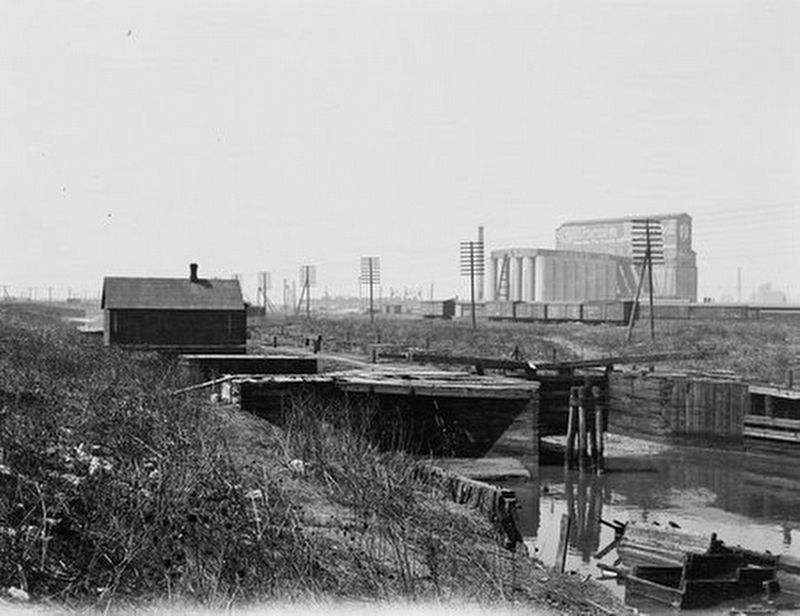
Charles R. Clark, photographer; Courtesy of Chicago History Museum (ICHi-071726), circa 1905
4. I&M Canal (circa 1905)
This photo shows a section of the Illinois & Michigan Canal at an unknown location in 1905.
Credits. This page was last revised on March 4, 2025. It was originally submitted on February 24, 2025, by Sean P. Flynn of Oak Park, Illinois. This page has been viewed 179 times since then and 46 times this year. Photos: 1, 2, 3, 4. submitted on February 24, 2025, by Sean P. Flynn of Oak Park, Illinois.
