Spartanburg in Spartanburg County, South Carolina — The American South (South Atlantic)
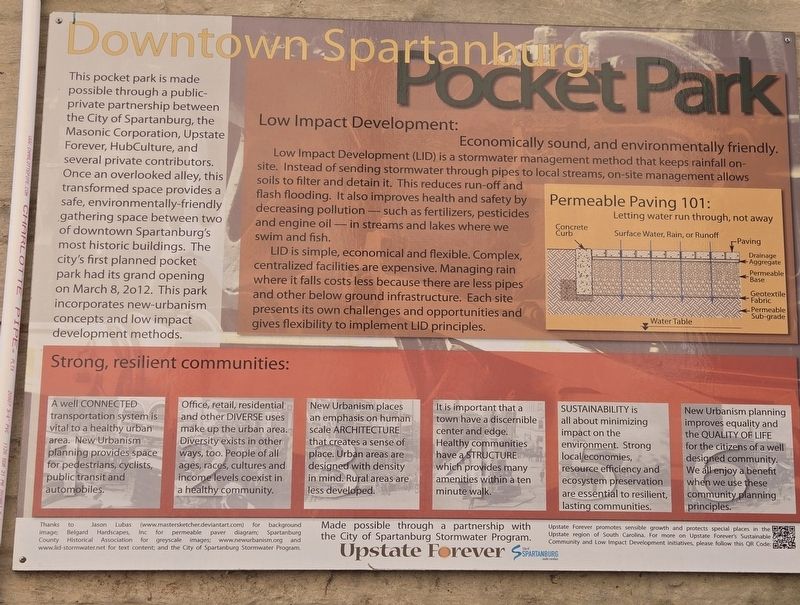
Downtown Spartanburg Pocket Park
Photographed by Mark Parker, February 21, 2025
1. Downtown Spartanburg Pocket Park Marker
Low Impact Development:
Economically sound, and environmentally friendly.
Low Impact Development (LID) is a stormwater management method that keeps rainfall on-site. Instead of sending stormwater through pipes to local streams, on-site management allows soils to filter and detain it. This reduces run-off and flash flooding. It also improves health and safety by decreasing pollution—such as fertilizers, pesticides and engine oil—in streams and lakes where we swim and fish.
LID is simple, economical and flexible. Complex, centralized facilities are expensive. Managing rain where it falls costs less because
this page online
Strong, resilient communities:
1. A well Connected transportation system is vital to a healthy urban area. New Urbanism planning provides space for pedestrians, cyclists, public transit and automobiles.
2. Office, retail, residential and other Diverse uses make up the urban area. Diversity exists in other ways, too. People of all ages, races, cultures and income levels coexist in a healthy community.
3. New Urbanism places an emphasis on human scale Architecture that creates a sense of place. Urban areas are designed with density in mind. Rural areas are less developed.
4. It is important that a town have a discernible center and edge. Healthy communities have a Structure which provides many amenities within a ten minute walk.
5.Sustainability is all about minimizing impact on the environment. Strong local economies, resource efficiency and ecosystem preservation are essential to resilient, lasting communities.
6. New Urbanism planning improves equality
Photographed by Mark Parker, February 21, 2025
2. Downtown Spartanburg Pocket Park
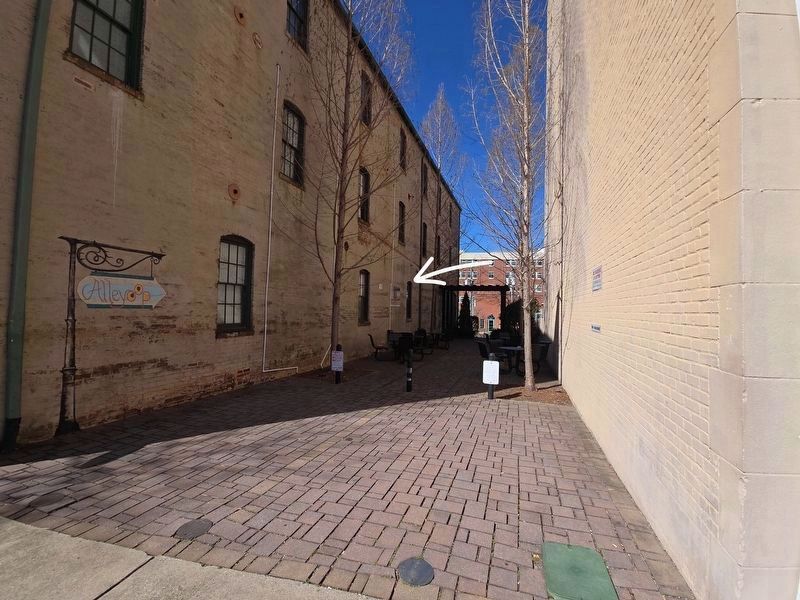
Entrance to the pocket park is from West Main Street between the Cantrell Wagon Building (left) and the Masonic Temple. Indicated by the arrow, the marker is on the left in the alley way.
Thanks to Jason Lubas (www.mastersketcher.deviantart.com) for background image; Belgard Hardscapes Inc for permeable paver diagram; Spartanburg County Historical Association for greyscale images; www.newurbanism.org and www.d-stormwater.net for text content; and the City of Spartanburg Stormwater Program
Upstate Forever promotes sensible growth and protects special places in the Upstate region of South Carolina. For more on Upstate Forever's Sustainable Community and Low Impact Development initiatives, please follow this QR Code.
Erected by Upstate Forever, The City of Spartanburg, South Carolina.
Topics. This historical marker is listed in these topic lists: Environment • Parks & Recreational Areas. A significant historical date for this entry is March 8, 2012.
Location. 34° 56.932′ N, 81° 56.078′ W. Marker is in Spartanburg, South Carolina, in Spartanburg County. It is on West Main Street west of King Street, on the right when traveling west. The marker is on the east facing wall of the Cantrell Wagon building in the Spartanburg Pocket Park. Touch for map. Marker is at or near this postal address: 190 W Main St, Spartanburg SC 29306, United States of America. Touch for directions.

Regionally, this marker is in Upstate. It is also in the American South, specifically in the Deep South, in Appalachia, and specifically in Southern Appalachia. Globally, it is in North America, the Western Hemisphere, the Western World, and the Anglosphere. Historically, it finds itself in what was once the original Cherokee Nation, the territory of the Mississippian Culture, one of the original Thirteen Colonies, one of the Confederate States of America, and the Antebellum South.
Other nearby markers. At least 8 other markers are within walking distance of this marker: 175th Anniversary Spartan Lodge No. 70 A.F.M. (a few steps from this marker); Masonic Temple (a few steps from this marker); Arthur Prysock/Ira Tucker (within shouting distance of this marker); Cantrell Wagon Building (within shouting distance of this marker); Carlos Moseley/Peter Cooper (within shouting distance of this marker); Spartanburg Water Works (within shouting distance of this marker); Spartanburg Town Clock (about 300 feet away, measured in a direct line); James Reese / Fayssoux McLean (about 400 feet away). Touch for a list and map of all markers in Spartanburg.
Credits. This page was last revised on April 6, 2025. It was originally submitted on February 24, 2025, by Mark Parker of Hickory, North Carolina. This page has been viewed 215 times since then and 31 times this year. Photos: 1, 2. submitted on February 24, 2025, by Mark Parker of Hickory, North Carolina. • Bernard Fisher was the editor who published this page.
