
Downtown in Sioux Falls in Minnehaha County, South Dakota — The American Midwest (Upper Plains)
Flandreau Colony
January 22, 2025
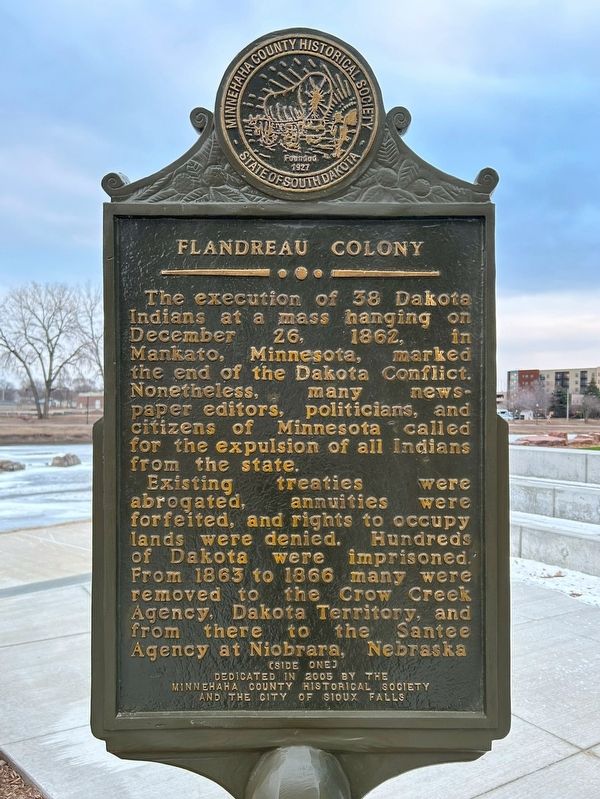
1. Flandreau Colony Marker, Side One
Existing treaties were abrogated, annuities were forfeited, and rights to occupy lands were denied. Hundreds of Dakota were imprisoned. From 1863 to 1866 many were removed to the Crow Creek Agency, Dakota Territory, and from there to the Santee Agency at Niobrara, Nebraska
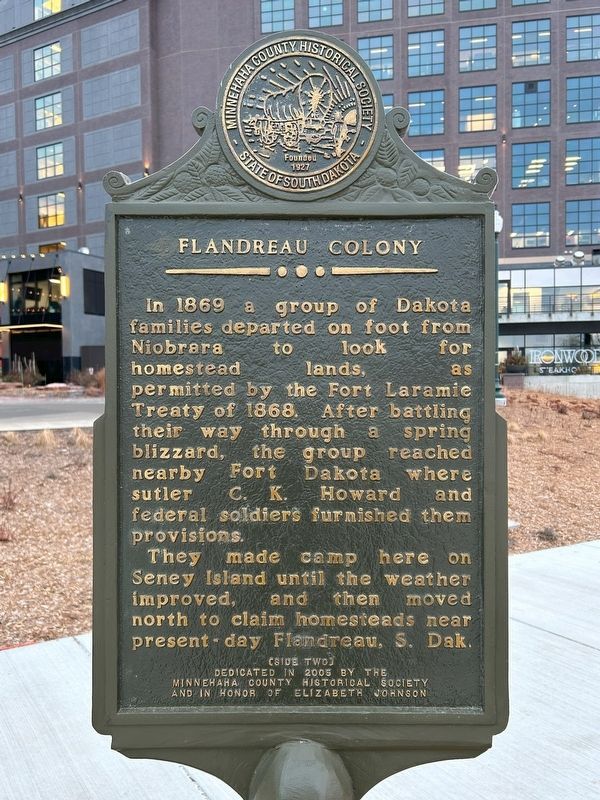
In 1869 a group of Dakota families departed on foot from Niobrara to look for homestead lands, as permitted by the Fort Laramie Treaty of 1868. After battling their way through a spring blizzard, the group reached nearby Fort Dakota where sutler C. K. Howard and federal soldiers furnished them provisions.
They made camp here on Seney Island until the weather improved, and then moved north to claim homesteads near present-day Flandreau, S. Dak.
Dedicated in 2005 by the Minnehaha County Historical Society and in honor of Elizabeth Johnson
Erected 2005 by the Minnehaha County Historical Society and the City of Sioux Falls.
Topics. This historical marker is listed in these topic lists: Indigenous Peoples and Communities
this page online
Location. 43° 33.224′ N, 96° 43.448′ W. Marker is in Sioux Falls, South Dakota, in Minnehaha County. It is in Downtown. It is on East 4th Place 0.1 miles east of North Phillips Avenue. Touch for map. Marker is at or near this postal address: 150 E 4th Pl, Sioux Falls SD 57104, United States of America. Touch for directions.

Regionally, this marker is in East River. It is also in the American Midwest, in the Lewis & Clark Corridor, in the Corn Belt, on the prairies, and on the Northern Plains. Globally, it is in North America, the Western Hemisphere, the Western World, and the Anglosphere. Historically, it finds itself in what was once Rupert’s Land and also the Louisiana Purchase.
Other nearby markers. At least 8 other markers are within walking distance of this marker: Seney Island (within shouting distance of this marker); Falls Park: Transformation Over Time (about 300 feet away, measured in a direct line); a different marker also named Falls Park: Transformation Over Time (about 400 feet away); Remnants of Change: The Railroad Bridge (about 700 feet away); Remnants of Change: The Mill Race & Dam (about 700 feet away); Phillips to the Falls (about 700 feet away); Foundation of the City (about 700 feet away); Beginning of Great Changes (about 700 feet away). Touch for a list and map of all markers in Sioux Falls.
Also see . . . Aftermath | The U.S.-Dakota War of 1862. (Submitted on February 27, 2025.)
January 22, 2025
2. Flandreau Colony Marker, Side Two
January 22, 2025
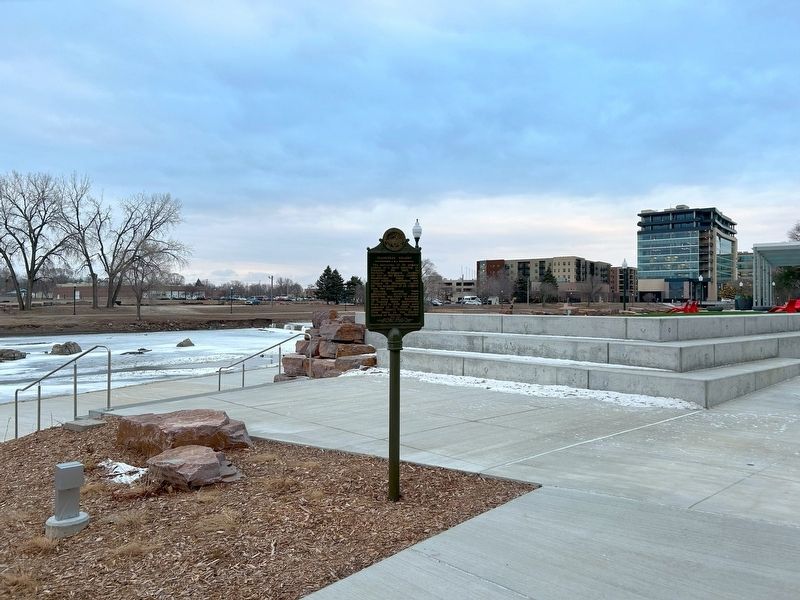
3. Flandreau Colony Marker
January 22, 2025
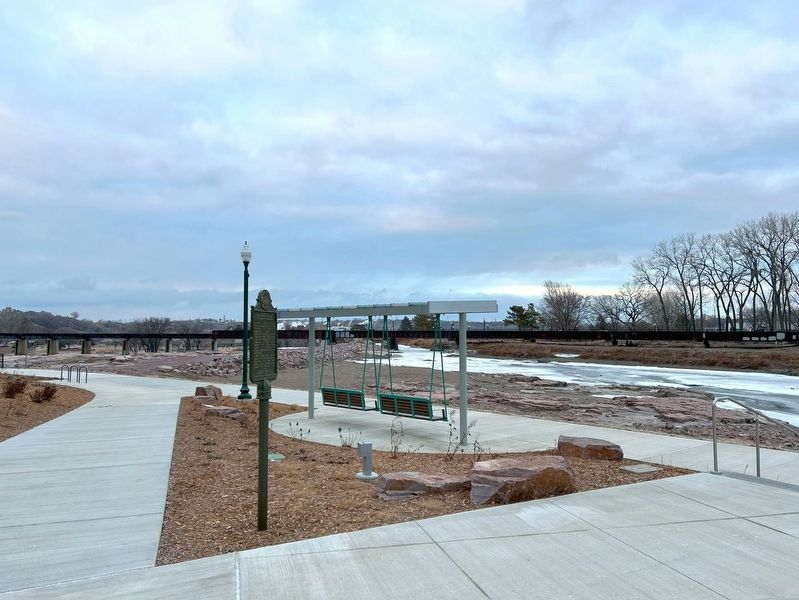
4. Flandreau Colony Marker
Credits. This page was last revised on July 20, 2025. It was originally submitted on February 27, 2025. This page has been viewed 208 times since then and 20 times this year. Photos: 1, 2, 3, 4. submitted on February 27, 2025.
