Sint Willibrordus, Curaçao, Dutch Caribbean — Caribbean (Dutch Caribbean)
1st Battle won by Freedom Fighters
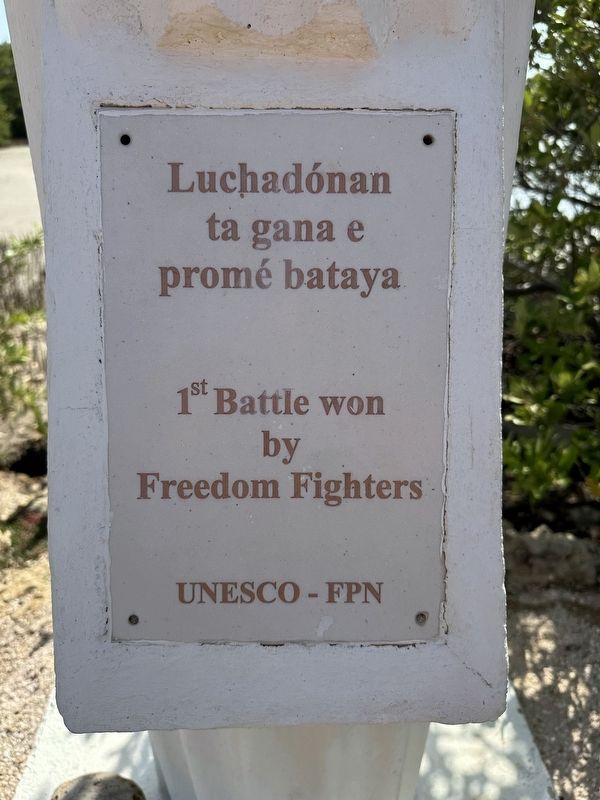
Photographed by Pete Skillman, February 21, 2025
1. 1st Battle won by Freedom Fighters Marker

(Papiamento):
(English):
UNESCO - FPN
Topics. This historical marker is listed in these topic lists: Civil Rights • Colonial Era • Patriots & Patriotism.
Location. 12° 12.813′ N, 69° 3.232′ W. Marker is in Sint Willibrordus, Curaçao (Curaçao). It is on Weg naar St Willibrordus, on the right when traveling east. Touch for map. Marker is at or near this postal address: Weg naar St Willibrordus 36, Sint Willibrordus, Curaçao, Dutch Caribbean. Touch for directions.

Regionally, it is one of the Lesser Antilles on the Caribbean Sea, on in the Atlantic Ocean, and in North America.
Other nearby markers. At least 8 other markers are within 18 kilometers of this marker, measured as the crow flies: Rif St.Marie (about 120 meters away, measured in a direct line); Headquarters & Meeting with Father Schinck (approx. 1.8 kilometers away); Area Information: Rif St Marie (approx. 3.1 kilometers away); USS Erie PG-50 (approx. 14.7 kilometers away); Tribute to the Martyrs of 1795
this page online
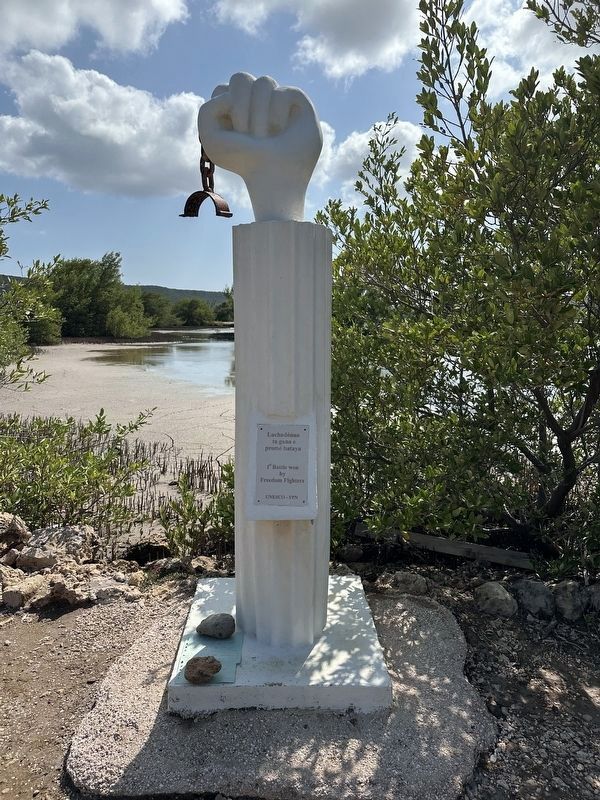
More about this marker. This marker is located at the site of the first battle of the largest slave revolt in Curacao's history. There is a series of similar markers spread across the island at locations where significant events of the revolt took place.
Related markers. Click here for a list of markers that are related to this marker.
Also see . . . 1795 Tula, The Revolt - Curacao History.
It is not known where Tula came from, but he was well aware of the situation in Haiti, where a slave revolt led by Toussaint had taken over the Colonial regime. He was aware of the French Revolution and the revolutionary ideals of liberty, equality, and fraternity. He knew that the French revolutionary regime had occupied a large part of Europe and that this regime wanted to abolish slavery in the French colonies. Among the insurgents a letter from General Rigaud was cited,(Submitted on March 1, 2025, by Pete Skillman of Wilmington, Delaware.)in which freedom was promised to all slaves in all countries which were under French rule. Now that the Netherlands was placed under French rule (1795-1801), it was Tula's conviction that slavery would soon be abolished here, in Curaçao, as well.Photographed by Pete Skillman, February 21, 20252. 1st Battle won by Freedom Fighters Marker - wide view
Credits. This page was last revised on March 5, 2025. It was originally submitted on March 1, 2025, by Pete Skillman of Wilmington, Delaware. This page has been viewed 363 times since then and 105 times this year. Photos: 1, 2. submitted on March 1, 2025, by Pete Skillman of Wilmington, Delaware.
