South Loop in Chicago in Cook County, Illinois — The American Midwest (Great Lakes)
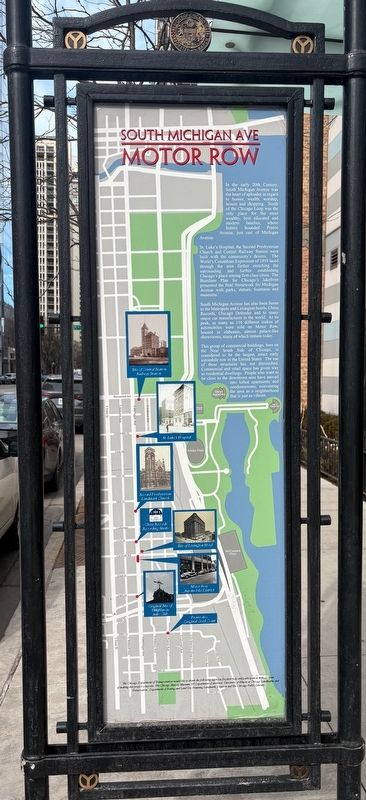
South Michigan Ave. Motor Row
Photographed by Sean P. Flynn, February 28, 2025
1. South Michigan Ave. Motor Row side of marker
St. Luke's Hospital, the Second Presbyterian Church and Central Railway Station were built with the community's desires. The World's Columbian Exposition of 1893 laced through the area further enriching the surrounding and further establishing Chicago's place among first-class cities. The Burnham Plan for Chicago's lakefront presented the final framework for Michigan Avenue with parks, statues, fountains and museums.
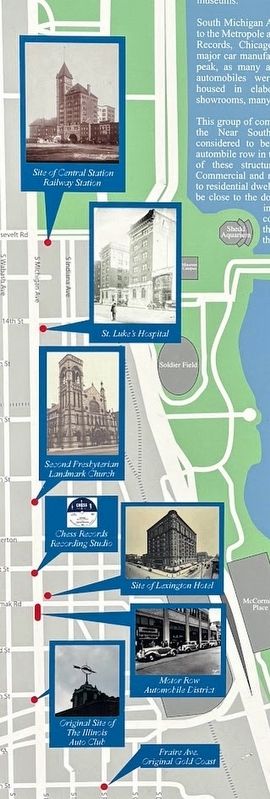
South Michigan Avenue has also been home to the Metropole and Lexington hotels, Chess Records, Chicago Defender and to many major car manufacturer in the world. At its peak, as many as 116 different makes of automobiles were sold on Motor Row, housed in elaborate, almost palace-like showrooms, many of which remain today.
This group of commercial buildings, here on the Near South Side of Chicago, is considered to be the largest, intact early autombile row in the United States. The use of these structures has not diminished. Commercial and retail space has given way to residential dwellings. People who want to be close to the downtown area have moved into lofted apartments and condominiums, reinventing the area as a neighborhood that is just as vibrant.
Erected by Chicago Department of Transportation.
Topics. This historical marker is listed in these topic lists: Industry & Commerce • Religion & Religious Structures • Roads & Vehicles • Science & Medicine. A significant historical year for this entry is 1893.
Location. 41° 51.828′ N, 87° 37.465′ W. Marker is in Chicago, Illinois,
this page online

Regionally, this marker is on Chicago’s South Side. It is also in the American Midwest. Globally, it is in North America, on the Great Lakes, in the Western Hemisphere, in the Western World, and in the Anglosphere. Historically, it finds itself in what was once the Viceroyalty of New France, the territory of the Mississippian Culture, and the Northwest Territory.
Other nearby markers. At least 8 other markers are within walking distance of this marker: 20th Century Healthcare: St. Luke's Hospital (a few steps from this marker); (Former) Engine Company 104, Truck 31 (within shouting distance of this marker); George Smith Memorial Building (about 400 feet away, measured in a direct line); Old St. Mary Church (approx. 0.2 miles away); Hotel Somerset (approx. 0.3 miles away); The Blues Trail: Mississippi to Chicago (approx. 0.3 miles away); Central Station Fragments (approx. 0.3 miles away);
Photographed by Sean P. Flynn, February 28, 2025
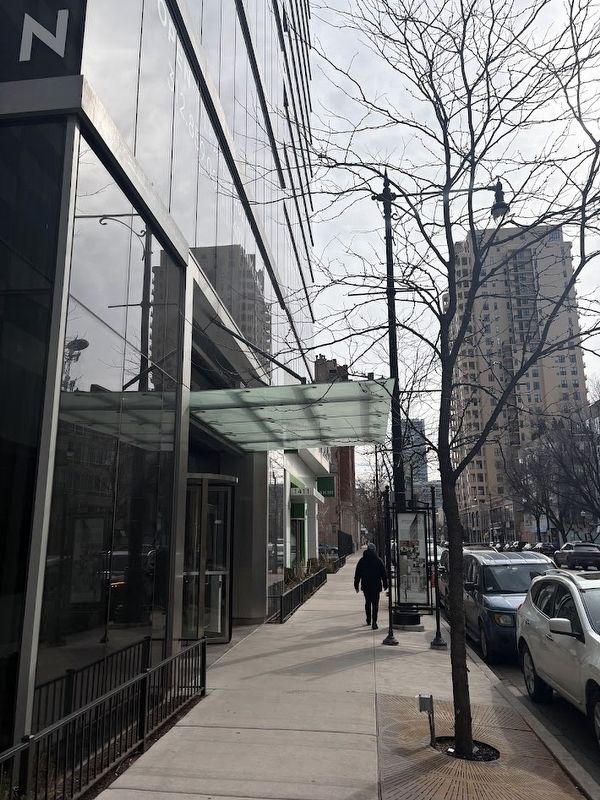
2. The marker, facing south
More about this marker. On the rear side of this sign is a marker about St. Luke's Presbyterian Church, which was located on this block. At least two more identical markers can be found in this neighborhood, one by Chess Records and another by Second Presbyterian Church.
Also see . . . Commission on Chicago Landmarks: Motor Row District.
Excerpt: "Auto rows developed in numerous cities shortly after 1900 as car companies sought to create districts where the sale and repair of cars could become an easy urban shopping experience. At its peak, as many as 116 different makes of automobiles were being sold on Motor Row. Some are familiar today, including Ford, Buick, Fiat, and Cadillac, while others are better known to historians and old-car buffs, including Hudson, Locomobile, Marmon, and Pierce-Arrow."(Submitted on March 4, 2025, by Sean P. Flynn of Oak Park, Illinois.)

Photographed by Sean P. Flynn, February 28, 2025
3. The marker, facing north
Photographed by Sean P. Flynn, February 28, 2025
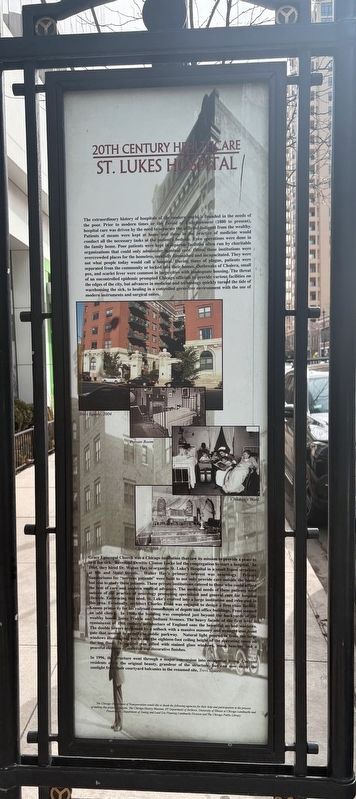
4. 20th Century Healthcare: St. Luke's Hospital side of marker
Photographed by Sean P. Flynn, February 28, 2025
5. Close-up of the photos of Motor Row
Credits. This page was last revised on March 10, 2025. It was originally submitted on March 4, 2025, by Sean P. Flynn of Oak Park, Illinois. This page has been viewed 164 times since then and 25 times this year. Photos: 1, 2, 3, 4, 5. submitted on March 4, 2025, by Sean P. Flynn of Oak Park, Illinois.
