Milllican Townsite in Navasota in Brazos County, Texas — The American South (West South Central)
Millican Massacre
Photographed by Morgan Petermann, March 4, 2025
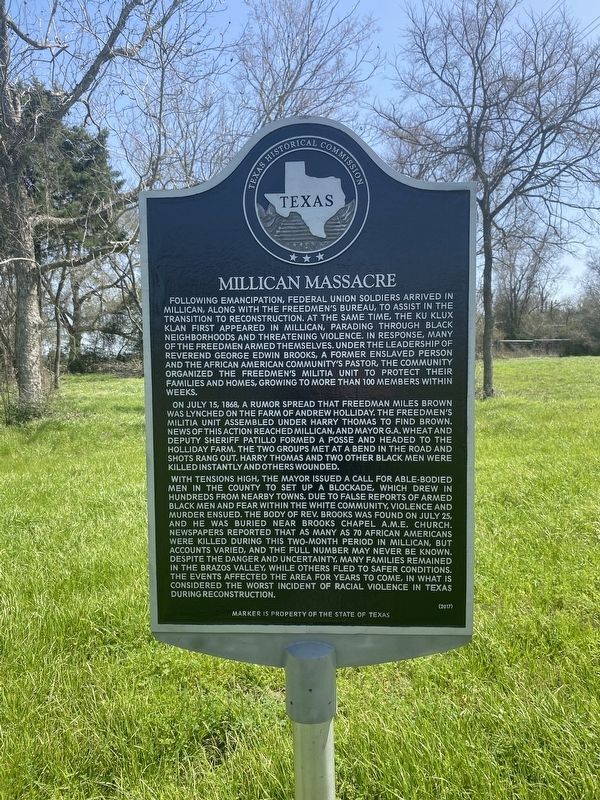
1. Millican Massacre Marker
Following Emancipation, Federal Union soldiers arrived in Millican, along with the Freedmen's Bureau, to assist in the transition to Reconstruction. At the same time, the Ku Klux Klan first appeared in Millican, parading through Black neighborhoods and threatening violence. In response, many of the Freedmen armed themselves. Under the leadership of Reverend George Edwin Brooks, a former enslaved person and the African American community's pastor, the community organized the Freedmen's Militia Unit to protect their families and homes, growing to more than 100 members within weeks.
On July 15, 1868, a rumor spread that freedman Miles Brown was lynched on the farm of Andrew Holliday. The Freedmen's Militia Unit assembled under Harry Thomas to find Brown. News of this action reached Millican, and mayor G.A. Wheat and deputy sheriff Patillo formed a posse and headed to the Holliday farm. The two groups met at a bend in the road and shots rang out. Harry Thomas and two other Black men were killed instantly and others wounded.
With tensions high, the mayor issued a call for able-bodied men in the county to set up a blockade,
this page online
Erected 2017 by Texas Historical Commission. (Marker Number 20150.)
Topics and series. This historical marker is listed in these topic lists: African Americans • Civil Rights • Law Enforcement. In addition, it is included in the African Methodist Episcopal (AME) Church series list. A significant historical date for this entry is July 15, 1868.
Location. 30° 28.279′ N, 96° 12.247′ W. Marker is in Navasota, Texas, in Brazos County. It is in Milllican Townsite. It is
Photographed by Morgan Petermann, March 4, 2025
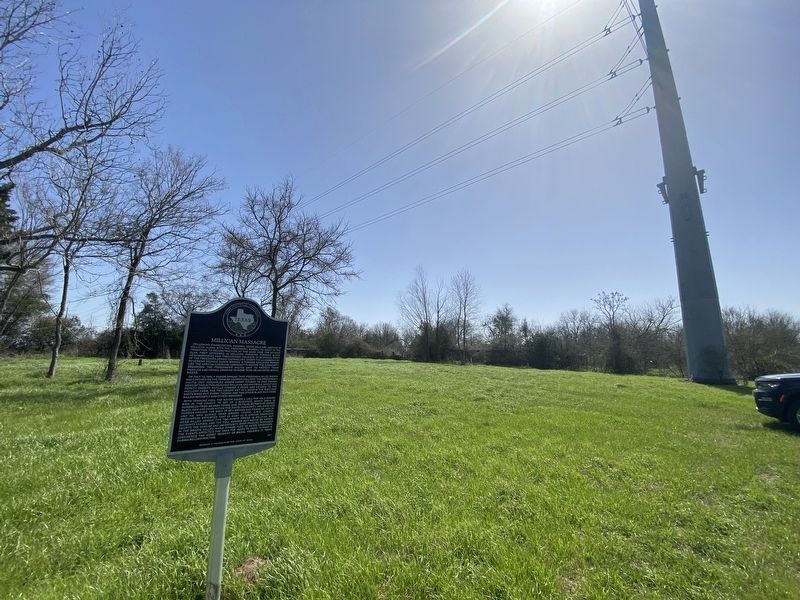
2. Millican Massacre Marker

Regionally, this marker is in the Prairies & Lakes Region. It is also in the American South. Globally, it is in North America, a Gulf of Mexico state, the Western Hemisphere, the Western World, and the Anglosphere. Historically, it finds itself in what was once New Spain, the Republic of Texas, one of the Confederate States of America, and the Antebellum South.
Other nearby markers. At least 8 other markers are within 9 miles of this marker, measured as the crow flies: Millican, C.S.A. (approx. ¼ mile away); William Templeton Millican (approx. 3.4 miles away); Wellborn Cemetery (approx. 7.1 miles away); Site of Piedmont Springs Resort (approx. 7.7 miles away); Flags over Texas Monument (approx. 8.6 miles away); M-60 Tank Memorial (approx. 8.6 miles away); La Bahia Trail (approx. 8.9 miles away); Mance Lipscomb (approx. 8.9 miles away). Touch for a list and map of all markers in Navasota.
Also see . . . Remembering The Millican Massacre. Texas A&M Today article detailing the work of Professor Amy Earhart, who research and completed the application for this historical marker. (Submitted on March 6, 2025, by Morgan Petermann of Hurst, Texas.)
Credits. This page was last revised on May 25, 2026. It was originally submitted on March 5, 2025, by Morgan Petermann of Hurst, Texas. This page has been viewed 857 times since then and 320 times this year. Photos: 1, 2. submitted on March 5, 2025, by Morgan Petermann of Hurst, Texas. • Devry Becker Jones was the editor who published this page.
