Fort Eustis in Newport News, Virginia — The American South (Mid-Atlantic)
The Civil War on Fort Eustis
Photographed by Evan Dwyer
1. The Civil War on Fort Eustis Marker
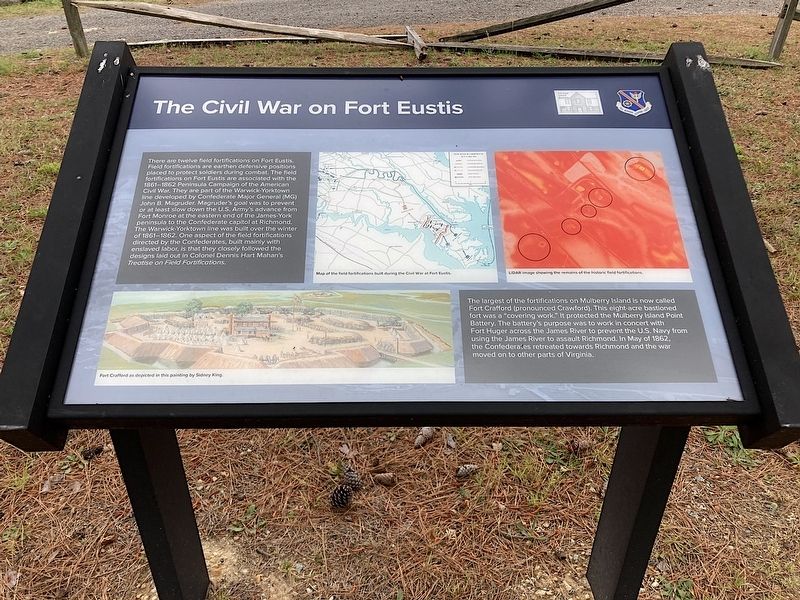
There are twelve field fortifications on Fort Eustis. Field fortifications are earthen defensive positions placed to protect soldiers during combat. The field fortifications on Fort Eustis are associated with the 1861-1862 Peninsula Campaign of the American Civil War. They are part of the Warwick-Yorktown line developed by Confederate Major General (MG) John B. Magruder. Magruder's goal was to prevent or at least slow down the U.S. Army's advance from Fort Monroe at the eastern end of the James-York peninsula to the Confederate capitol at Richmond. The Warwick-Yorktown line was built over the winter of 1861-1862. One aspect of the field fortifications directed by the Confederates, built mainly with enslaved labor, is that they closely followed the designs laid out in Colonel Dennis Hart Mahan's Treatise on Field Fortifications.
The largest of the fortifications on Mulberry Island is now called Fort Crafford (pronounced Crawford). This eight-acre bastioned fort was a "covering work." It protected the Mulberry Island Point Battery. The battery's purpose was to work in concert with Fort Huger across the James River to
this page online
Erected by Fort Eustis Cultural Resources Management.
Topics. This historical marker is listed in these topic lists: Anthropology & Archaeology • Forts and Castles • War, US Civil.
Location. 37° 9.002′ N, 76° 36.683′ W. Marker is in Newport News, Virginia. It is in Fort Eustis. It is on Harrison Road north of Back River Road, on the right when traveling south. This marker is on post. Access to the fort is limited to authorized personnel and sponsored or escorted visitors. Touch for map. Marker is in this post office area: Fort Eustis VA 23604, United States of America. Touch for directions.

Regionally, this marker is on Virginia’s Peninsula, in Hampton Roads, in Coastal Virginia, and in the Hampton Roads Metropolitan Area. It is also in the American South, specifically in the Upper South, in the Tidewater, and on the Eastern Seaboard. Globally, it is in the North Atlantic Region, North

Photographed by Evan Dwyer, December 14, 2024
2. Fort Crafford North Bastion
Fort Crafford is preserved with a short walking trail and three historic markers off a dirt road to the west of where Harrison Road enters the James River Reserve Fleet.
Other nearby markers. At least 8 other markers are within walking distance of this marker: Native Americans on this Land (approx. ¼ mile away); The Lee Hall Balloon School (approx. 0.3 miles away); Colossian Baptist Church (approx. 0.4 miles away); The Landship (Building 415) (approx. 0.4 miles away); John Rolfe (approx. half a mile away); Felker Army Airfield (approx. ¾ mile away); Mulberry Point & Sir Thomas West (approx. 0.8 miles away); Matthew Jones House (approx. 0.8 miles away). Touch for a list and map of all markers in Newport News.

Photographed by Evan Dwyer, December 14, 2024
3. 'Magruder Line' Southall's Point Battery
The most accessible trace of Confederate fortifications on post are in the park above the Warwick Pier & Boat Ramp off Wilson Avenue across from the Fort Eustis Club. This is the indistinct parapet of the battery.

Photographed by Evan Dwyer, May 4, 2024
4. Marker LiDAR Imaging
The marker's LiDAR image highlights a series of redoubts that comprised the Miner (or Minor) Line, constructed across the southern part of Mulberry Island between the James and Warwick Rivers. The line was abandoned when Magruder's defensive line was re-oriented from Lee's Mill out to Skiffes Creek to reduce manpower needs and allow re-allocation of men to the vicinity of Dam Number 1 (now in Newport News Park). The fortifications shown in the image are on either side of Mulberry Island Road but are within the installation's firing range and unsafe to visit without range officer authorization.
Credits. This page was last revised on July 24, 2025. It was originally submitted on March 5, 2025, by Evan Dwyer of Richmond, Virginia. This page has been viewed 297 times since then and 54 times this year. Photos: 1, 2, 3, 4. submitted on March 5, 2025, by Evan Dwyer of Richmond, Virginia. • Bernard Fisher was the editor who published this page.
Editor’s want-list for this marker. A wide shot of the marker in context. • Can you help?
