Kempsville Gardens in Virginia Beach, Virginia — The American South (Mid-Atlantic)
Kempes Landing

Photographed by Brandon D Cross
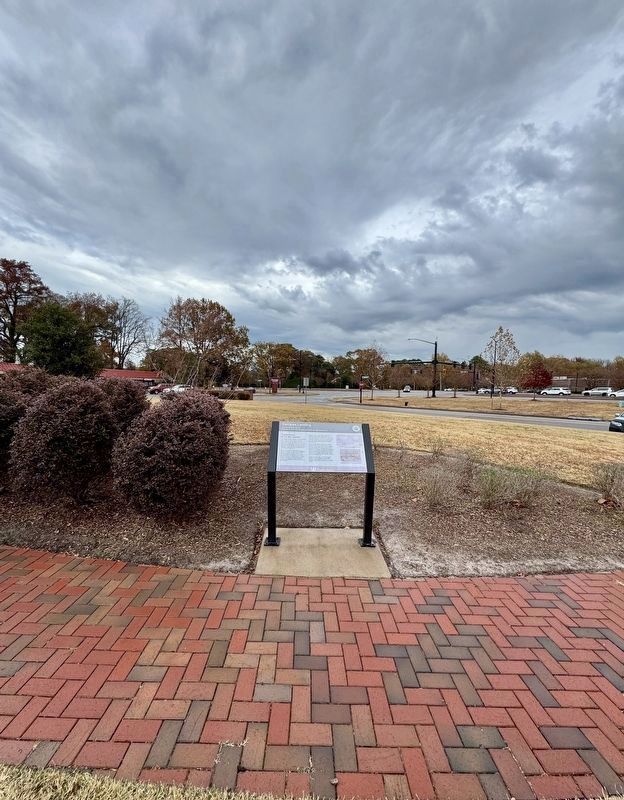
1. Kempes Landing Marker
The Revolution & The New Republic
Prior to English colonization beginning at Jamestown, remnants of the Algonquian-speaking Chesapeake native tribe traversed this area. Three decades after successors to Jamestown began to settle land south of the James River, George Kempe acquired a parcel of land in 1652 at the terminus of the Eastern Branch of the Elizabeth River. Farmers from the interior moved tobacco, and later, timber and grain, into Norfolk via longboats. A drawbridge at Kempes Landing allowed oceangoing sailing ships to enter and dock at warehouses along the riverbank. By the 1740s, the small port was designated as one of the Virginia Colony's official tobacco inspection stations, further elevating the village's stature.
In October 1775, the Royal Governor of Virginia, Lord Dunmore, anticipating the use of force by colonists protesting British taxation, made an unsuccessful effort to seize militia weapons and gunpowder in Kempes Landing. This was followed in November by a skirmish on the western edge of the village between Dunmore's British troops and locally assembled militiamen. The militiamen were so ill-equipped,
this page online
Dunmore's troops at Kempes Landing included his Ethiopian Regiment made up of formerly enslaved Virginians. His proclamation offered freedom to slaves who would join British forces. All area residents were ordered to take an oath of loyalty to the Crown. Many did so. In 1781, the traitor Benedict Arnold assembled local citizens at Kempes Landing to again encourage them to take the oath of loyalty to King George III. Despite. these efforts, Patriot support remained strong throughout the Revolutionary War.
In 1778, as the War was being waged, the General Assembly approved a petition from Princess Anne County residents to relocate the county seat from Newtown to Kempes Landing. At war's end in 1783, the village became the town of Kempsville, and existing property holders retained ownership of their irregular tracts, eliminating a more formal layout conducive to traditional
Photographed by Brandon D Cross
2. Kempes Landing Marker
George Kemp (1612 - 1675)
Wikipedia entry: "Kempsville was certainly derived from Kempe's Landing, land acquired by George Kempe, an industrious English immigrant.
Click for more information.
Wikipedia entry: "Kempsville was certainly derived from Kempe's Landing, land acquired by George Kempe, an industrious English immigrant.
Click for more information.
The Reverend Anthony Walke III of Kempsville's Fairfield Plantation was a county delegate to the 1788 Richmond convention at which Virginia ratified the United States Constitution. The following January he was one of the state's 12 electors, voting for George Washington as the nation's first President.
(captions)
Map of the Country Contiguous to Norfolk ca. 1812 Eastern Branch Elizabeth River showing Kempsville to the right. Courtesy of National Archives, Washington, D.C. (https://catalog.archives.gov/id/17370586)
Conjectural illustration of the wharf and port at Kempes Landing by Emily Whaley (coloration added). Courtesy of Virginia Wesleyan University Archives
Erected by City of Virginia Beach, Department of Planning & Community Development.
Topics. This historical marker is listed in these topic lists: Colonial Era • Settlements & Settlers • War, US Revolutionary • Waterways & Vessels. A significant historical year for this entry is 1652.
Location. 36° 49.73′ N, 76° 9.628′ W. Marker is in Virginia Beach, Virginia. It is in Kempsville Gardens. It is at the intersection of South Witchduck Road and Office Square Lane, on the left when traveling south on South Witchduck Road. Touch for map. Marker is at or near this postal address: 405 South Witchduck Road, Virginia Beach VA 23462, United States of America. Touch for directions.

Regionally, this marker is in Virginia’s Hampton Roads, specifically in Coastal Virginia, and in the Hampton Roads Metropolitan Area. It is also in the American South, specifically in the Upper South, in the Tidewater, and on the Eastern Seaboard. Globally, it is in the North Atlantic Region, North America, the Western Hemisphere, the Western World, and the Anglosphere. Historically, it finds itself in what was once the territory of the Mississippian Culture, one of the original Thirteen Colonies, one of the Confederate States of America, and the Antebellum South.
Other nearby markers. At least 8 other markers are within walking distance of this marker: Kempsville in the 19th Century (a few steps from this marker); Kempsville in the 20th Century (a few steps from this marker); Declaration of Independence Victory Dance (about 600 feet away, measured in a direct line); The Skirmish Of Kempsville (about 700 feet away); Willis Augustus Hodges (1815~1890) (about 700 feet away); Princess Anne County Courthouse (about 800 feet away); Skirmish at Kemp’s Landing (approx. 0.2 miles away); Kempsville (approx. 0.2 miles away). Touch for a list and map of all markers in Virginia Beach.
Also see . . . Princess Anne County. (Submitted on December 11, 2024, by Brandon D Cross of Flagler Beach, Florida.)
Credits. This page was last revised on October 19, 2025. It was originally submitted on December 11, 2024, by Brandon D Cross of Flagler Beach, Florida. This page has been viewed 949 times since then and 128 times this year. Last updated on March 6, 2025, by Carl Gordon Moore Jr. of North East, Maryland. Photos: 1, 2. submitted on December 11, 2024, by Brandon D Cross of Flagler Beach, Florida. • Devry Becker Jones was the editor who published this page.
