Buckhannon in Upshur County, West Virginia — The American South (Appalachia)
Polygonum cuspidatum (Japanese knotweed)

Photographed by Bradley Owen, February 24, 2025
1. Polygonum cuspidatum (Japanese knotweed) Marker
Family: Polygonaceae (Knotweed Family)
Distribution: Japanese knotweed can be found throughout North America with the exception of a few southern states and central Canada. It is present in almost every county in West Virginia.
Size: This plant can reach heights up to 12 ft.
Habitat/Description: This herbaceous perennial, which appears woody, can grow in a wide range of habitats, including roadsides, waste places, streambanks, wet lands, riparian areas, and neglected gardens. It tolerates dry soil, salt, and high temperatures very well. It prefers sunlight, but is tolerant of mild to moderate shade. Numerous, attractive white inflorescences with tiny flowers appear between July and October. The winged, papery fruits contain smooth, shiny black, triangular seeds. Japanese knotweed aggressively forms dense, persistent thickets that overtake other neighboring foliage. This is a problem because such severely altered habitats may negatively affect wildlife. These thickets grow in size very quickly because this plant reproduces vegetatively by vigorous rhizomes that form a dense mat. As a result, populations are difficult
this page online
Ethnobotanical Uses: Japanese knotweed is a native of Asia. Sometime after 1830, this plant was introduced to Europe. It was widely distributed in plant catalogs, but as the aggressive nature of the plant was discovered, it began to decline in popularity. In the late 1800s, Japanese knotweed was brought to the United States for horticultural use, and it soon escaped cultivation. It quickly became naturalized in Pennsylvania, New York, New Jersey, and surrounding areas. By the 1930s, invasiveness had become such an issue that catalogs began publishing information about how to eradicate it from gardens. When the Cherokee encountered it, they used Japanese knotweed as a leafy vegetable. Young shoots may be eaten as a tasty potherb.
Erected 2017 by West Virginia Wesleyan College Department of Biology.
Topics. This historical marker is listed in these topic lists: Environment • Horticulture & Forestry • Indigenous Peoples and Communities. A significant historical year for this entry is 1830.
Location. 38° 59.611′ N, 80° 13.065′ W.
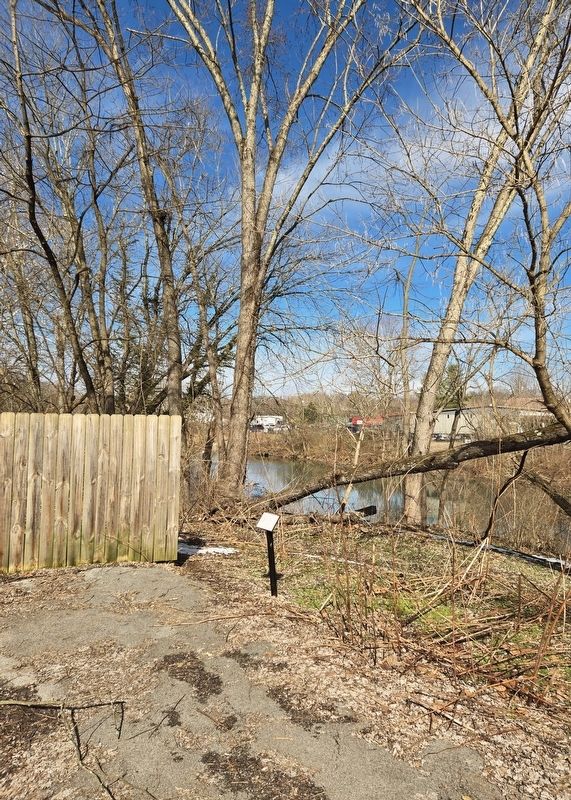
Photographed by Bradley Owen, February 24, 2025
2. Polygonum cuspidatum (Japanese knotweed) Marker

Regionally, this marker is in North Central West Virginia. It is also in the American South, specifically in the Upper South, in Appalachia, and specifically in Northern Appalachia. Globally, it is in North America, the Western Hemisphere, the Western World, and the Anglosphere. Historically, it finds itself in what was once the territory of the Mississippian Culture.
Other nearby markers. At least 8 other markers are within walking distance of this marker: Platanus occidentalis (American sycamore) (a few steps from this marker); West Virginia Split Rail / West Virginia Forest Products (within shouting distance of this marker); Asimina triloba (pawpaw, or West Virginia banana) (within shouting distance of this marker); Euonymus atropurpureus (burning bush, eastern wahoo) (within shouting distance of this marker); Chionanthus virginicus (fringetree) (within shouting distance of this marker); Acer saccharum (sugar maple) (within shouting distance of this marker); Acer rubrum (red maple) (within shouting distance of this marker); Tony Gum Bridge (within shouting distance of this marker). Touch for a list and map of all markers in Buckhannon.
Credits. This page was last revised on March 6, 2025. It was originally submitted on March 6, 2025, by Bradley Owen of Morgantown, West Virginia. This page has been viewed 139 times since then and 15 times this year. Photos: 1, 2. submitted on March 6, 2025, by Bradley Owen of Morgantown, West Virginia.
