Willow Springs in Cook County, Illinois — The American Midwest (Great Lakes)
Land of the Healing Waters

Photographed by Sean P. Flynn, March 6, 2025
1. Land of the Healing Waters Marker
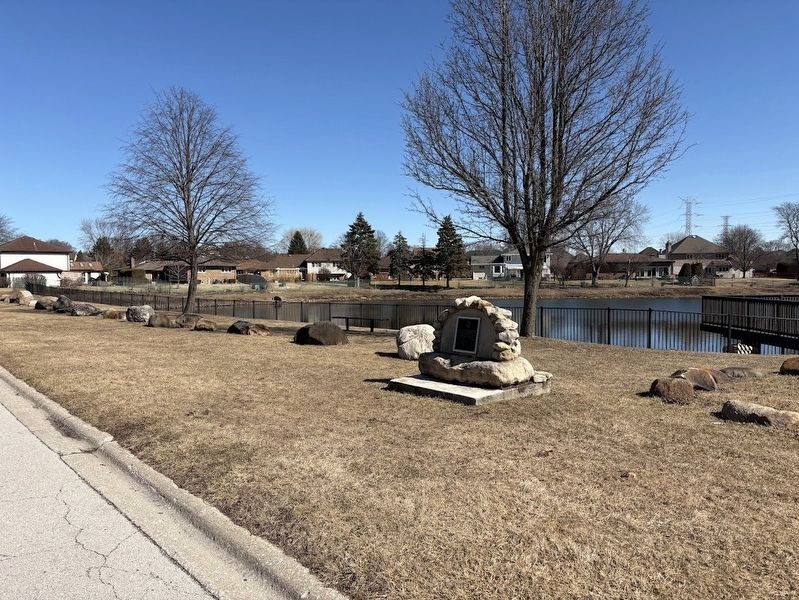
This plaque, presented in 1984 by the Swallow Cliff Chapter, National Society Daughters of the American Revolution, commemorates the site where, hundreds of years before the white settlers came, the Potawatomi and other Indian tribes in the Midwest area sought out the sacred "Land of the Healing Waters", because of the many springs thought to possess recuperative powers. They knew they had reached it when they came upon a formation of large boulders arranged in a north to south direction, in the area now known as Willow Springs. A circle of boulders contained the ceremonial eternal flame kept burning by the Mascoutin Society, a religious group. The Indians came to this place to be cared for until healed.
Erected 1984 by Swallow Cliff Chapter, National Society Daughters of the American Revolution; Willow Springs Historical Society.
Topics and series. This historical marker is listed in these topic lists: Indigenous Peoples and Communities • Settlements & Settlers • Waterways & Vessels. In addition, it is included in the Daughters of the American Revolution (DAR) series list.
Location. 41° 44.136′ N,
this page online

Regionally, this marker is in Greater Chicago. It is also in the American Midwest. Globally, it is in North America, on the Great Lakes, in the Western Hemisphere, in the Western World, and in the Anglosphere. Historically, it finds itself in what was once the Viceroyalty of New France, the territory of the Mississippian Culture, and the Northwest Territory.
Other nearby markers. At least 8 other markers are within walking distance of this marker: Old Towpath (approx. 0.6 miles away); Original Illinois & Michigan Canal (approx. 0.6 miles away); "The Worker" (approx. ¾ mile away); ...And It Came to Be (approx. ¾ mile away); Willow Springs Civilian Conservation Corps Camp #612 (con’t…) (approx. ¾ mile away); Willow Springs Civilian Conservation Corps Camp #612 (approx. ¾ mile away); The Civilian Conservation Corps (CCC) (approx. ¾ mile away); Willow Springs Honor Roll
Photographed by Sean P. Flynn, March 6, 2025
2. Land of the Healing Waters Marker
The line of stones referenced on the marker is to the left; the ceremonial circle is to the right.
More about this marker. A straight, north-south line of boulders can be found to the left (north) of the plaque; to the right is a circle of stones.
Regarding Land of the Healing Waters. According to a 1996 article in the Orland Park Star, evidence of these "healing waters" was discovered by Thomas Greenwood, a Willow Springs resident of Cherokee descent, in the 1960s. According to the article, a Potawatomi elder living in Kansas had presented Greenwood with a pre-white settlement map of the Willow Springs area, including this location (west of Willow Road and south of German Church Road) where natural springs were in abundance in the time before the I&M Canal and the later Chicago Sanitary and Ship Canal were constructed. When Greenwood returned home, he found more than 50 boulders at this location north of the Des Plaines River in Willow Springs; the location is believed to have been where a tribe called the Mascoutin came to a spring for what they believed to be its healing powers. Greenwood worked to preserve the site even as the modern
Photographed by Sean P. Flynn, March 6, 2025
3. Healing Waters Park
Also see . . .
1. Native American Lore of Healing Waters Park.
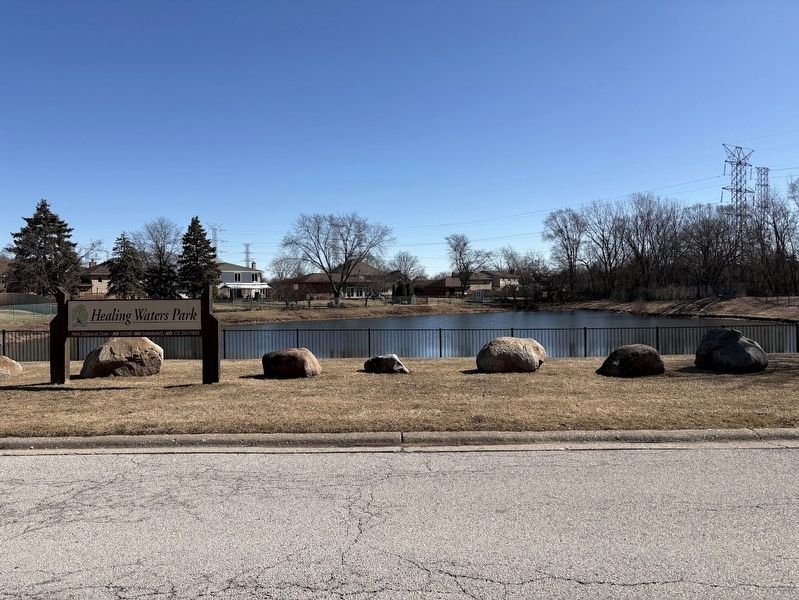
Excerpt: "The park, which consists of a small pond and a row of boulders 92 yards in length, is the last vestige of the area’s prehistory. Long before the first Europeans set foot on the land that would one day become the village of Willow Springs, the Algonquian peoples traveled to this area to drink from springs that reportedly possessed healing powers."(Submitted on March 7, 2025, by Sean P. Flynn of Oak Park, Illinois.)
2. Profiles: Thomas Greenwood, Native American Rights Activist. From Mother Earth News, a 1985 interview with Thomas Greenwood, a Chicago-area Native American activist
Excerpt: “Today, Thomas Greenwood’s energy and enthusiasm remain high. For Greenwood, being in 'retirement' means only that he has more time to concentrate on two of the most important issues of his life: the restoration of the environment and the preservation of his 2,000-year-old heritage. Tom recently completed a successful campaign to preserve 92 miles along the historic Illinois and Michigan Canal. And he’s currently coauthoring a history of the Des Plaines River Valley.”(Submitted on March 7, 2025, by Sean P. Flynn of Oak Park, Illinois.)
3. DAR Swallow Cliff Chapter. The chapter is based in Palos Heights, Illinois, about eight miles southeast of this historical marker. (Submitted on March 7, 2025, by Sean P. Flynn of Oak Park, Illinois.)
Credits. This page was last revised on July 5, 2025. It was originally submitted on March 7, 2025, by Sean P. Flynn of Oak Park, Illinois. This page has been viewed 614 times since then and 159 times this year. Photos: 1, 2, 3. submitted on March 7, 2025, by Sean P. Flynn of Oak Park, Illinois.
