Greensboro in Greene County, Georgia — The American South (South Atlantic)
Governor Peter Early
1773-1817
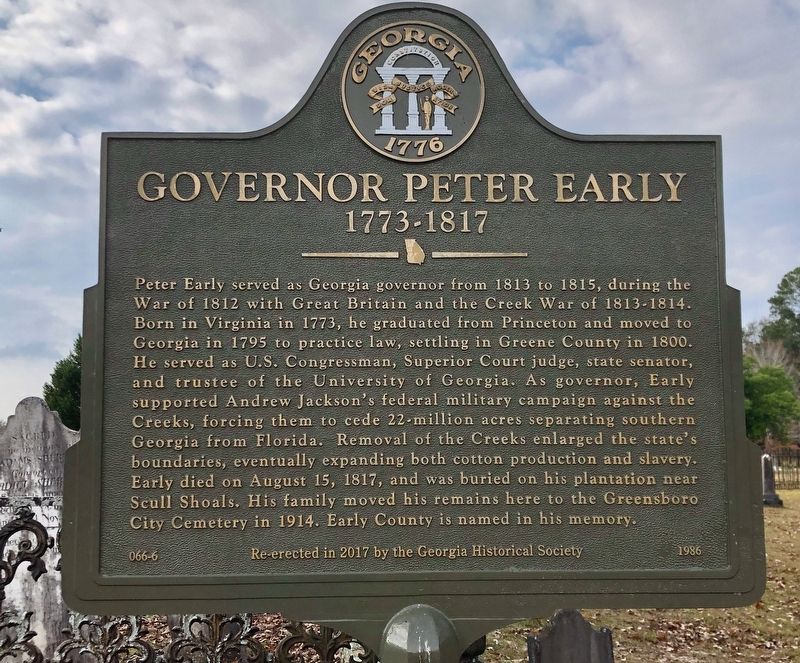
Photographed by Duane and Tracy Marsteller, November 26, 2024
1. Governor Peter Early Marker
Erected 2017 by Georgia Historical Society. (Marker Number 066-6.)
Topics and series. This historical marker is listed in these topic lists: Government & Politics • Indigenous Peoples and Communities • War of 1812 • Wars, US Indian. In addition, it is included
this page online
Location. 33° 34.89′ N, 83° 10.853′ W. Marker is in Greensboro, Georgia, in Greene County. It can be reached from Memorial Drive west of North East Street, on the left when traveling west. Marker is in Greensboro City Cemetery. Touch for map. Marker is at or near this postal address: 104 East Richland Ave, Greensboro GA 30642, United States of America. Touch for directions.

Regionally, this marker is in the Antebellum Trail and in the Piedmont. It is also in the American South and specifically in the Deep South. Globally, it is in North America, the Western Hemisphere, the Western World, and the Anglosphere. Historically, it finds itself in what was once the territory of the Mississippian Culture, one of the original Thirteen Colonies, one of the Confederate States of America, and the Antebellum South.
Other nearby markers. At least 8 other markers are within walking distance of this marker: Peter Early (here, next to this marker); The Mounger Square (within shouting distance of this marker); Gwyn Allison (within shouting distance
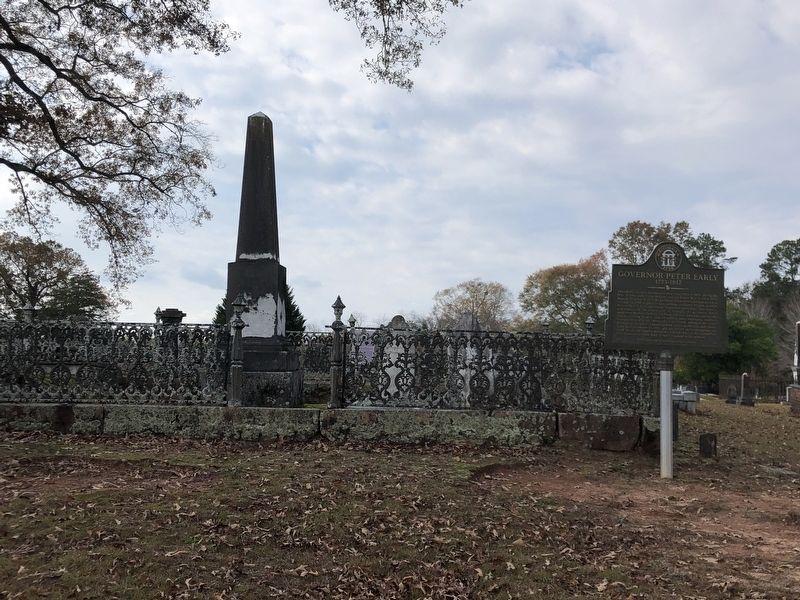
Photographed by Duane and Tracy Marsteller, November 26, 2024
2. Governor Peter Early Marker
Also see . . . Peter Early. Peter Early served as governor of Georgia at the height of the Creek War of 1813-14. His administration’s enthusiastic backing of federal military expeditions on this “other front” of the War of 1812 (1812-15) enlarged and secured Georgia’s frontier by hastening the Indians’ removal, thus fostering the state’s nineteenth-century transition from an undeveloped frontier to a “cotton kingdom.” (Keith Hulett, University of Georgia Libraries; via New Georgia Encyclopedia) (Submitted on March 7, 2025, by Duane and Tracy Marsteller of Murfreesboro, Tennessee.)

Photographed by Duane and Tracy Marsteller, November 26, 2024
3. Grave of Gov.Peter Early
Credits. This page was last revised on March 7, 2025. It was originally submitted on March 7, 2025, by Duane and Tracy Marsteller of Murfreesboro, Tennessee. This page has been viewed 158 times since then and 35 times this year. Photos: 1, 2, 3. submitted on March 7, 2025, by Duane and Tracy Marsteller of Murfreesboro, Tennessee.
