Buckhannon in Upshur County, West Virginia — The American South (Appalachia)
Celastrus orbiculatus (Oriental bittersweet)
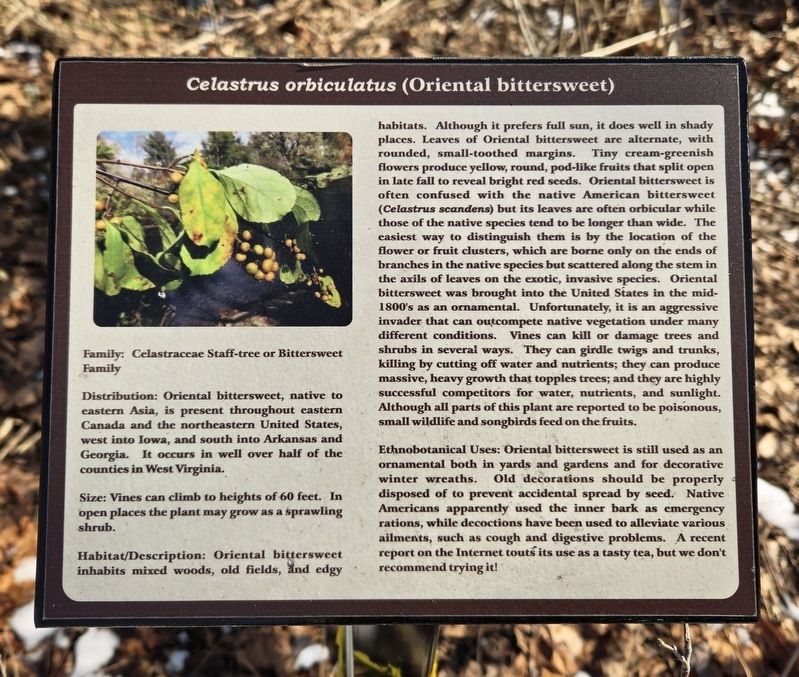
Photographed by Bradley Owen, February 24, 2025
1. Celastrus orbiculatus (Oriental bittersweet) Marker
Family: Celastraceae Staff-tree or Bittersweet Family
Distribution: Oriental bittersweet, native to eastern Asia, is present throughout eastern Canada and the northeastern United States, west into Iowa, and south into Arkansas and Georgia. It occurs in well over half of the counties in West Virginia.
Size: Vines can climb to heights of 60 feet. In open places the plant may grow as a sprawling shrub.
Habitat/Description: Oriental bittersweet inhabits mixed woods, old fields, and edgy habitats. Although it prefers full sun, it does well in shady places. Leaves of Oriental bittersweet are alternate, with rounded, small-toothed margins. Tiny cream-greenish flowers produce yellow, round, pod-like fruits that split open in late fall to reveal bright red seeds. Oriental bittersweet is often confused with the native American bittersweet (Celastrus scandens) but its leaves are often orbicular while those of the native species tend to be longer than wide. The easiest way to distinguish them is by the location of the flower or fruit clusters, which are borne only on the ends of branches in the native species but scattered
this page online
Ethnobotanical Uses: Oriental bittersweet is still used as an ornamental both in yards and gardens and for decorative winter wreaths. Old decorations should be properly disposed of to prevent accidental spread by seed. Native Americans apparently used the inner bark as emergency rations, while decoctions have been used to alleviate various ailments, such as cough and digestive problems. A recent report on the Internet touts its use as a tasty tea, but we don't recommend trying it!
Erected 2017
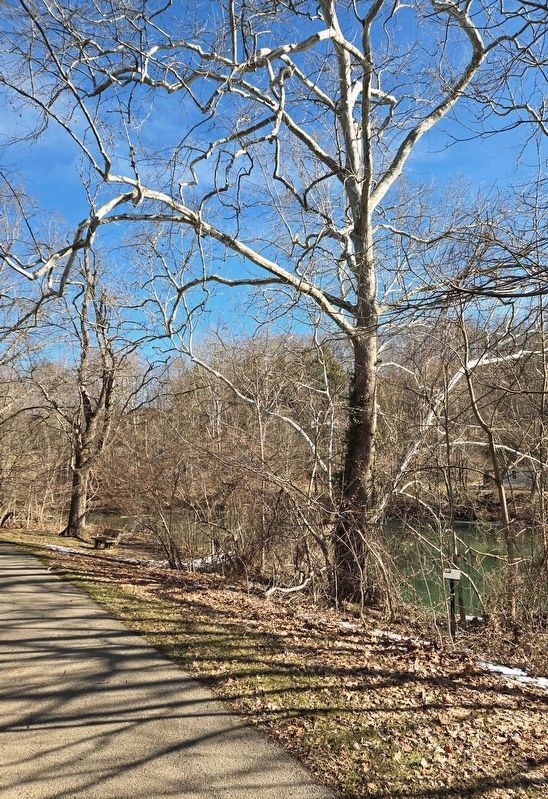
Photographed by Bradley Owen, February 24, 2025
2. Celastrus orbiculatus (Oriental bittersweet) Marker
Marker is located in the lower right of the photo, right of the large tree.
Topics. This historical marker is listed in these topic lists: Environment • Horticulture & Forestry • Indigenous Peoples and Communities.
Location. 38° 59.512′ N, 80° 12.714′ W. Marker is in Buckhannon, West Virginia, in Upshur County. It can be reached from the intersection of Walktrail Lane and Wood Street, on the left when traveling east. Marker is located on the Buckhannon River Walk Trail most easily accessed from the Buckhannon Dog Park parking lot. Touch for map. Marker is at or near this postal address: 54 Walktrail Lane, Buckhannon WV 26201, United States of America. Touch for directions.

Regionally, this marker is in North Central West Virginia. It is also in the American South, specifically in the Upper South, in Appalachia, and specifically in Northern Appalachia. Globally, it is in North America, the Western Hemisphere, the Western World, and the Anglosphere. Historically, it finds itself in what was once the territory of the Mississippian Culture.
Other nearby markers. At least 8 other markers are within walking distance of this marker: The Bicentennial Sycamore (within shouting distance of this marker); Two Buddies & An Angel (within shouting distance of this marker); West Virginia Wesleyan College (about 300 feet away, measured in a direct line); Castanea dentata x mollissima (Dunstan chestnut) (about 300 feet away); Juglans nigra (black walnut) (about 400 feet away); Juglans cinerea (butternut, or white walnut) (about 400 feet away); Parthenocissus quinquefolia (Virginia creeper) (about 500 feet away); Bob Wallace Bridge (about 800 feet away). Touch for a list and map of all markers in Buckhannon.
Credits. This page was last revised on March 8, 2025. It was originally submitted on March 8, 2025, by Bradley Owen of Morgantown, West Virginia. This page has been viewed 99 times since then and 13 times this year. Photos: 1, 2. submitted on March 8, 2025, by Bradley Owen of Morgantown, West Virginia.
