Elizabethton in Carter County, Tennessee — The American South (East South Central)
Fort Watauga and the Cherokee War

Photographed by Mark Parker, March 14, 2025
1. Fort Watauga and the Cherokee War Marker
In May 1776 the Cherokee chiefs, alarmed by the expansion of white settlers onto their land, gave the Wataugans twenty days to leave their lands or face war. The Wataugans asked for more time and built Fort Watauga (also called Fort Caswell) near a spring in a bottom one-half miles northeast of the mouth of Gap Creek. Anger among the Cherokee, who had allied themselves with the British, mounted when they heard of this stockade building. In mid July Old Abram of Chilowee led 300 warriors against Fort Watauga. (Dragging Canoe and The Raven of Chote, with 400 men, attacked the Holston and Carter's Valley settlements.) Counting on surprise, the Cherokee expected to destroy the whites easily. However, Nancy Ward, a Cherokee married to a white man, warned her white friends that a raid was coming. The Watauga and Nolichucky settlers fled their homes taking refuge in Fort Watauga and sending warnings to the other settlements. Old Abram attacked Fort Watauga at daybreak on July 21 surprising several women who were outside the fort milking. Their screams alerted the defenders, who manned the walls and began firing on the Indians.
this page online
"Strange as it may appear this territory owes its present consequence to this handful of men. It is very probable that if this small party had given way, the people would have generally (if not all) fled to the eastern side of the Allegheny Mountains.
William Tatham, a veteran of the fight at Fort Watauga writing in 1793 for the Knoxville Gazette.
(Captions)
"Around the fort was a kind of glade and the Indians could approach nearest the fort on the north shore of the river, which was skirted with trees, Behind these the chief portion of the enemy posted themselves, one got behind a tree.... and watching an opportunity when Sevier peeped through a port hole, the Indian shot. The ball struck in the timber but an inch or so from the hole."
James Sevier, twelve years old at the time of the siege.
Always located near a source of water, the frontier fort was typically built of pointed logs connecting several cabins. Blockhouses, with overhanging second-stories, were placed at the corners to guard the walls. The settlers sheltering in the fort lived in the cabins which sometimes had two floors with roughly dressed wooden floors but which were usually one-story with dirt floors. The defenders pierced the fort's walls with loopholes through which they could fire, This reconstruction of Fort Watauga is based on archacological and historical research.
Escape At least 225 men, women, and children "forted up" within Fort Watauga. Conditions soon became squalid and considerable sickness and suffering resulted.
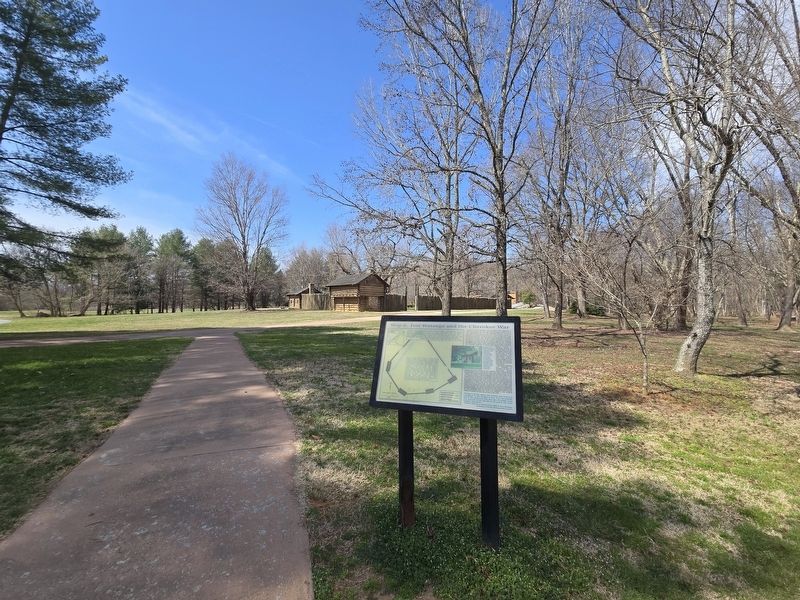
Photographed by Mark Parker, March 14, 2025
2. Marker in front of replica Fort Watauga
Topics. This historical marker is listed in these topic lists: Forts and Castles • Indigenous Peoples and Communities • Settlements & Settlers • Wars, US Indian. A significant historical month for this entry is May 1776.
Location. 36° 20.648′ N, 82° 15.199′ W. Marker is in Elizabethton, Tennessee, in Carter County. It is on West Elk Avenue (U.S. 321) west of Franklin Springs Circle, on the right when traveling west. The marker is at the Sycamore Shoals Historic Area approximately 200 feet behind the Visitors Center. Touch for map. Marker is at or near this postal address: 1504 W Elk Ave, Elizabethton TN 37643, United States of America. Touch for directions.

Regionally, this marker is in East Tennessee and in the Tri-Cities Area. It is also in the American South, specifically in the Upper South, in Appalachia, and specifically in Southern Appalachia. Globally, it is in North America, the Western Hemisphere, the Western World, and the Anglosphere. Historically, it finds itself in what was once the original Cherokee Nation, the territory of the Mississippian Culture, one of the Confederate States
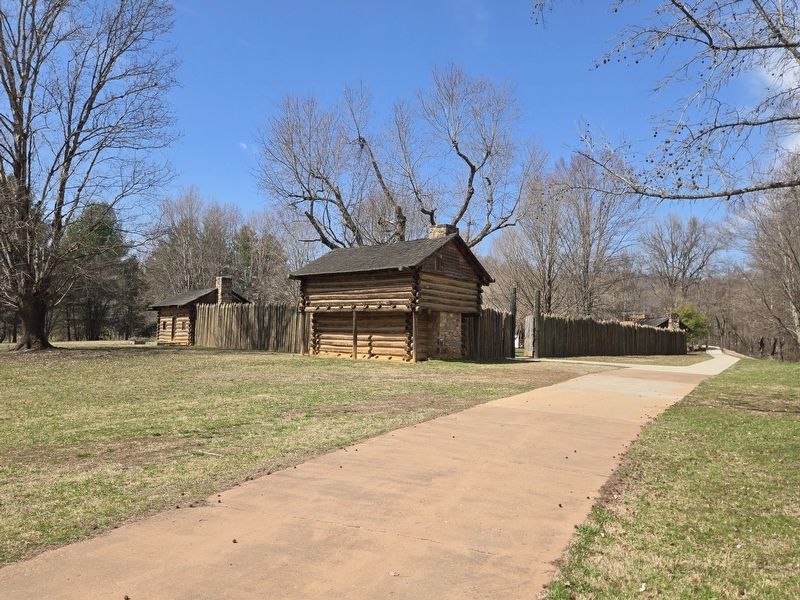
Photographed by Mark Parker, March 14, 2025
3. Replica Fort Watauga
Other nearby markers. At least 8 other markers are within walking distance of this marker: Sycamore Shoals State Historic Area (within shouting distance of this marker); John Crockett: Frontier Ranger (within shouting distance of this marker); David Crockett (within shouting distance of this marker); Valentine Sevier, "The Immigrant" (within shouting distance of this marker); Dedicated to the Spirit of the Overmountain Men (within shouting distance of this marker); The Tipton Family (about 500 feet away, measured in a direct line); Sycamore Shoals of the Watauga (about 500 feet away); Watauga Fort (about 500 feet away). Touch for a list and map of all markers in Elizabethton.
More about this marker. The marker is the second stop of an interactive trail that circles the park's property.
Credits. This page was last revised on July 20, 2025. It was originally submitted on March 18, 2025, by Mark Parker of Hickory, North Carolina. This page has been viewed 434 times since then and 135 times this year. Photos: 1, 2, 3. submitted on March 18, 2025, by Mark Parker of Hickory, North Carolina. • James Hulse was the editor who published this page.
