Old Montreal in Montréal, Québec — Central Canada (French-Canadian)
La Grande Paix de Montréal
⎯⎯⎯
The Great Peace of Montréal

Photographed by Cosmos Mariner, May 20, 2024
1. La Grande Paix de Montréal/The Great Peace of Montréal Marker

this page online
Erected 2001 by Commission des lieux et monuments historiques du Canada/Historic Sites and Monuments Board of Canada.
Topics and series. This historical marker is listed in these topic lists: Colonial Era • Indigenous Peoples and Communities • Peace. In addition, it is included in the Canada, Historic Sites and Monuments Board series list. A significant historical date for this entry is August 4, 1701.
Location. 45° 30.095′ N, 73° 33.313′ W. Marker is in Montréal, Québec. It is in Old Montreal. It is on Place d'Youville just south of Rue Saint-Nicolas, on the left when traveling south. The marker is located along the pedestrian walkway between the north- and south-bound Place d'Youville segments. Touch for map. Marker is at or near this postal address: 285 Place d'Youville, Montréal QC H2Y 2C2, Canada. Touch for directions.

Regionally, this marker is in Central Canada. Globally, it is in North America, the Western Hemisphere, and the Western World. Historically, it finds itself in what was once a British colony, the Viceroyalty of New
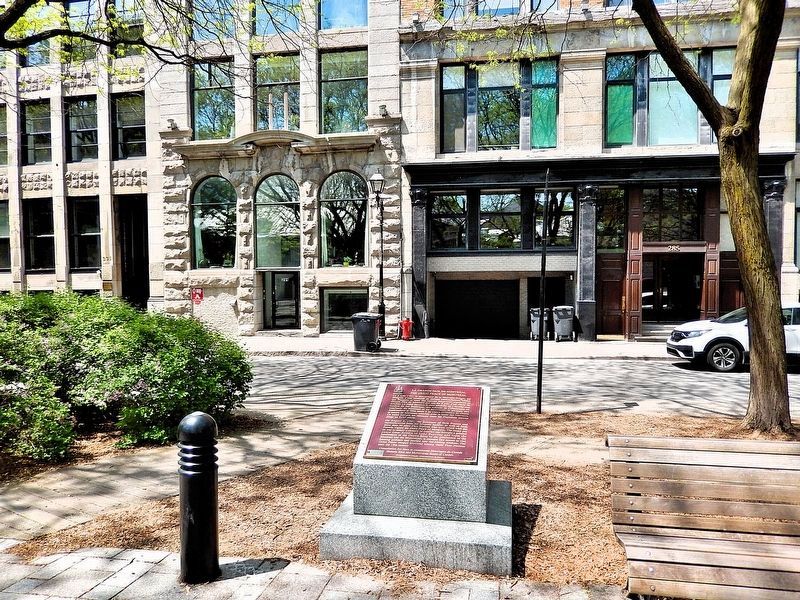
Photographed by Cosmos Mariner, May 20, 2024
2. La Grande Paix de Montréal/The Great Peace of Montréal Marker
Looking west from the median walkway; southbound Place d'Youville crosses in the background.
Other nearby markers. At least 8 other markers are within walking distance of this marker: Kondiaronk and Callière (a few steps from this marker); Caserne 1 (within shouting distance of this marker); Montréal’s Founders and First Colonists Monument (about 90 meters away, measured in a direct line); Mère Marie-Marguerite d'Youville (about 120 meters away); Maison de Mère d'Youville (about 120 meters away); L'évolution du site comme témoin du quartier / The Evolution of the site as Witness to Neighbourhood (about 120 meters away); Agathe de Saint-Père de Repentigny (about 120 meters away); Les Sœurs Grises de Montréal / The Grey Nuns of Montréal (about 120 meters away). Touch for a list and map of all markers in Montréal.
Also see . . . Great Peace of Montreal (Wikipedia).
Excerpt: A peace treaty between New France and 39 First Nations of North America that ended the Beaver Wars. It was signed on August 4, 1701, by Louis-Hector de Callière, governor of New France, and 1300 representatives of 39 Indigenous nations. Present for the diplomatic event were the various peoples; part of the Iroquois confederacy, the Huron peoples, and the Algonquin peoples. This has sometimes been called the Grand Settlement of 1701. It has often been referred to as La Paix des Braves, meaning "The Peace of the Braves".(Submitted on March 22, 2025, by Cosmos Mariner of Cape Canaveral, Florida.)The treaty was highly symbolic for the aboriginal nations as the Tree of Peace was now established among all the Great Lakes' nations. Commerce and exploratory expeditions quietly resumed in peace after the signing of the treaty. Jesuit priests resumed their spiritual mission-based work in the north. The Great Peace of Montreal is a unique diplomatic event in the history of both North and South America. The treaty is still considered valid by the Indigenous people of the American First Nations tribes involved.
Credits. This page was last revised on April 5, 2025. It was originally submitted on March 21, 2025, by Cosmos Mariner of Cape Canaveral, Florida. This page has been viewed 282 times since then and 90 times this year. Photos: 1, 2. submitted on March 22, 2025, by Cosmos Mariner of Cape Canaveral, Florida.
