Buckhannon in Upshur County, West Virginia — The American South (Appalachia)
Juglans nigra (black walnut)

Photographed by Bradley Owen, March 10, 2025
1. Juglans nigra (black walnut) Marker
Family: Juglandaceae (Walnut family)
Distribution: Black walnut can be found growing throughout eastern North America and west to Utah. It is common throughout West Virginia, except at high elevations.
Size: This is a medium-sized tree that grows between 70-90 ft. tall. However, it has been known to reach 150 ft. in height. Black walnut trees usually mature in about 150 years.
Habitat/Description: This tree can be found growing in open fields and rich woods. Black walnut prefers soils that are neutral, well-drained, and deep. Inconspicuous male and female flowers bloom in late-spring to mid-summer. The resulting spherical fruits have a thick, semi-fleshy husk covered with short hairs and are yellowish-green in color. The large nuts are often stored by wildlife for food for the winter. Black walnut produces a toxin known as juglone, which inhibits the growth of other plants around it. This reduces competition with other foliage. It has no serious pest or disease problems.
Ethnobotanical Uses: The Cherokee ate the fruit of black walnut and chewed the bark for toothaches. The bark was also used by the Chippewa
this page online
Erected 2017 by West Virginia Wesleyan College Department of Biology.
Topics. This historical marker is listed in these topic lists: Horticulture & Forestry • Indigenous Peoples and Communities • Industry & Commerce • Science & Medicine.
Location. 38° 59.571′ N, 80° 12.768′ W. Marker is in Buckhannon, West Virginia, in Upshur County. It can be reached from the intersection of Walktrail Lane and Wood Street, on the left when traveling east. Marker is located on the Buckhannon River Walk Trail most easily accessed from the Buckhannon Dog Park parking lot. Touch for map. Marker is at or near this
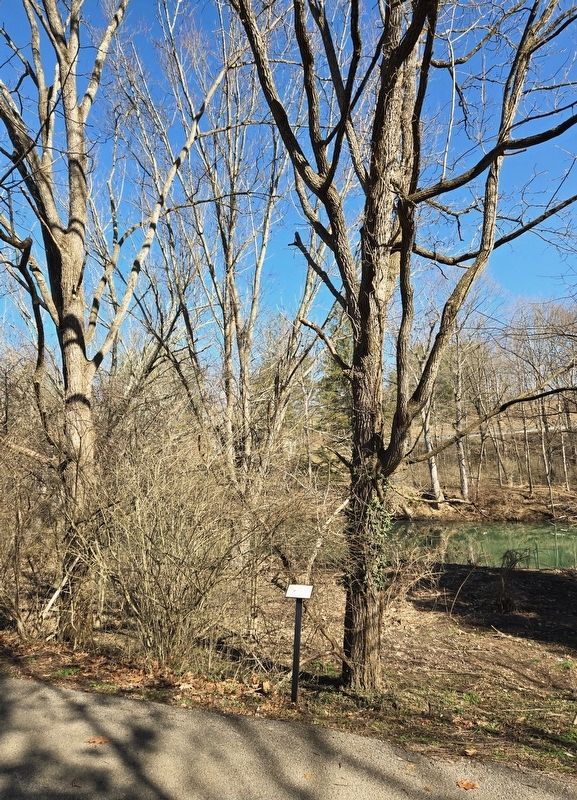
Photographed by Bradley Owen, March 10, 2025
2. Juglans nigra (black walnut) Marker

Regionally, this marker is in North Central West Virginia. It is also in the American South, specifically in the Upper South, in Appalachia, and specifically in Northern Appalachia. Globally, it is in North America, the Western Hemisphere, the Western World, and the Anglosphere. Historically, it finds itself in what was once the territory of the Mississippian Culture.
Other nearby markers. At least 8 other markers are within walking distance of this marker: Juglans cinerea (butternut, or white walnut) (here, next to this marker); Parthenocissus quinquefolia (Virginia creeper) (within shouting distance of this marker); West Virginia Wesleyan College (within shouting distance of this marker); Two Buddies & An Angel (within shouting distance of this marker); Bob Wallace Bridge (about 400 feet away, measured in a direct line); Celastrus orbiculatus (Oriental bittersweet) (about 400 feet away); Castanea dentata x mollissima (Dunstan chestnut) (about 500 feet away); The Bicentennial Sycamore (about 600 feet away). Touch for a list and map of all markers in Buckhannon.
Credits. This page was last revised on March 24, 2025. It was originally submitted on March 24, 2025, by Bradley Owen of Morgantown, West Virginia. This page has been viewed 115 times since then and 15 times this year. Photos: 1, 2. submitted on March 24, 2025, by Bradley Owen of Morgantown, West Virginia.
