Menands in Albany County, New York — The American Northeast (Mid-Atlantic)
Arent van Curler & Fr. Isaac Jogues at the Flatts in 1643
Schuyler Flatts Cultural Park
Photographed by Steve Stoessel, March 22, 2025
1. Arent van Curler & Fr. Isaac Jogues at the Flatts in 1643 Marker
[Main Text]
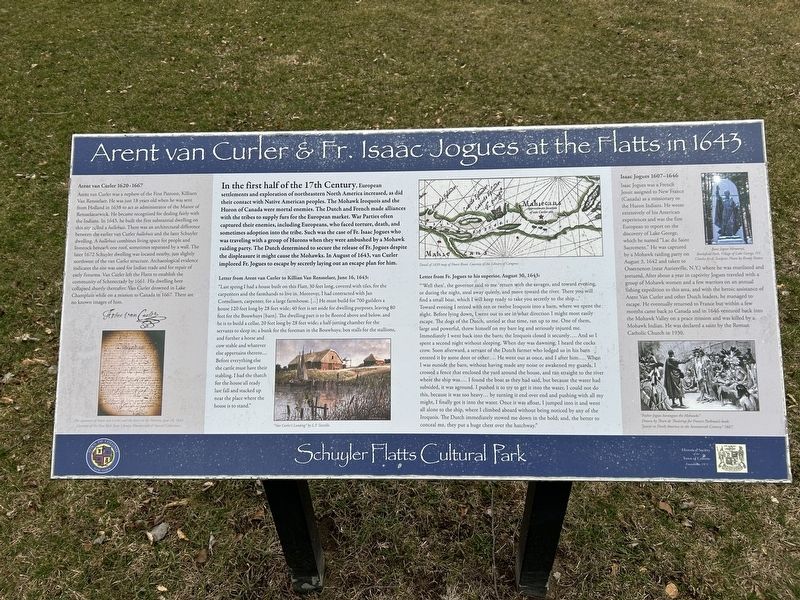
In the first half of the 17th Century, European settlements and exploration of northeastern North America increased, as did their contact with Native American peoples. The Mohawk Iroquois and the Huron of Canada were mortal enemies. The Dutch and French made alliances with the tribes to supply furs for the European market. War Parties often captured their enemies, including Europeans, who faced torture, death, and sometimes adoption into the tribe. Such was the case of Fr. Isaac Jogues who was traveling with a group of Hurons when they were ambushed by a Mohawk raiding party. The Dutch determined to secure the release of Fr. Jogues despite the displeasure it might cause the Mohawks. In August of 1643, van Curler implored Fr. Jogues to escape by secretly laying out an escape plan for him.
Letter from Arent van Curler to Killian Van Rensselaer, June 16, 1643:
"Last spring I had a house built on this Flatt, 30 feet long, covered with tiles, for the carpenters and the farmhands to live in. Moreover, I had contracted with Jan Cornelissen, carpenter, for a large farmhouse. [...] He must build for 700 guilders a
this page online
[Illustration Captions]
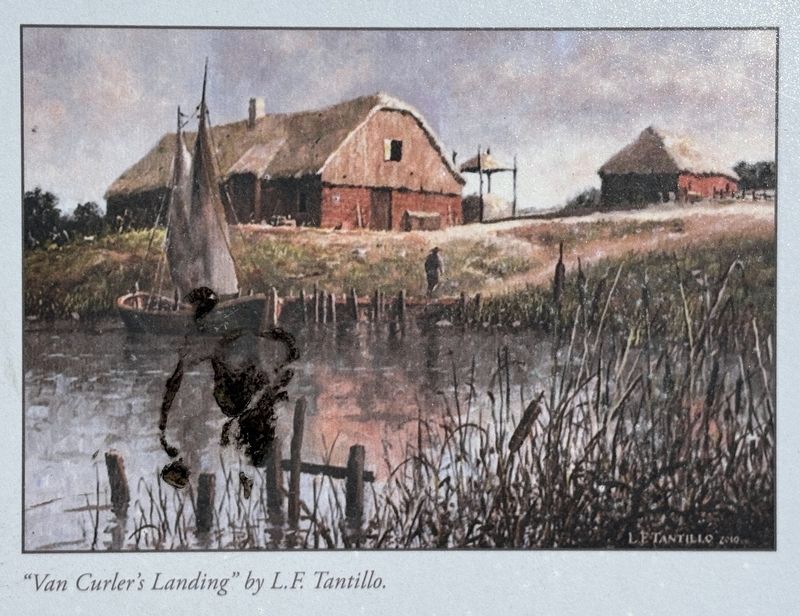
- "Van Curler's Landing" by LE Tantillo.
- Detail of 1639 map of Noort River.
Letter from Fr. Jogues to his superior, August 30, 1643:
"Well then', the governor said to me return with the savages, and toward evening, or during the night, steal away quietly, and move toward the river. There you will find a small boat, which I will keep ready to take you secretly to the ship...
Toward evening I retired with ten or twelve Iroquois into a barn, where we spent the night. Before lying down, I went out to see in what
Photographed by Steve Stoessel, March 22, 2025
2. Arent van Curler & Fr. Isaac Jogues at the Flatts in 1643 Marker
Immediately I went back into the barn; the Iroquois closed it securely.... And so I spent a second night without sleeping. When day was dawning, I heard the cocks crow. Soon afterward, a servant of the Dutch farmer who lodged us in his barn entered it by some door or other.... He went out at once, and I after him.... When I was outside the barn, without having made any noise or awakened my guards, I crossed a fence that enclosed the yard around the house, and ran straight to the river where the ship was... I found the boat as they had said, but because the water had subsided, it was aground. I pushed it to try to get it into the water, I could not do this, because it was too heavy... by turning it end over end and pushing with all my might, I finally got it into the water. Once it was afloat, I jumped into it and went all alone to the ship, where I climbed aboard without being noticed by any of the Iroquois. The Dutch immediately stowed me down in the
Photographed by Howard C. Ohlhous, August 22, 2025
3. Arent van Curler & Fr. Isaac Jogues at the Flatts in 1643 Marker
[Left Inset]
Arent van Curler 1620-1667
Arent van Curler was a nephew of the First Patroon, Killiaen Van Rensselaer. He was just 18 years old when he was sent from Holland in 1638 to act as administrator of the Manor of Rensselaearwick. He became recognized for dealing fairly with the Indians. In 1643, he built the first substantial dwelling on this site called a hallehuis. There was an architectural difference between the earlier van Curler hallehuis and the later Schuyler dwelling. A hallehuis combines living space for people and livestock beneath one roof, sometimes separated by a wall. The later 1672 Schuyler dwelling was located nearby, just slightly northwest of the van Curler structure. Archaeological evidence indicates the site was used for Indian trade and for repair of early firearms. Van Curler left the Flatts to establish the community of Schenectady by 1661. His dwelling here collapsed shortly thereafter. Van Curler drowned in Lake Champlain while on a mission to Canada in 1667. There are no known images of him.
[Illustration] The signature of Arent van Curler and the letter to the Patroon, June 16, 1643.
[Right Inset]
Isaac Jogues 1607-1646 Isaac

Photographed by Steve Stoessel, March 22, 2025
4. Arent van Curler & Fr. Isaac Jogues at the Flatts in 1643 Marker
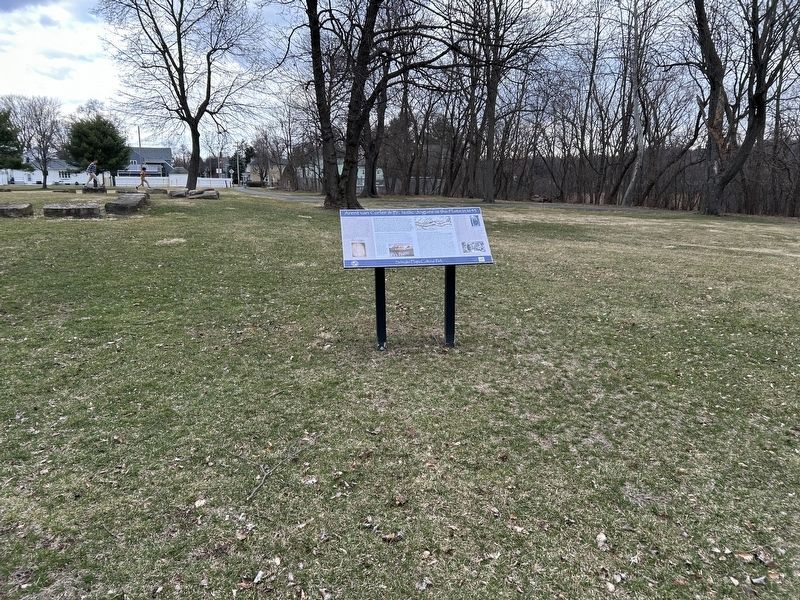
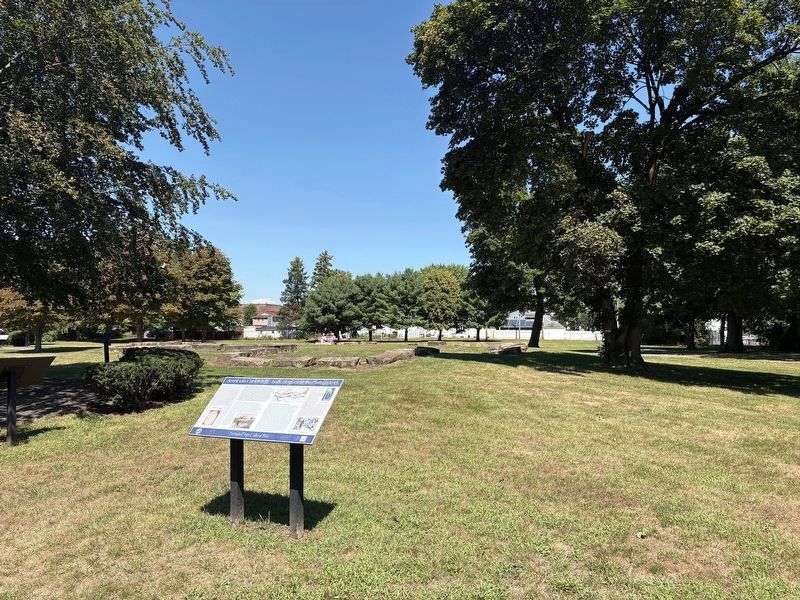
The marker on the right is the Arent van Curler marker.
[Photo and Illustraion Captions]
= Isaac Jogues Memorial, Battlefield Park, Village of Lake George, NY
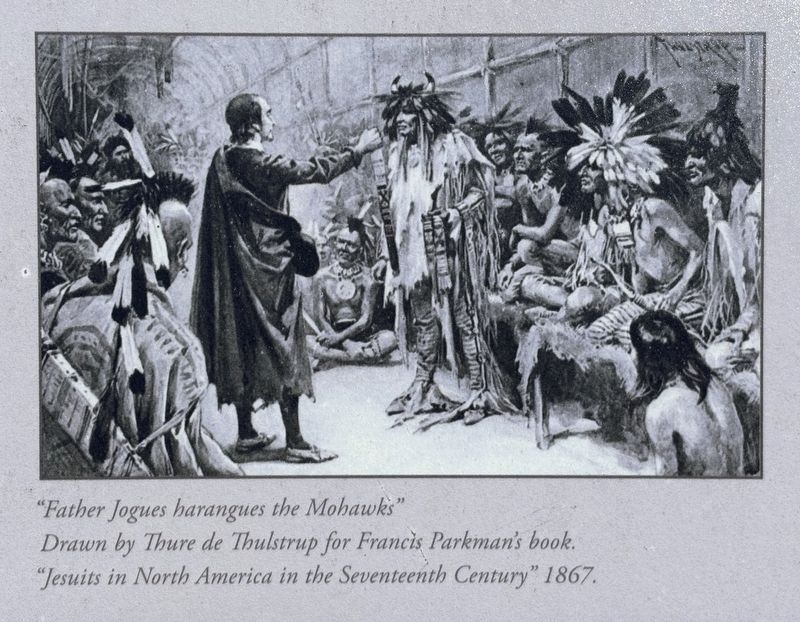
- "Father Jogues harangues the Mohawks" Drawn by Thure de Thulstrup for Francis Parkman's book "Jesuits in North America in the Seventeenth Century" 1867.
Erected by Town
Photographed by Howard C. Ohlhous, August 22, 2025
5. Arent van Curler & Fr. Isaac Jogues at the Flatts in 1643 Marker Detail
Topics. This historical marker is listed in these topic lists: Colonial Era • Indigenous Peoples and Communities • Settlements & Settlers. A significant historical date for this entry is August 3, 1642.
Location. 42° 42.356′ N, 73° 42.517′ W. Marker is in Menands, New York, in Albany County. It can be reached from Schuyler Lane, on the right when traveling north. Marker is on the footpath in the park, approximately 0,1 mi from the parking lot. Touch for map. Marker is at or near this postal address: Schuyler Flatts Cultural Park, Watervliet NY 12189, United States of America. Touch for directions.

Regionally, this marker is in Upstate New York, in the Capital District, and in the Albany Metropolitan Area. It is also in the American Northeast and in the Mid-Atlantic. Globally, it is in North America, the Western Hemisphere, the Western World, and the Anglosphere. Historically, it finds itself in what was once New Netherland and also one of the original Thirteen Colonies.
Other nearby markers. At least 8 other markers are within walking distance of this marker: The Colonial & Revolutionary Wars
Photographed by Howard C. Ohlhous, August 22, 2025
6. Arent van Curler & Fr. Isaac Jogues at the Flatts in 1643 Marker Detail
Also see . . .
1. Arent van Curler (Wikipedia). (Submitted on March 25, 2025, by Steve Stoessel of Niskayuna, New York.)
2. Issac Jogues (Wikipedia). (Submitted on March 25, 2025, by Steve Stoessel of Niskayuna, New York.)
3. Mohawk People (Wikipedia). (Submitted on March 25, 2025, by Steve Stoessel of Niskayuna, New York.)
4. Wyandot (Huron) people (Wikipedia). (Submitted on March 25, 2025, by Steve Stoessel of Niskayuna, New York.)
Credits. This page was last revised on August 30, 2025. It was originally submitted on March 25, 2025, by Steve Stoessel of Niskayuna, New York. This page has been viewed 336 times since then and 44 times this year. Photos: 1, 2. submitted on March 25, 2025, by Steve Stoessel of Niskayuna, New York. 3. submitted on August 23, 2025, by Howard C. Ohlhous of Duanesburg, New York. 4. submitted on March 25, 2025, by Steve Stoessel of Niskayuna, New York. 5, 6. submitted on August 23, 2025, by Howard C. Ohlhous of Duanesburg, New York.
