Menands in Albany County, New York — The American Northeast (Mid-Atlantic)
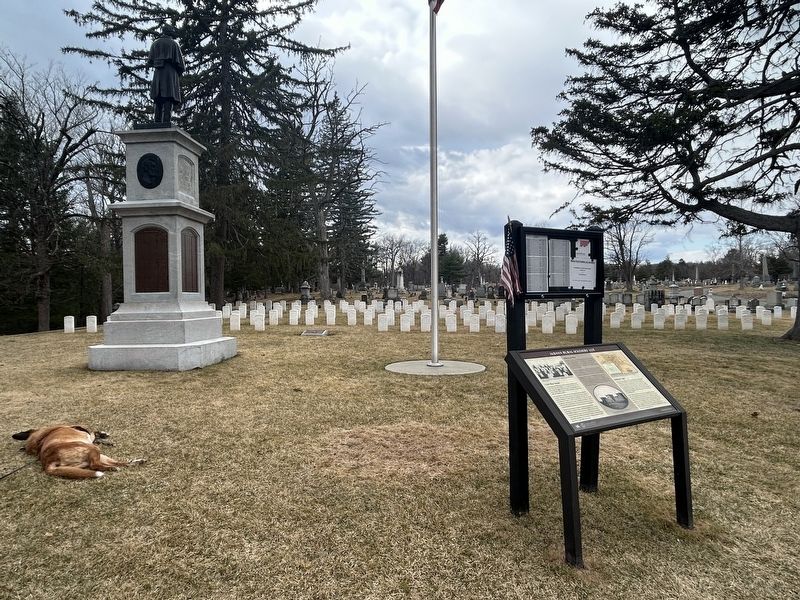
Albany Rural Cemetery Soldiers’ Lot

Photographed by Steve Stoessel, March 22, 2025
1. Albany Rural Cemetery Soldiers’ Lot Marker
[ Left Column ]
Civil War Dead
An estimated 700,000 Union and Confederate soldiers died in the Civil War (1861-1865). As the death toll rose, the U.S. government struggled with the urgent but unplanned need to bury fallen Union troops. This propelled the creation of a national cemetery system.
On September 11, 1861, the War Department directed officers to keep "accurate and permanent records of deceased soldiers." Federal authority to create military burial grounds came in an Omnibus Act of July 17, 1862. Cemetery sites were chosen where troops were concentrated: camps, hospitals, battlefields, railroad hubs. By 1872, 74 national cemeteries and several soldiers' lots contained 305,492 remains. About 45 percent were unknown.
The U.S. government established soldiers' lots at private cemeteries in northern states. National cemeteries, in contrast, were built throughout the South where most Civil War action occurred. While the army reported dozens of lots containing Union dead in the 1870s, the National Cemetery Administration maintains only fifteen. The number of graves ranges from less than ten to nearly 400 in these
this page online
[ Photo Caption]
Mourners at Alexandria National Cemetery, Virginia, c. 1865. After 1873, standard marble headstones replaced the wood headboards seen here. Miller, Photographic History of the Civil War (1910).
[ Center Column ]
Albany at War]
On April 12, 1861, Confederate forces fired on Fort Sumter, South Carolina. The next day, the New York State Assembly appropriated $3 million to raise and provision 30,000 troops to help suppress the southern rebellion. Albany County raised ten Union infantry regiments and one artillery battery to fight the Civil War.
The area transportation network made the city a strategic military crossroads. Thousands of soldiers traveled by rail or river from Albany to New York City. There, they boarded southbound steamships that took them to the battlefront.
In spring 1861, Gen. John F. Rathbone, commander of the New York Militia, converted the Albany Industrial School into a hospital and erected three new buildings on, the campus. Originally known as "The Barracks," it later became a U.S. General Hospital named in honor of New York Senator Ira Harris.
[ Photo Caption] Undated photograph of Ira Harris U.S. General Hospital. U.S. National Library of Medicine.
[
Photographed by Steve Stoessel, March 22, 2025
2. Albany Rural Cemetery Soldiers’ Lot Marker
Soldiers' Lot
Albany Rural Cemetery was an early pastoral burial ground established in 1844. In June 1862, the Albany Cemetery Association donated a small parcel in Lot 7, Section 75, to the U.S. government for the burial of Union dead. By 1868, it contained the remains of 126 soldiers and two sailors. Most had died in city hospitals, others were removed from southern battlefields or hospitals. Today 149 men lie in this lot, the last one buried in 1897.
In the 1870s, a Civil War monument was gradually erected here. On Decoration (Memorial) Day 1872, the Grand Army-of the Republic Lew Benedict Post No. 5 dedicated a granite pedestal and bust of President Abraham Lincoln. Four bronze plaques, cast from melted cannon, name the "648 brave souls from the county of Albany who gave their lives that the country might live." By 1875, the monument featured a bas-relief medallion of Lincoln, and a bronze figure of a Union soldier had replaced the bust.
[ Map Caption]
Albany Rural Cemetery plan showing soldiers' lot, Phelps, The Albany Rural Cemetery (1893). Inset: Plan of the soldiers' lot, 1866. National Archives and Records Administration.
Erected by U.S.

Photographed by Steve Stoessel, March 22, 2025
3. Albany Rural Cemetery Soldiers’ Lot Marker
Topics. This memorial is listed in these topic lists: Cemeteries & Burial Sites • War, US Civil.
Location. 42° 42.567′ N, 73° 43.675′ W. Memorial is in Menands, New York, in Albany County. It is at the intersection of North Ridge Road and Section 75, on the left when traveling north on North Ridge Road. Touch for map. Memorial is at or near this postal address: N Ridge Rd, Albany NY 12211, United States of America. Touch for directions.

Regionally, this memorial is in Upstate New York, in the Capital District, and in the Albany Metropolitan Area. It is also in the American Northeast and in the Mid-Atlantic. Globally, it is in North America, the Western Hemisphere, the Western World, and the Anglosphere. Historically, it finds itself in what was once New Netherland and also one of the original Thirteen Colonies.
Other nearby markers. At least 8 other markers are within walking distance of this marker: Grand Army of the Republic Memorial 1861-1865 (a few steps from this marker); Col. John Mills (within shouting distance of this marker);

Photographed by Steve Stoessel, March 22, 2025
4. Albany Rural Cemetery Soldiers’ Lot Marker
Credits. This page was last revised on March 25, 2025. It was originally submitted on March 25, 2025, by Steve Stoessel of Niskayuna, New York. This page has been viewed 166 times since then and 20 times this year. Photos: 1, 2, 3, 4. submitted on March 25, 2025, by Steve Stoessel of Niskayuna, New York.
