
Griffin in Spalding County, Georgia — The American South (South Atlantic)
James Stoddard Boynton
Citizen, Soldier and Statesman
| — | May7, 1833 to December 22, 1902 | — |

Photographed by Darren Jefferson Clay, March 16, 2025
1. James Stoddard Boynton Marker
Upon passing the Bar in October 1852, Boynton practiced in both Monticello and Jackson, Georgia. In 1860, he was elected Ordinary of Butts County, Georgia.
On September 25, 1861, as hostilities increased between the United States and Confederate States, Boynton enlisted as a Private into what would become known as Co. A, 30th Regiment Georgia Volunteer Infantry. On May 15, 1862, he was elected Major and by December 16, 1862 was elected again Lt. Col. After the retirement of Colonel Thomas W. Mangham, Boynton was promoted to Colonel on May 14, 1864. On July 22, 1864, while leading his men at the Battle of Atlanta, Col. Boynton was severely wounded. He was taken to Utoy Primitive Baptist Church, which was used as a Confederate Hospital.
After discharge, Col. Boynton rejoined his unit and surrendered on April 26, 1865 in Greensboro, North Carolina.
After the war he rejoined his family in Griffin and again practiced law. In
this page online
As a freshman, he was unanimously elected. President of the Senate and held that position until March 4, 1883. Governor Alexander Hamilton Stephens died in office on that date, thus thrusting Boynton into the Governor's seat. He would serve as Governor until May 10, 1883.
On January 1, 1886, he was appointed Superior Court Judge of the Flint Circuit until resigning on April 8, 1893.
In 1896, he was elected to serve Spalding County in the Georgia House of Representatives and he did so for two years. He died at his home in Griffin on December 22, 1902 and is buried in Oak Hill Cemetery.
A.P. Adamson wrote of Boynton in A Brief History of the Thirteen Georgia Regiment. "Very few public men in Georgia had greater personal popularity than Col. Boynton. There was a certain magnetism about him that drew men toward him. Of fine personal appearance, attractive and courtly manners, and genial companionship, with an intellect naturally strong, u lawyer learned in his profession, quick, logical and forcible in debate, he was a man to command attention before any audience Behind all was his pure, sincere and earnest character that gave weight to every utterance he made. The simplicity and generosity of his character, the nobility of his nature and his many amiable qualities combined to make a personality so winning that few men held more warm friends. He was a man close to the people, and no wonder their hearts went out to him as the blossom to the sun, for the sunlight of his nature shone upon all of them. As the commander of his regiment, he was honored and revered, and his surviving comrades feel a just pride in his patriotic record as a soldier, his eminent ability as a lawyer and jurist, his wisdom as a legislator and chief magistrate of our state, and his high Christian character and many noble qualities."
The
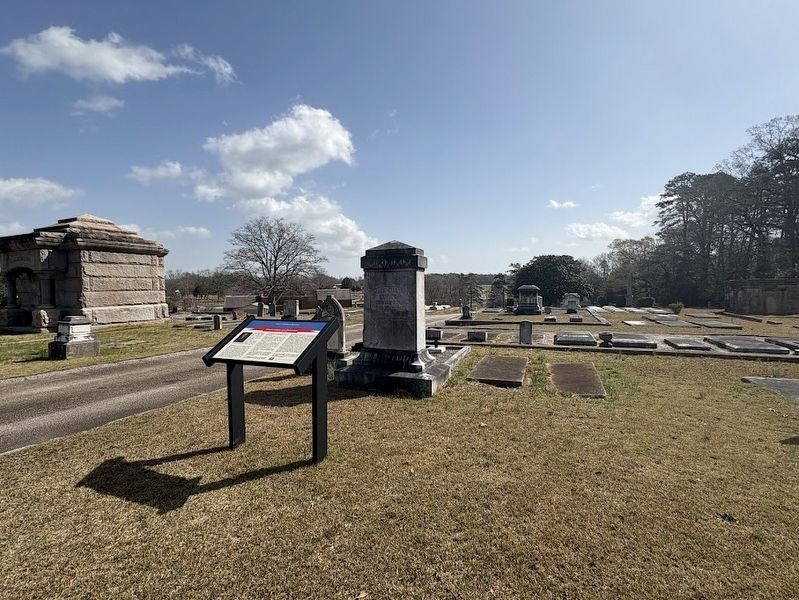
Photographed by Darren Jefferson Clay, March 16, 2025
2. James Stoddard Boynton Marker
Erected by Georgia Civil War Commission.
Topics. This historical marker is listed in these topic lists: Cemeteries & Burial Sites • War, US Civil.
Location. 33° 14.643′ N, 84° 15.31′ W. Marker is in Griffin, Georgia, in Spalding County. It can be reached from East Poplar Street west of 2nd Street, on the right when traveling east. Located in Oak Hill Cemetery. Touch for map. Marker is in this post office area: Griffin GA 30224, United States of America. Touch for directions.

Regionally, this marker is in Georgia’s Piedmont and in Metro Atlanta. It is also in the American South and specifically in the Deep South. Globally, it is in North America, the Western Hemisphere, the Western World, and the Anglosphere. Historically, it finds itself in what was once the territory of the Mississippian Culture, one of the original Thirteen Colonies, one of the Confederate States of America,
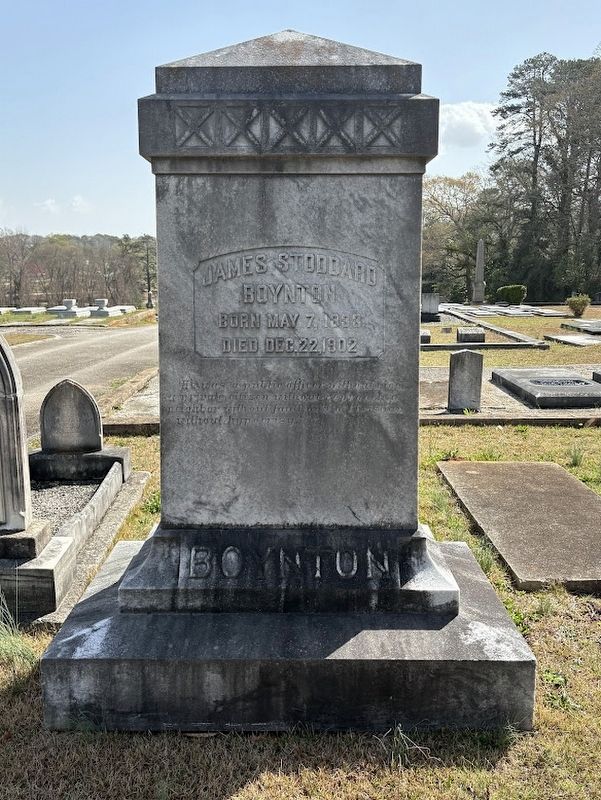
Photographed by Darren Jefferson Clay, March 16, 2025
3. James Stoddard Boynton's headstone
Other nearby markers. At least 8 other markers are within walking distance of this marker: John McIntosh Kell (about 400 feet away, measured in a direct line); “Doc” Holliday Final Resting Place? (about 500 feet away); SSgt. Woodrow Wilson Smith (about 700 feet away); Capt. Robert Langdon Ferguson (about 700 feet away); Seaman George Holman Conkle (about 700 feet away); Tech 5 John Emmett Wallace, III (about 700 feet away); Lt. Charles Davis "Snag" Smith (about 700 feet away); Pvt. James Reynolds (about 700 feet away). Touch for a list and map of all markers in Griffin.
Credits. This page was last revised on March 26, 2025. It was originally submitted on March 25, 2025, by Darren Jefferson Clay of Duluth, Georgia. This page has been viewed 122 times since then and 21 times this year. Photos: 1, 2, 3. submitted on March 25, 2025, by Darren Jefferson Clay of Duluth, Georgia. • Bernard Fisher was the editor who published this page.
