Near Oakley in Gove County, Kansas — The American Midwest (Upper Plains)
Monument Rocks Chalk Pyramids
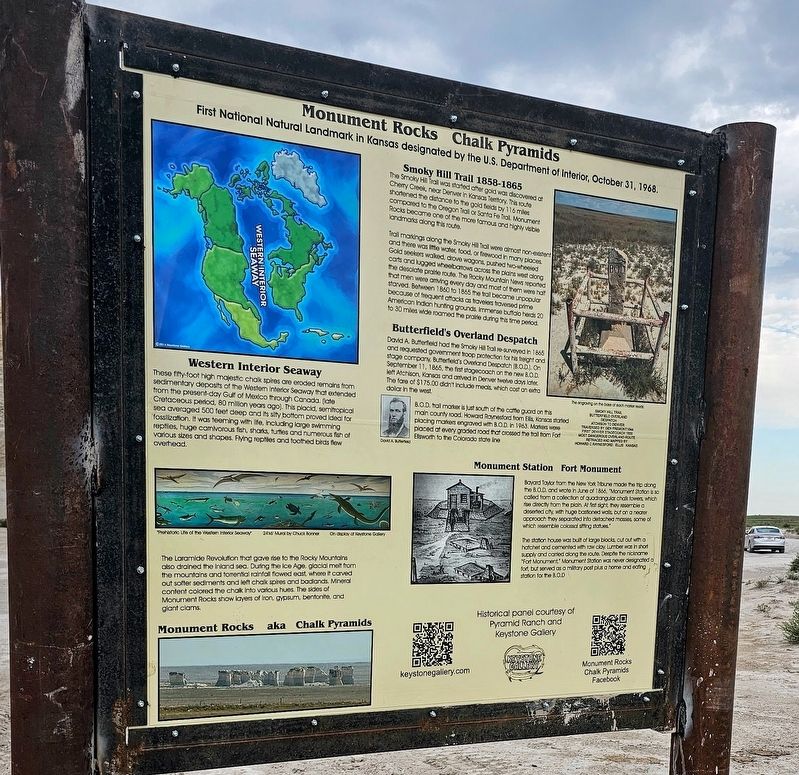
Photographed by Ian Lefkowitz, June 29, 2023
1. Monument Rocks Chalk Pyramids Marker
Western Interior Seaway
These fifty-foot high majestic chalk spines are eroded remains from sedimentary deposits of the Western Interior Seaway that extended from the present-day Gulf of Mexico through Canada (late Cretaceous period, 80 million years ago). This placid, semitropical sea averaged 500 feet deep and its silty bottom proved ideal for fossilization. It was teeming with life, including large swimming reptiles, huge carnivorous fish, sharks, turtles and numerous fish of various sizes and shapes. Flying reptiles and toothed beds flew overhead.
The Laramide Revolution that gave rise to the Rocky Mountains also drained the inland sea. During the Ice Age, glacial melt from the mountains and torrential rainfall flowed east, where it carved out softer sediments and left chalk spires and badlands. Mineral content colored the chalk into various hues. The sides of Monument Rocks show layers of iron, gypsum, bentonite, and giant clams.
Smoky Hill Trail 1858-1865
The Smoky Hill Trail was established after
this page online
Trail markings along the Smoky Hill Trail were almost nonexistent, and there was little water, food, or firewood in many places. Gold seekers walked, drove wagons, pushed two-wheeled carts, and lugged wheelbarrows across the plains west along the desolate prairie route. The Rocky Mountain News reported that men were arriving every day, and most were half starved. Between 1860 and 1865, the trail became unpopular because of frequent attacks as travelers traversed prime American Indian hunting grounds. Immense buffalo herds 20 to 30 miles wide roamed the prairie during this time period.
Butterfield’s Overland Despatch
David A. Butterfield had the Smoky Hill Trail re-surveyed in 1865 and requested government troop protection for his freight and stage company, Butterfield’s Overland Despatch (B.O.D.). On September 11, 1865, the first stagecoach on the new B.O.D.

Photographed by Ian Lefkowitz, June 29, 2023
2. Monument Rocks
A view of Kansas's monumental natural landmark.
B.O.D. trail marker is just south of the cattle guard on this main county road. Howard Raynesford from Ellis, Kansas, began placing markers engraved with "B.O.D." in 1963. Markers were placed at every graded road that crossed the trail from Fort Ellsworth to the Colorado state line
Monument Station Fort Monument
Bayard Taylor from the New York Tribune made the trip along the B.O.D. and wrote in June of 1866 “Monument Station is so called from a collection of quadrangular chalk towers, which rise directly from the plain. At first sight, they resemble a deserted city, with huge bastioned walls, but upon a nearer approach they separated into detached masses, some of which resemble colossal sitting statues.”
The station house was built of large blocks, cut out with a hatchet and cemented with raw clay. Lumber was in short supply and carried along the route. Despite the nickname “Fort Monument,” Monument Station was never designated a fort, but served as a military post, home and
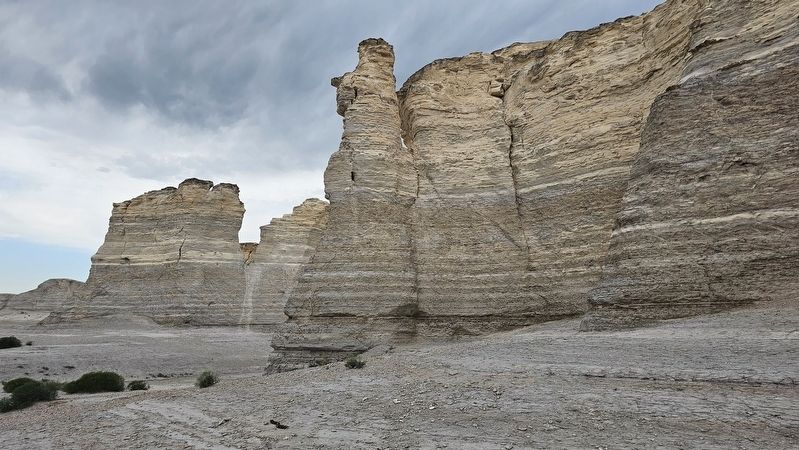
Photographed by Ian Lefkowitz, June 29, 2023
3. Monument Rocks
Monument Rocks is the first National Natural Landmark in Kansas.
Historical panel courtesy of Pyramid Ranch and Keystone Gallery
Topics and series. This historical marker is listed in these topic lists: Landmarks • Natural Features • Roads & Vehicles. In addition, it is included in the National Natural Landmarks series list. A significant historical date for this entry is September 11, 1865.
Location. 38° 47.715′ N, 100° 45.844′ W. Marker is near Oakley, Kansas, in Gove County. It is on Gove County Road 16. Touch for map. Marker is at or near this postal address: 756 Gove County Rd 16, Oakley KS 67748, United States of America. Touch for directions.

Regionally, this marker is in the American Midwest, in the Corn Belt, on the prairies, on the Great Plains, on the Southern Plains, and specifically on the High Plains. Globally, it is in North America, the Western Hemisphere, the Western World, and the Anglosphere. Historically, it finds itself in what was once the Louisiana Purchase.
Other nearby markers. At least 8 other markers are within 14 miles of this marker, measured as the crow flies: Smoky Hill Trail (approx. 0.4 miles away); El Cuartelejo Archeology (approx. 11½ miles away); El Cuartelejo (approx. 11½ miles away); Plains Apache at El Cuartelejo (approx. 11½ miles away); Pueblo Floor Plan (approx. 11½ miles away); El Quartelejo (approx. 11.6 miles away); Steele Memorial (approx. 11.8 miles away); a different marker also named El Quartelejo (approx. 13.7 miles away).
Credits. This page was last revised on April 3, 2025. It was originally submitted on March 27, 2025, by Ian Lefkowitz of New York, New York. This page has been viewed 202 times since then and 70 times this year. Photos: 1, 2, 3. submitted on March 27, 2025, by Ian Lefkowitz of New York, New York. • Andrew Ruppenstein was the editor who published this page.
