Little Havana in Miami in Miami-Dade County, Florida — The American South (South Atlantic)
Impact of the Bay of Pigs Invasion in Miami
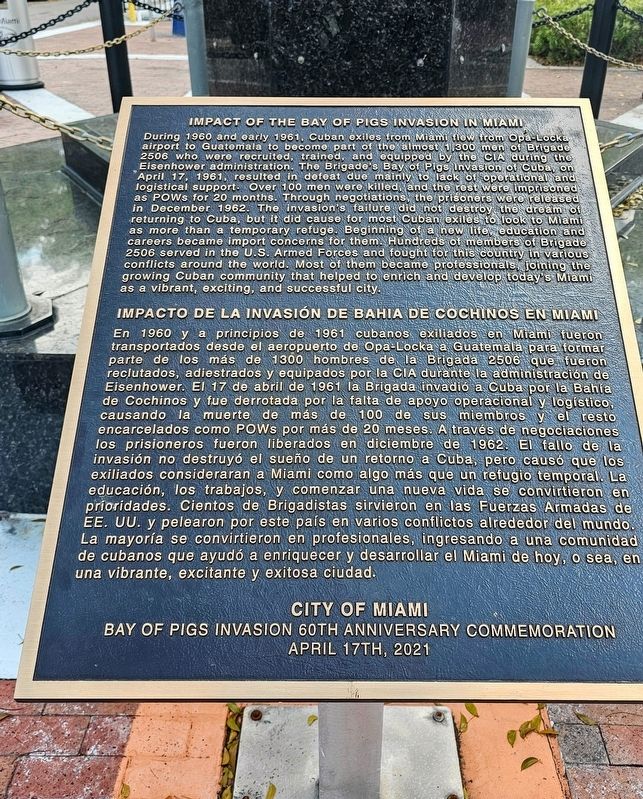
Photographed by Ian Lefkowitz, March 21, 2024
1. Impact of the Bay of Pigs Invasion in Miami Marker

During 1960 and early 1961, Cuban exiles from Miami flew from Opa-Locka airport to Guatemala to become part of the almost 1,300 men of Brigade 2506 who were recruited, trained, and equipped by the CIA during the Eisenhower administration. The Brigade’s Bay of Pigs Invasion of Cuba on April 17, 1961, resulted in defeat due mainly to lack of operational and logistical support. Over 100 men were killed, and the rest were imprisoned as POWs for 20 months. Through negotiations, the prisoners were released in December 1962. The invasion’s failure did not destroy the dream of returning to Cuba, but it did cause for most Cuban exiles to look to Miami as more than a temporary refuge. Beginning anew with little, education and careers became important concerns for them. Hundreds of Brigade 2506 served in the U.S. Armed Forces and fought for this country in various conflicts around the world. Most of them became professionals, joining the growing Cuban community that helped to enrich and develop today’s Miami as a vibrant, exciting, and successful city.
En 1960 y a
this page online
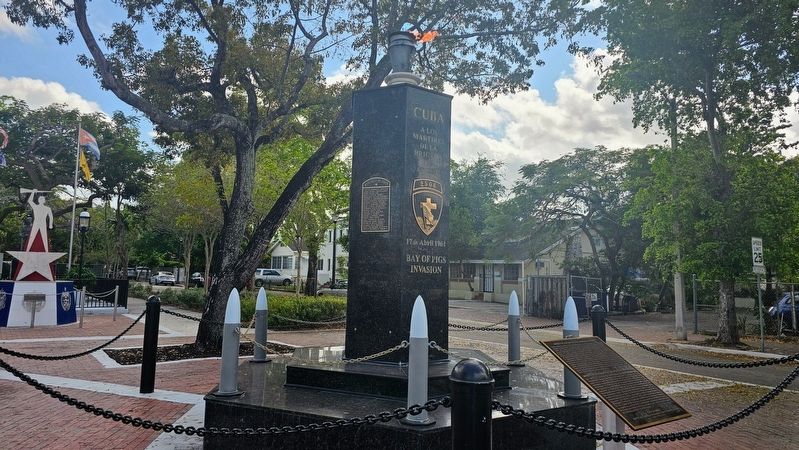
Photographed by Ian Lefkowitz, March 21, 2024
2. Bay of Pigs Invasion Monument
Erected 2021 by City of Miami for the Bay of Pigs Invasion 60th Anniversary Commemoration.
Topics. This historical marker is listed in these topic lists: Immigration • War, Cold. A significant historical date for this entry is April 17, 1961.
Location. 25° 45.942′ N, 80° 12.991′ W. Marker is in Miami, Florida, in Miami-Dade County. It is in Little Havana. It is at the intersection of Southwest 13th Avenue and Tamiami Trail, in the median on Southwest 13th Avenue. Touch for map. Marker is at or near this postal address: 806 SW 13th Ave, Miami FL 33135, United States of America. Touch for directions.

Regionally, this marker is in South Florida and on the Gold Coast. It is also in the American South and on the Eastern Seaboard. Globally, it is in the North Atlantic Region, North America, a Gulf of Mexico state, the Western Hemisphere, the Western World, and the Anglosphere. Historically, it finds itself in what was once New Spain, the territory of the Mississippian Culture, one of the Confederate States of America, and the Antebellum South.
Other nearby markers. At least 8 other markers are within walking distance of this marker: Bay of Pigs Monument (a few steps from this marker); A la lucha guerrillera anticomunista / To the Anti-Communist Guerrilla (a few steps from this marker); Nestor Izquierdo Plaza (within shouting distance of this marker); Cruceiro Xacobeo Monument (within shouting distance of this marker); José Martí Plaza (about 400 feet away, measured in a direct line); Calle de las Presas Politicas Cubana (about 500 feet away); Operation Pedro Pan (about 500 feet away); Lt. General Antonio Maceo Grajales Plaza (about 600 feet away). Touch for a list and map of all markers in Miami.
Other markers no longer nearby. Nestor A. Izquierdo (was within shouting distance of this marker but has been permanently removed); Memorial to the Fallen of Cuban Liberation (was within shouting distance of this marker but has been permanently removed); José Martí (was about 500 feet away but has been permanently removed); General Antonio Maceo (was about 600 feet away but has been replaced with another marker now near it).
Credits. This page was last revised on March 17, 2026. It was originally submitted on March 28, 2025, by Ian Lefkowitz of New York, New York. This page has been viewed 210 times since then and 36 times this year. Photos: 1, 2. submitted on March 28, 2025, by Ian Lefkowitz of New York, New York. • Bernard Fisher was the editor who published this page.
