Buckhannon in Upshur County, West Virginia — The American South (Appalachia)
Ulmus americana (American elm)
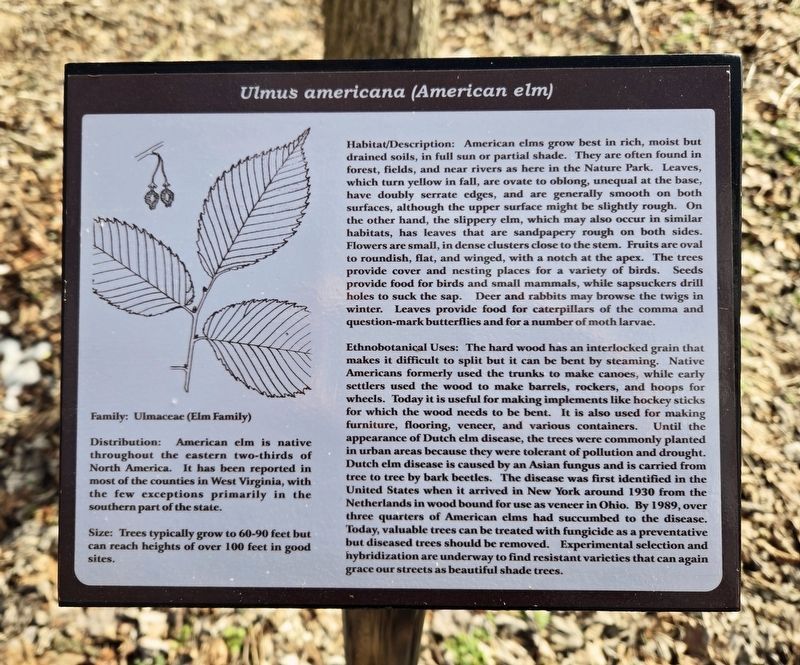
Photographed by Bradley Owen, February 24, 2025
1. Ulmus americana (American elm) Marker
Family: Ulmaceae (Elm Family)
Distribution: American elm is native throughout the eastern two-thirds of North America. It has been reported in most of the counties in West Virginia, with the few exceptions primarily in the southern part of the state.
Size: Trees typically grow to 60-90 feet but can reach heights of over 100 feet in good sites.
Habitat/Description: American elms grow best in rich, moist but drained soils, in full sun or partial shade. They are often found in forest, fields, and near rivers as here in the Nature Park. Leaves, which turn yellow in fall, are ovate to oblong, unequal at the base, have doubly serrate edges, and are generally smooth on both surfaces, although the upper surface might be slightly rough. On the other hand, the slippery elm, which may also occur in similar habitats, has leaves that are sandpapery rough on both sides. Flowers are small, in dense clusters close to the stem. Fruits are oval to roundish, flat, and winged, with a notch at the apex. The trees provide cover and nesting places for a variety of birds. Seeds provide food for birds and small mammals, while sapsuckers
this page online
Ethnobotanical Uses: The hard wood has an interlocked grain that makes it difficult to split but it can be bent by steaming. Native Americans formerly used the trunks to make canoes, while early settlers used the wood to make barrels, rockers, and hoops for wheels. Today it is useful for making implements like hockey sticks for which the wood needs to be bent. It is also used for making furniture, flooring, veneer, and various containers. Until the appearance of Dutch elm disease, the trees were commonly planted in urban areas because they were tolerant of pollution and drought. Dutch elm disease is caused by an Asian fungus and is carried from tree to tree by bark beetles. The disease was first identified in the United States when it arrived in New York around 1930 from the Netherlands in wood bound for use as veneer in Ohio. By 1989, over three quarters of American elms had succumbed to the disease. Today, valuable trees can be treated with

Photographed by Bradley Owen, March 10, 2025
2. Ulmus americana (American elm) Marker
Erected 2017 by West Virginia Wesleyan College Department of Biology.
Topics. This historical marker is listed in these topic lists: Environment • Horticulture & Forestry • Industry & Commerce • Science & Medicine. A significant historical year for this entry is 1930.
Location. 38° 59.588′ N, 80° 13.016′ W. Marker is in Buckhannon, West Virginia, in Upshur County. It can be reached from Camden Avenue north of Walktrail Lane, on the left when traveling north. Marker is located on the Buckhannon Nature Park and Learning Trail west of the Camden Avenue parking area. Touch for map. Marker is at or near this postal address: 8 Camden Avenue, Buckhannon WV 26201, United States of America. Touch for directions.

Regionally, this marker is in North Central West Virginia. It is also in the American South, specifically in the Upper South, in Appalachia, and specifically in Northern Appalachia. Globally, it is in North America, the Western Hemisphere, the Western World, and the Anglosphere. Historically, it finds itself in what was once the territory of the Mississippian Culture.
Other nearby markers. At least 8 other markers are within walking distance of this marker: Euonymus fortunei (winter creeper or Fortune's spindle) (a few steps from this marker); Hydrangea arborescens (wild hydrangea) (a few steps from this marker); Baptisia australis (blue false indigo) (a few steps from this marker); Prunus serotina (black cherry) (a few steps from this marker); Fraxinus americana (white ash) (a few steps from this marker); Ligustrum vulgare (Chinese or common privet) (within shouting distance of this marker); Lindera benzoin (spicebush) (within shouting distance of this marker); Acer saccharinum (silver maple) (within shouting distance of this marker). Touch for a list and map of all markers in Buckhannon.
Credits. This page was last revised on March 28, 2025. It was originally submitted on March 28, 2025, by Bradley Owen of Morgantown, West Virginia. This page has been viewed 107 times since then and 24 times this year. Photos: 1, 2. submitted on March 28, 2025, by Bradley Owen of Morgantown, West Virginia.
