Fort Worth in Tarrant County, Texas — The American South (West South Central)
Quanah Parker
Photographed by Alan Stricklin
1. Quanah Parker Marker
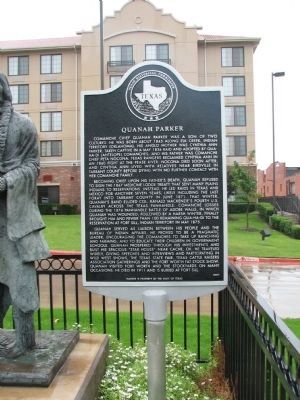
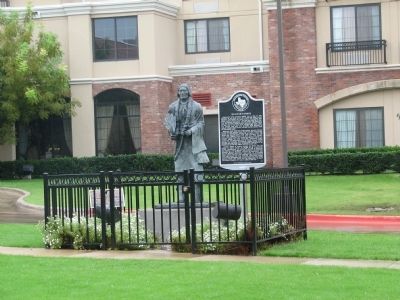
Comanche chief Quanah Parker was a son of two cultures. He was born about 1845 along Elk Creek, Indian Territory (Oklahoma). His Anglo mother was Cynthia Ann Parker, taken captive in a May 1836 raid and adopted by Qua-Ha-Di (Antelope) Comanches, and his father was Comanche chief Peta Nocona. Texas Rangers reclaimed Cynthia Ann in an 1860 fight at the Pease River. Nocona died soon after, and Cynthia Ann lived with relatives near Birdville in Tarrant County before dying with no further contact with her Comanche family.
Becoming chief upon his father’s death, Quanah refused to sign the 1867 Medicine Lodge Treaty that sent many Plains Indians to reservations. Instead, he led raids in Texas and Mexico for another seven years, likely including the last foray into Tarrant County in June 1871. That winter, Quanah’s band eluded Col. Ranald MacKenzie’s Fourth U.S. Cavalry across the Texas panhandle. Comanche losses during the 1874 Panhandle Battle of Adobe Walls, in which Quanah was wounded, followed by a harsh winter, finally brought him and fewer than 100 remaining Qua-Ha-Di to the reservation at Fort Sill, Indian Territory
this page online
Quanah served as liaison between his people and the Bureau of Indian Affairs. He proved to be a pragmatic leader, encouraging the Comanches to take up ranching and farming, and to educate their children in government schools. Quanah prospered through his investments and built his spacious “Star House” near Cache, OK. He traveled widely, giving speeches and interviews and participating in wild west shows, the Texas State Fair, Texas Cattle Raisers Association gathering and the Fort Worth Fat Stock Show. Quanah visited Fort Worth and the Stockyards on many occasions. He died in 1911 and is buried at Fort Sill.
Erected 2007 by Texas Historical Commission. (Marker Number 14005.)
Topics. This historical marker is listed in these topic lists: Indigenous Peoples and Communities • Wars, US Indian. A significant historical month for this entry is May 1836.
Location. 32° 47.301′ N, 97° 20.795′ W. Marker is in Fort Worth, Texas, in Tarrant County. It can be reached from East Exchange. Touch for map. Marker is at or near this postal address: 131 E Exchange, Fort Worth TX 76104, United States of America. Touch for directions.

Regionally,
Photographed by Alan Stricklin, October 13, 2009
2. Quanah Parker Marker
Other nearby markers. At least 8 other markers are within walking distance of this marker: Fort Worth Livestock Exchange (about 300 feet away); The Fort Worth Stock Yards Company (about 300 feet away); Fort Worth Stockyards Horse and Mule Barns (about 300 feet away); The Coliseum (about 500 feet away); The First Bulldogger (about 500 feet away); Woody-Kutch Livestock Commission Company (about 600 feet away); Thomas B. Saunders Family (about 600 feet away); Fort Worth Stock Yards Entrance (about 600 feet away). Touch for a list and map of all markers in Fort Worth.
Other markers no longer nearby. The Trailblazer (was about 300 feet away, measured in a direct line but has been confirmed missing); America's First Horse (was about 300 feet away but has been confirmed missing); Early Quarter Horse Shows
Photographed by Alan Stricklin
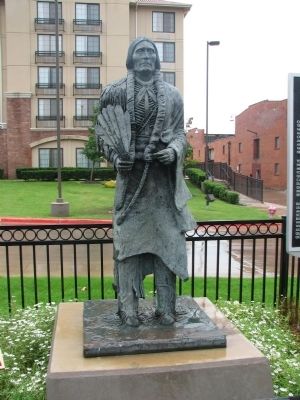
3. Quanah Parker Statue
Additional keywords. Multiracial Americans
Photographed by Denise Boose, May 22, 2010
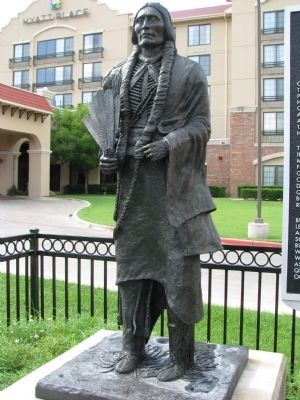
4. Quanah Parker Statue
Photographed by Denise Boose, May 22, 2010
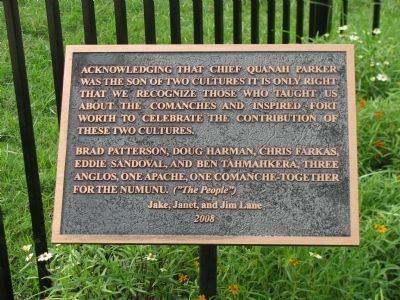
5. Quanah Parker Dedication Marker
Acknowledging that Chief Quanah Parker was the son of two cultures it is only right that we recognize those who taught us about the Comanches and inspired Fort Worth to celebrate the contribution of these two cultures.
Brad Patterson, Doug Harman, Chris Farkas, Eddie Sandoval, and Ben Tahmahkera, Three Anglos, one Apache, one Comanche-together for the Numunu. ("The People")
Jake, Janet, and Jim Lane
2008
Brad Patterson, Doug Harman, Chris Farkas, Eddie Sandoval, and Ben Tahmahkera, Three Anglos, one Apache, one Comanche-together for the Numunu. ("The People")
2008
Photographed by Jeff Leichsenring, November 9, 2025
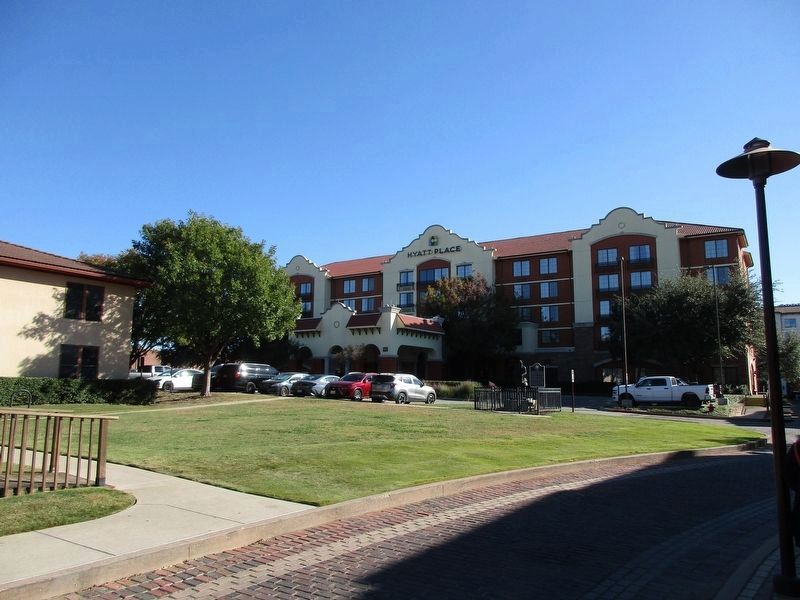
6. Quanah Parker Marker
Credits. This page was last revised on February 15, 2026. It was originally submitted on January 17, 2010, by Alan Stricklin of Fort Worth, Texas. This page has been viewed 4,541 times since then and 186 times this year. Last updated on January 26, 2010, by Alan Stricklin of Fort Worth, Texas. Photos: 1, 2, 3. submitted on January 17, 2010, by Alan Stricklin of Fort Worth, Texas. 4, 5. submitted on January 18, 2012, by Denise Boose of Tehachapi, California. 6. submitted on November 9, 2025, by Jeff Leichsenring of Garland, Texas. • Kevin W. was the editor who published this page.
