Sugar Creek Township near Marshall in Parke County, Indiana — The American Midwest (Great Lakes)
Life After Mining
Photographed by Daniel Barriball, March 25, 2025
1. Life After Mining Marker
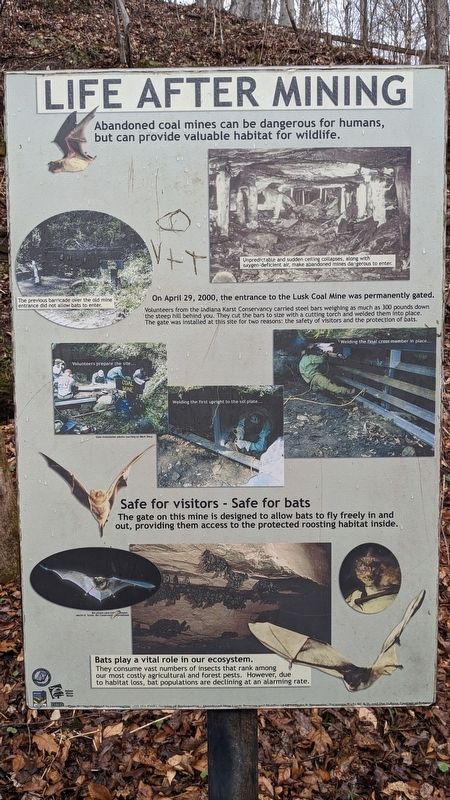
Abandoned coal mines can be dangerous for humans, but can provide valuable habitat for wildlife.
Unpredictable and sudden ceiling collapses, along with oxygen-deficient air, make abandoned mines dangerous to enter.
The previous barricade over the old mine entrance did not allow bats to enter.
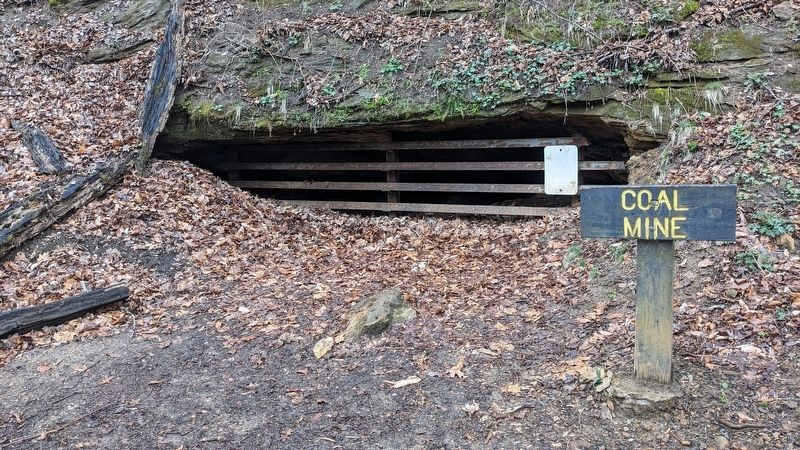
On April 29, 2000, the entrance to the Lusk Coal Mine was permanently gated.
Volunteers from the Indiana Karst Conservancy carried steel bars weighing as much as 300 pounds down the steep hill behind you. They cut the bars to size with a cutting torch and welded them into place. The gate was installed at this site for two reasons: the safety of visitors and the protection of bats.
Volunteers prepare the site…
Welding the first upright to the sill plate…
Welding the final cross member in place…
Gate installation photos courtesy of Mark Stacy
Safe for visitors-Safe for bats
The gate on this mine is designed to allow bats to fly freely in and out, providing them access to the protected roosting habitat inside.
Bats play a vital role in our ecosystem.
They consume vast numbers of insects that rank among our most costly agricultural and forest pests. However, due to habitat loss, bat populations are declining at an alarming rate.
Bat photos used with permission, Merlin D. Tuttle, Bat Conservation International
This display designed in cooperation with the IDNR's Division of Reclamation-Abandoned Mine Lands Program and Division of State Parks & Reservoirs, Sycamore Trails RC & D, and the Indiana Geological Survey
Topics. This historical marker is listed in these topic lists: Animals • Charity & Public Work • Environment • Parks & Recreational Areas. A significant historical date for this entry is April 29, 2000.
Location. 39° 53.385′ N, 87° 11.795′ W. Marker is near Marshall, Indiana, in Parke
this page online

Regionally, this marker is in Central Indiana and in the Wabash Valley. It is also in the American Midwest and in the Corn Belt. Globally, it is in North America, the Western Hemisphere, the Western World, and the Anglosphere. Historically, it finds itself in what was once the territory of the Mississippian Culture and also the Northwest Territory.
Other nearby markers. At least 8 other markers are within walking distance of this marker: Working In A Drift Mine (here, next to this marker); Arthur C. Newby (approx. 0.2 miles away); The Lusk Home (approx. 0.6 miles away); The Lusk Family (approx. 0.6 miles away); Welcome to the Turkey Run Inn (approx. 0.6 miles away); Turkey Run (approx. 0.6 miles away); Turkey Run: Cradle of State Parks (approx. 0.6 miles away); Juliet Strauss Memorial (approx. 0.6 miles away). Touch for a list and map of all markers in Marshall.
Related markers.

Photographed by Daniel Barriball, March 25, 2025
2. Life After Mining Marker in context
Photographed by Daniel Barriball, March 25, 2025
3. Coal Mine

Photographed by Daniel Barriball, March 25, 2025
4. Adjacent Coal Formation in Indiana signage
From the hot, humid swamps teeming with exotic vegetation comes the rock that burns: COAL.
In this warm and swampy environment, plants grew abundantly. Dead plant debris accumulated faster than it could decompose and, as thousands of years passed, a carbon-rich material-peat-was formed. Over millions of years, thick layers of sediments were deposited on top of the peat, squeezing water from the underlying layers and creating the pressure and temperature necessary to turn peat to coal. It took about 30 feet of peat to make the 3-foot seam of coal that ran through the hillside in front of you.
The fossils shown below are remains of ancient plants. These and other fossils helped the artist visualize this interpretation of what the Turkey Run State Park area might have looked like during the Pennsylvanian Period, more than 300 million years ago.
In this warm and swampy environment, plants grew abundantly. Dead plant debris accumulated faster than it could decompose and, as thousands of years passed, a carbon-rich material-peat-was formed. Over millions of years, thick layers of sediments were deposited on top of the peat, squeezing water from the underlying layers and creating the pressure and temperature necessary to turn peat to coal. It took about 30 feet of peat to make the 3-foot seam of coal that ran through the hillside in front of you.
The fossils shown below are remains of ancient plants. These and other fossils helped the artist visualize this interpretation of what the Turkey Run State Park area might have looked like during the Pennsylvanian Period, more than 300 million years ago.
Credits. This page was last revised on April 17, 2025. It was originally submitted on March 30, 2025, by Daniel Barriball of Chesterton, Indiana. This page has been viewed 186 times since then and 20 times this year. Photos: 1, 2, 3, 4. submitted on March 30, 2025, by Daniel Barriball of Chesterton, Indiana. • Devry Becker Jones was the editor who published this page.
