Rittenhouse Square in Philadelphia in Philadelphia County, Pennsylvania — The American Northeast (Mid-Atlantic)
Philadelphia Horticulture and the College
Photographed by Devry Becker Jones (CC0), March 29, 2025
1. Philadelphia Horticulture and the College Marker
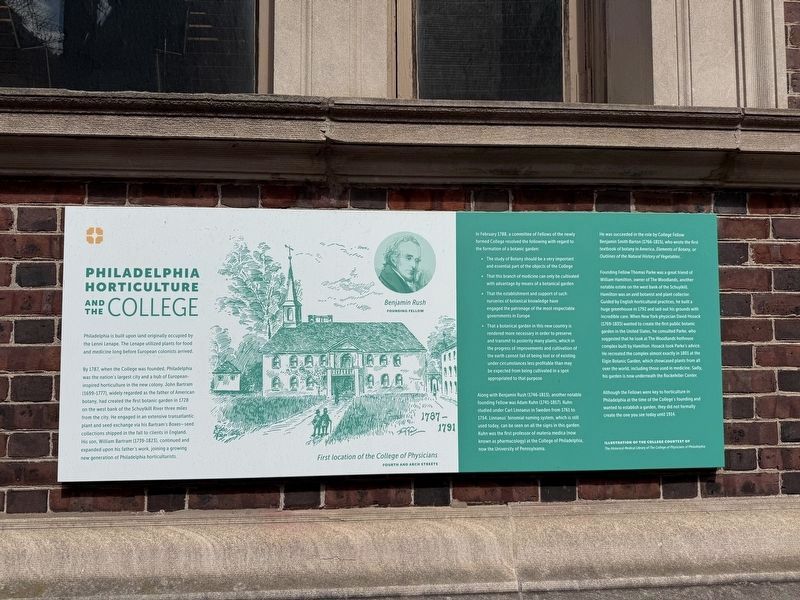
Philadelphia is built upon land originally occupied by the Lenni Lenape. The Lenape utilized plants for food and medicine long before European colonists arrived.
By 1787, when the College was founded, Philadelphia was the nation's largest city and a hub of European-inspired horticulture in the new colony. John Bartram (1699-1777), widely regarded as the father of American botany, had created the first botanic garden in 1728 on the west bank of the Schuylkill River three miles from the city. He engaged in an extensive Transatlantic plant and seed exchange via his Bartram's Boxes—seed collections shipped in the fall to clients in England. His son, William Bartram (1739-1823), continued and expanded upon his father's work, joining a growing new generation of Philadelphia horticulturists.
• The study of Botany should be a very important and essential part of the objects of the College
• That this branch of medicine can only be cultivated with advantage by means of a botanicalgarden
Click or scan to see
this page online
• That the establishment and support of such nurseries of botanical knowledge have engaged the patronage of the most respectable governments in Europe
• That a botanical garden in this new country is rendered more necessary in order to preserve and transmit to posterity many plants, which in the progress of improvements and cultivation of the earth cannot fail of being lost or of existing under circumstances less profitable than may be expected from being cultivated in a spot appropriated to that purpose
Along with Benjamin Rush (1746-1813), another notable founding Fellow was Adam Kuhn (1741-1817). Kuhn studied under Carl Linnaeus in Sweden from 1761 to 1764. Linnaeus' binomial naming system, which is still used today, can be seen on all the signs in this garden. Kuhn was the first professor of materia medica (now known as pharmacology) at the College of Philadelphia, now the University of Pennsylvania.
He was succeeded in the role by College Fellow Benjamin Smith Barton (1766-1815), who wrote the first textbook of botany in America, Elements of Botany, or Outlines of the Natural History of Vegetables.
Founding
Photographed by Devry Becker Jones (CC0), March 29, 2025
2. Philadelphia Horticulture and the College Marker
Although the Fellows were key to horticulture in Philadelphia at the time of the College's founding and wanted to establish a garden, they did not formally create the one you see today until 1914.
Erected by Mütter Museum.
Topics. This historical marker is listed in these topic lists: Colonial Era • Education • Horticulture & Forestry • Science & Medicine. A significant historical month for this entry is February 1788.
Location. 39° 57.188′ N, 75° 10.595′ W. Marker is in Philadelphia, Pennsylvania, in Philadelphia County. It is in Rittenhouse Square. It can be reached from South 22nd Street north of Chestnut Street, on the right when traveling north. Touch for map. Marker is at or near this postal address: 19 S 22nd St, Philadelphia PA 19103, United States of America. Touch for directions.

Regionally, this marker is in Southeast Pennsylvania. It is also in the American Northeast and in the Mid-Atlantic. Globally, it is in North America, the Western Hemisphere, the Western World, and the Anglosphere. Historically, it finds itself in what was once the Haudenosaunee (Iroquois) Confederacy, New Netherland, and one of the original Thirteen Colonies.
Other nearby markers. At least 8 other markers are within walking distance of this marker: Plant As Medicine (here, next to this marker); Benjamin Rush Medicinal Plant Garden (a few steps from this marker); a different marker also named Benjamin Rush Medicinal Plant Garden (a few steps from this marker); Okra (a few steps from this marker); a different marker also named Benjamin Rush Medicinal Plant Garden (a few steps from this marker); Ginger (a few steps from this marker); a different marker also named Benjamin Rush Medicinal Plant Garden (a few steps from this marker); Medical Aloe (a few steps from this marker). Touch for a list and map of all markers in Philadelphia.
Other markers no longer nearby. Ginger (was a few steps from this marker but has been replaced with another marker now near it); a different marker also named Benjamin Rush Medicinal Plant Garden (was a few steps from this marker but has been replaced with another marker now near it).
Credits. This page was last revised on March 30, 2025. It was originally submitted on March 30, 2025, by Devry Becker Jones of Washington, District of Columbia. This page has been viewed 120 times since then and 20 times this year. Photos: 1, 2. submitted on March 30, 2025, by Devry Becker Jones of Washington, District of Columbia.
