Old Port of Montreal in Montréal, Québec — Central Canada (French-Canadian)
Russel Quay
⎯⎯⎯
quai Russel
Photographed by Cosmos Mariner, May 21, 2024
1. Russel Quay/quai Russel Marker

—Rachel Billette, who, in 1963 at the age of 20, left for a two-month trip to Europe with three of her friends from Saint-Louis-de-Gonzague.
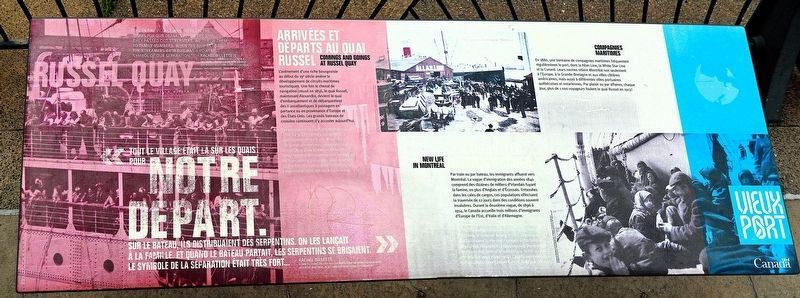
Comings and goings at Russel Quay
The emergence of a wealthy bourgeoisie in the early 19th century led to the development of sea tours. When the navigation channel was completed in 1856, Russel Quay (now known as Alexandra Quay) became the boarding and landing pier for transatlantic passenger ships traveling to and from Europe and the United States. Large cruise ships still dock there today.
New Life in Montréal
Immigrants streamed into Montréal by train and boat. During the immigration wave of the 1840s, tens of thousands of Irishmen fleeing famine, Englishmen and Scots came to the city. Cramped in the holds of cargo ships, they spent 12 days crossing the ocean in conditions that were often unsanitary. In the second immigration wave (1896 to 1914),
this page online
Shipping Companies
In 1880, some 30 shipping companies transited through the port on a regular basis, including the Allan, White Star and Cunard lines. Their ships linked Montréal to Europe, Great Britain and cities along the American coastline as well as port cities in Québec and Ontario. In 1913, over 1,000 people descended upon Russel Quay every day for business or pleasure!
—Rachel Billette, à l'âge de 20 ans, in 1963, elle est partie pour un voyage de deux mois en Europe avec trois de ses amis de Saint-Louis-de-Gonzague.
Arrivées et départs au Quai Russel
L'avènement d'une riche bourgeoisie au début du 19e siècle amène le développement de circuits maritimes touristiques. Une fois le chenal de navigation creusé en 1856, le quai Russel, maintenant Alexandra, devient le quai d'embarquement et de débarquement
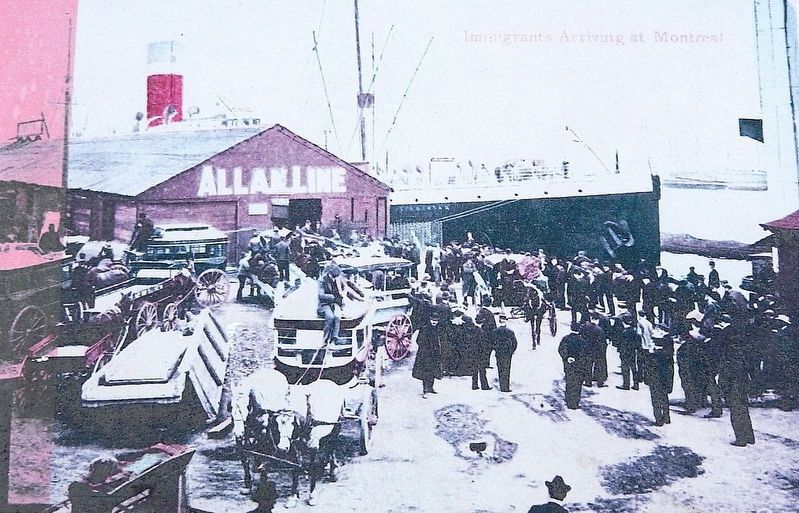
© Bibliothèque et Archives nationales du Québec, CP 3001
2. Marker detail: Immigrants Arriving at Montréal
Postcard Montréal, Allan Line Wharf
Carte postale Montréal, le quai de la compagnie Allan Line
Carte postale Montréal, le quai de la compagnie Allan Line
Une nouvelle terre d’accueil
Par train ou par bateau, les immigrants affluent vers Montréal. La vague d'immigration des années 1840 comprend des dizaines de milliers d'Irlandais fuyant la famine, en plus d'Anglais et d'Écossais. Entassées dans tes cales de cargos, ces populations effectuent la traversée de 12 jours dans des conditions souvent insalubres. Durant la deuxième vague, de 1896 à 1914, le Canada accueille trois millions d'immigrants d'Europe de l'Est, d'Italie et d'Allemagne.
Compagnies Maritimes
En 1880, une trentaine de compagnies maritimes fréquentent régulièrement le port, dont la Allan Line, la White Star Line et la Cunard. Leurs navires relient Montréal non seulement à l'Europe, à la Grande-Bretagne et aux villes côtières américaines, mais aussi à différentes villes portuaires québécoises et ontariennes. Par plaisir ou par affaires, chaque jour, plus de 1 000 voyageurs foulent le quai Russel en 1913 !
Topics. This historical marker is listed in these topic
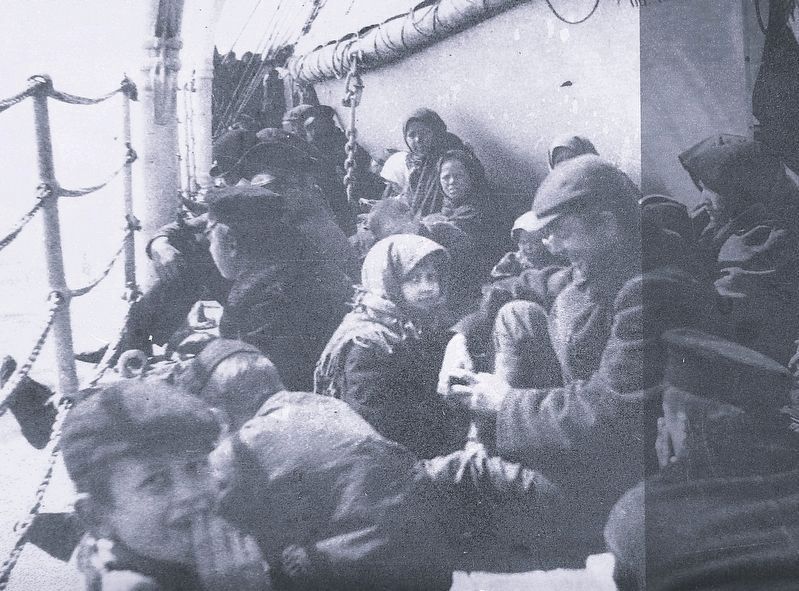
Courtesy Musée McCord Museum, MP-1981.160.258
3. Marker detail: Group of refugees or immigrants on a ship
Groupe de réfugiés ou d'immigrants sur un bateau
Martin Wolff 1907-14©
Martin Wolff 1907-14©
Location. 45° 30.112′ N, 73° 33.167′ W. Marker is in Montréal, Québec. It is in Old Port of Montreal. It can be reached from Rue Quai Alexandra just east of Rue de la Commune Ouest, on the right when traveling east. The marker is located on the Promenade du Vieux-Port, on the south side of the Grand Quay of the Port of Montréal. Touch for map. Marker is at or near this postal address: 200 Rue de la Commune Ouest, Montréal QC H2Y 4B2, Canada. Touch for directions.

Regionally, this marker is in Central Canada. Globally, it is in North America, the Western Hemisphere, and the Western World. Historically, it finds itself in what was once a British colony, the Viceroyalty of New France, the Haudenosaunee (Iroquois) Confederacy, and Rupert’s Land.
Other nearby markers. At least 8 other markers are within walking distance of this marker: Lieu Phare de l'histoire du Canada / A Landmark in Canada's History (within shouting distance of this marker); Lieu de passage et d'échange / A Place Transit & Trade (within
Photographed by Cosmos Mariner, May 21, 2024
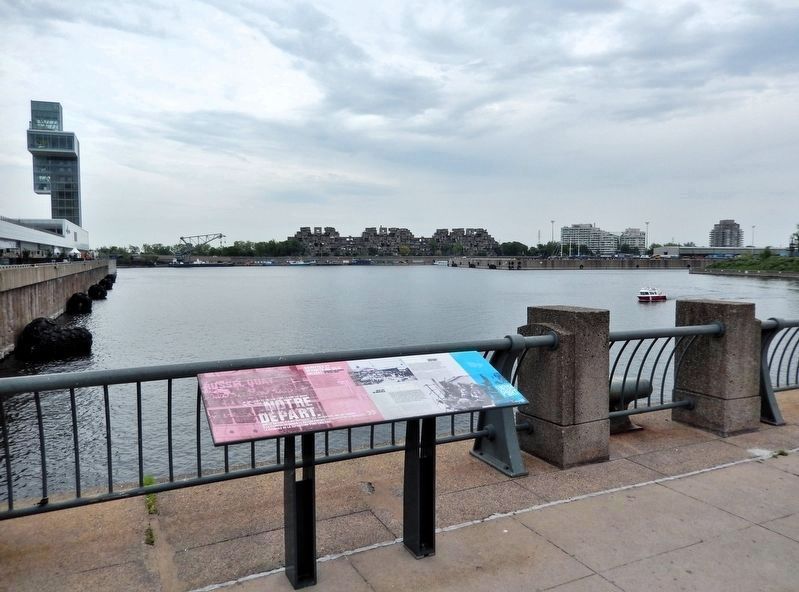
4. Russel Quay/quai Russel Marker
Looking east from the Promenade du Vieux-Port. The Grand Quay of the Port of Montreal is on the left.
Also see . . . The Port of Montreal Timeline & History.
Excerpt: The Port of Montreal is a privileged witness to the creation of Montreal, its economic development and the arrival of immigrants to the city. Here are the milestones of its rich history. During the 1830s, Hugh Allan, a Scottish-born businessman, bought several ships and founded the Allan Line, which 20 years later would ensure regular shipping between Montreal and British ports.(Submitted on March 31, 2025, by Cosmos Mariner of Cape Canaveral, Florida.)
1856: First regular marine shipping service between Montreal and Liverpool, England.
Credits. This page was last revised on April 5, 2025. It was originally submitted on March 30, 2025, by Cosmos Mariner of Cape Canaveral, Florida. This page has been viewed 123 times since then and 24 times this year. Photos: 1, 2, 3, 4. submitted on March 31, 2025, by Cosmos Mariner of Cape Canaveral, Florida.
