Loudonville in Albany County, New York — The American Northeast (Mid-Atlantic)
The Crossings Through the Ages
Photographed by Steve Stoessel, March 22, 2025
1. The Crossings Trhough the Ages Marker
Inscription.
The Crossings Through the Ages. .
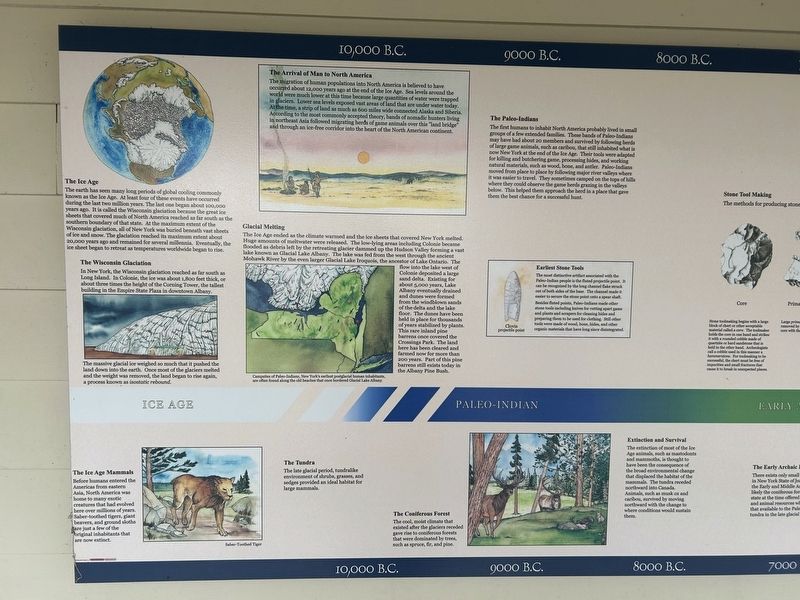
The Ice Age . The earth has seen many long periods of global cooling commonly known as the Ice Age. At least four of these events have occurred during the last two million years. The last one began about 100,000 years ago. It is called the Wisconsin glaciation because the great ice sheets that covered much of North America reached as far south as the southern boundary of that state. At the maximum extent of the Wisconsin glaciation, all of New York was buried beneath vast sheets of ice and snow. The glaciation reached its maximum extent about 20,000 years ago and remained for several millennia. Eventually, the ice sheet began to retreat as temperatures worldwide began to rise., The Wisconsin Glaciation In New York, the Wisconsin glaciation reached as far south as Long Island. In Colonie, the ice was about 1,800 feet thick, or about three times the height of the Corning Tower, the tallest building in the Empire State Plaza in downtown Albany. The massive glacial ice weighed so much that it pushed the land down into the earth. Once most of the glaciers melted and the weight was removed, the land began to rise again, a process known as isostatic rebound., The Ice Age Mammals Before humans entered the Americas from eastern Asia, North America was home to many exotic creatures that had evolved here over millions of years. Saber-toothed tigers, giant beavers, and ground sloths are just a few of the ricinal inhabitants that are now extinct.
10000 B.C.. The Arrival of Man to North America The migration of human populations into North America is believed to have occurred about 12,000 years ago at the end of the Ice Age. Sea levels around the world were much lower at this time because large quantities of water were trapped in glaciers. Lower sea levels exposed vast areas of land that are under water today. At the time, a strip of land as much as 600 miles wide connected Alaska and Siberia. According to the most commonly accepted theory, bands of nomadic hunters living in northeast Asia followed migrating herds of game animals over this "land bridge" and through an ice-free corridor into the heart of the North American continent., Glacial Melting The Ice Age ended as the climate warmed and the ice sheets that covered New York melted. Huge amounts of meltwater were released. The low-lying areas including Colonie became flooded as debris left by the retreating glacier dammed up the Hudson Valley forming a vast lake known as Glacial Lake Albany. The lake was fed from the west through the ancient Mohawk River by the even larger Glacial Lake Iroquois, the ancestor of Lake Ontario. The flow into the lake west of Colonie deposited a large sand delta. Existing for about 5,000 years, Lake Albany eventually drained and dunes were formed from the windblown sands of the delta and the lake floor. The dunes have been held in place for thousands of years stabilized by plants. This rare inland pine barrens once covered the Crossings Park. The land here has been cleared and farmed now for more than 200 years. Part of this pine barrens still exists today in the Albany Pine Bush., The Tundra The late glacial period, tundralike environment of shrubs, grasses, and sedges provided an ideal habitat for large mammals., The Coniferous Forest The cool, moist climate that existed after the glaciers receded gave rise to coniferous forests that were dominated by trees, such as spruce, fir, and pine., Extinction and Survival The extinction of most of the Ice Age animals, such as mastodonts and mammoths, is thought to have been the consequence of the broad environmental change that displaced the habitat of the mammals. The tundra receded northward into Canada. Animals, such as musk ox and caribou, survived by moving northward with the change to where conditions would sustain them.,
9,000 B.C. - Paleo-Indian . The Paleo-Indians The first humans to inhabit North America probably lived in small groups of a few extended families. These bands of Paleo-Indians may have had about 20 members and survived by following herds of large game animals, such as caribou, that still inhabited what is now New York at the end of the Ice Age. Their tools were adapted for killing and butchering game, processing hides, and working natural materials, such as wood, bone, and antler. Paleo-Indians moved from place to place by following major river valleys where it was easier to travel. They sometimes camped on the tops of hills where they could observe the game herds grazing in the valleys below. This helped them approach the herd in a place that gave them the best chance for a successful hunt. Clovis Projectile Point Earliest Stone Tools The most distinctive artifact associated with the Paleo-Indian people is the fluted projectile point. It can be recognized by the long channel flake struck out of both sides of the base. The channel made it easier to secure the stone point onto a spear shaft. Besides fluted points, Paleo-Indians made other stone tools including knives for cutting apart game and plants and scrapers for cleaning hides and preparing them to be used for clothing. Still other tools were made of wood, bone, hides, and oter organic materials that have long since disintegrated., Extinction and Survival The extinction of most of the Ice Age animals, such as mastodonts and mammoths, is thought to have been the consequence of the broad environmental change that displaced the habitat of the mammals. The tundra receded northward into Canada. Animals, such as musk ox and caribou, survived by moving northward with the change to where conditions would sustain them.
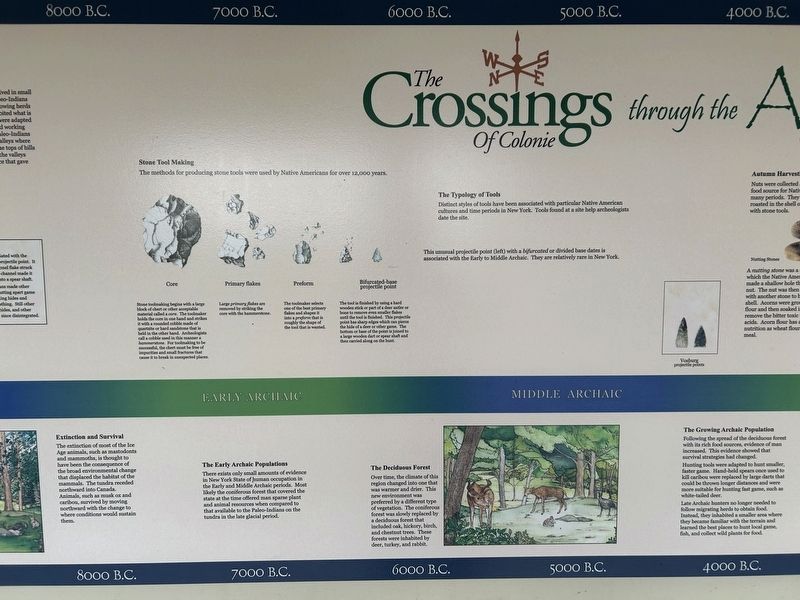
7,000 B.C - 4,000B.C. Early and Middle Archaic. Stone Tool Making The methods for producing stone tools were used by Native Americans for over 12,000 years., Core: Stone toolmaking begins with a large block of chert or other acceptable material called a core. The toolmaker holds the core in one hand and strikes it with a rounded cobble made of quartzite or hard sandstone that is held in the other hand. Archeologists call a cobble used in this manner a hammerstone. For toolmaking to be successful, the chert must be free of impurities and small fractures that cause it to break in unexpected places. Primary Flakes: Large primary flakes are removed by striking the core with the hammerstone. Preform: The toolmaker selects one of the best primary flakes and shapes it into a preform that is roughly the shape of the tool that is wanted. Bifurcated-base projectile point: The tool is finished by using a hard wooden stick or part of a deer antler or bone to remove even smaller flakes until the tool is finished. This projectile point has sharp edges which can pierce the hide of a deer or other game. The bottom or base of the point is joined to a large wooden dart or spear shaft and then carried along on the hunt., The Typology of Tools Distinct styles of tools have been associated with particular Native American cultures and time periods in New York. Tools found at a site help archeologists date the site. This unusual projectile point (left) with a bifurcated or divided base dates is associated with the Early to Middle Archaic. They are relatively rare in New York., The Early Archaic Populations There exists only small amounts of evidence in New York State of human occupation in the Early and Middle Archaic periods. Most likely the coniferous forest that covered the state at the time offered man sparse plant and animal resources when compared to that available to the Paleo-Indians on the tundra in the late glacial period., The Deciduous Forest Over time, the climate of this region changed into one that was warmer and drier. This new environment was preferred by a different type of vegetation. The coniferous forest was slowly replaced by a deciduous forest that included oak, hickory, birch, and chestnut trees. These forests were inhabited by deer, turkey, and rabbit., The Growing Archaic Population Following the spread of the deciduous forest with its rich food sources, evidence of man increased. This evidence showed that survival strategies had changed. Hunting tools were adapted to hunt smaller, faster game. Hand-held spears once used to kill caribou were replaced by large darts that could be thrown longer distances and were more suitable for hunting fast game, such as white-tailed deer. Late Archaic hunters no longer needed to follow migrating herds to obtain food. Instead, they inhabited a smaller area where they became familiar with the terrain and learned the best places to hunt local game, fish, and collect wild plants for food.,
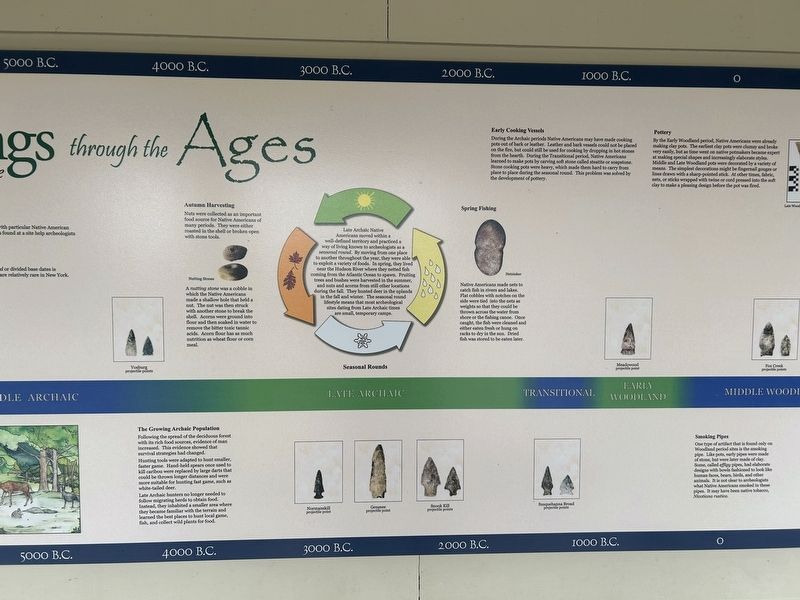
3,000 B.C. Late Archaic. Late Archaic Native Americans moved within a well-defined territory and practiced a way of living known to archeologists as a seasonal round. by moving from one place to another throughout the year, they were able to exploit a variety of foods. In spring, they lived near the Hudson River where they netted fish coming from the Atlantic Ocean to spawn. Fruiting trees and bushes were harvested in the summer. and nuts and acorns from still other locations during the fall. They hunted deer in the uplands in fall and winter. The seasonal round. lifestyle means that most archeological sites dating from Lale Archaic times are small, temporary camps. Spring Fishing Native Americans made nets to catch fish in rivers and lakes. Flat cobbles with notches on the side were tied into the nets as weights so that they could be thrown across the water from shore or the fishing canoe. Once caught, the fish were cleaned and either eaten fresh or hung on racks to dry in the sun. Dried fish was stored to be eaten later., Netsinker Nutting Stones, Autumn Harvesting Nuts were collected as an important food source for Native Americans of many periods. They were either roasted in the shell or broken open with stone tools. A nutting stone was a cobble in which the Native Americans made a shallow hole that held a nut. The nut was then struck with another stone to break the shell. Acorns were ground into flour and then soaked in water to remove the bitter toxic tannic acids. Acorn flour has as much nutrition as wheat flour or corn meal. ,nr>
2,000 B.C.. Early Cooking Vessels During the Archaic periods Native Americans may have made cooking pots out of bark or leather. Leather and bark vessels could not be placed on the fire, but could still be used for cooking by dropping in hot stones from the hearth. During the Transitional period, Native Americans learned to make pots by carving soft stone called steatite or soapstone. Stone cooking pots were heavy, which made them hard to carry from place to place during the seasonal round. This problem was solved by the development of pottery., [projectile Points, earliest to latest ] Normanskill projectile point Genesee projectile point Snook Kill projectile points Susquehanna Broad projectile point Meadowood projectile point,
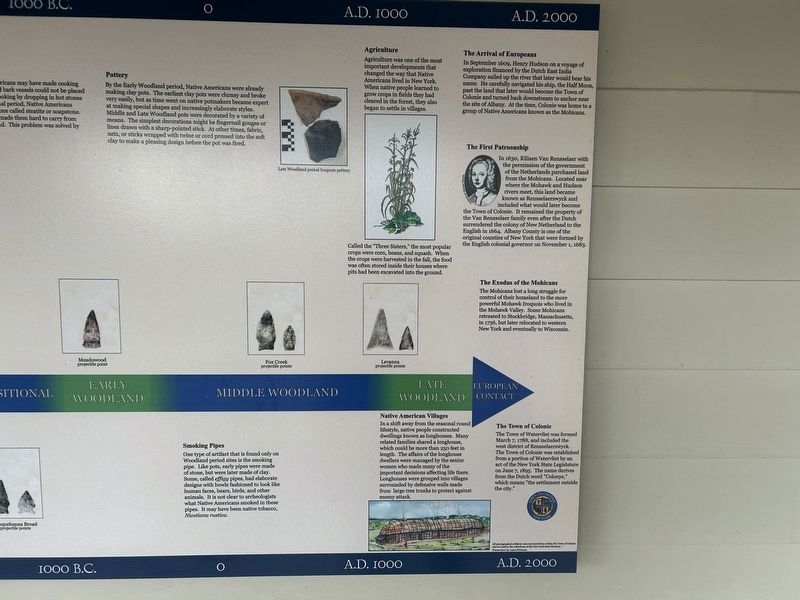
1,000 B.C. Early to Middle Woodland . Pottery By the Early Woodland period, Native Americans were already making clay pots. The earliest clay pots were clumsy and broke very easily, but as time went on native potmakers became expert at making special shapes and increasingly elaborate styles. Middle and Late Woodland pots were decorated by a variety of means. The simplest decorations might be fingernail gouges or lines drawn with a sharp-pointed stick. At other times, fabric, nets, or sticks wrapped with twine or cord pressed into the soft clay to make a pleasing design before the pot was fired., Late Woodland period Iroquois pottery Fox Creek projectile pointSmoking Pipes One type of artifact that is found only on Woodland period sites is the smoking pipe. Like pots, early pipes were made of stone, but were later made of clay. Some, called effigy pipes, had elaborate designs with bowls fashioned to look like human faces, bears, birds, and other animals. It is not clear to archeologists what Native Americans smoked in these pipes. It may have been native tobacco, Nicotiana rustica.,
A.D. 1000 Late Woodland to European Contact. Agriculture Agriculture was one of the most important developments that changed the way that Native Americans lived in New York. When native people learned to grow crops in fields they had cleared in the forest, they also began to settle in villages. Called the "Three Sisters," the most popular crops were corn, beans, and squash. When the crops were harvested in the fall, the food was often stored inside their houses where pits had been excavated into the ground., Native American Villages In a shift away from the seasonal round lifestyle, native people constructed dwellings known as longhouses. Many related families shared a longhouse, which could be more than 250 feet in length. The affairs of the longhouse dwellers were managed by the senior women who made many of the important decisions affecting life there. Longhouses were grouped into villages surrounded by defensive walls made from large tree trunks to protect against enemy attack., The Arrival of Europeans In September 1609, Henry Hudson on a voyage of exploration financed by the Dutch East India Company sailed up the river that later would bear his name. He carefully navigated his ship, the Half Moon, past the land that later would become the Town of Colonie and turned back downstream to anchor near the site of Albany. At the time, Colonie was home to a group of Native Americans known as the Mohicans., The First Patroonship In 1630, Kiliaen Van Rensselaer with the permission of the government of the Netherlands purchased land from the Mohicans. Located near where the Mohawk and Hudson rivers meet, this land became known as Rensselaerswyck and included what would later become the Town of Colonie. It remained the property of the Van Rensselaer family even after the Dutch surrendered the colony of New Netherland to the English in 1664. Albany County is one of the original counties of New York that were formed by the English colonial governor on November 1, 1683., The Exodus of the Mohicans The Mohicans lost a long struggle for control of their homeland to the more powerful Mohawk Iroquois who lived in the Mohawk Valley. Some Mohicans retreated to Stockbridge, Massachusetts, in 1736, but later relocated to western New York and eventually to Wisconsin., The Town of Colonie The Town of Waterviet was formed March 7, 1788, and included the west district of Rensselaerswyck. The Town of Colonie was established from a portion of Watervliet by an act of the New York State Legislature on June 7, 1895. The name derives from the Dutch word "Colonye," which means "the settlement outside the city."
The Ice Age
The earth has seen many long periods of global cooling commonly known as the Ice Age. At least four of these events have occurred during the last two million years. The last one began about 100,000 years ago. It is called the Wisconsin glaciation because the great ice sheets that covered much of North America reached as far south as the southern boundary of that state. At the maximum extent of the Wisconsin glaciation, all of New York was buried beneath vast sheets of ice and snow. The glaciation reached its maximum extent about 20,000 years ago and remained for several millennia. Eventually, the ice sheet began to retreat as temperatures worldwide began to rise.
The Wisconsin Glaciation
In New York, the Wisconsin glaciation reached as far south as Long Island. In Colonie, the ice was about 1,800 feet thick, or about three times the height of the Corning Tower, the tallest building in the Empire State Plaza in downtown Albany.
The massive glacial ice weighed so much that it pushed the land down into the earth. Once most of the glaciers melted and the weight was removed, the land began to rise again, a
Click or scan to see this page online
process known as isostatic rebound.
The Ice Age Mammals
Before humans entered the Americas from eastern
Asia, North America was home to many exotic creatures that had evolved here over millions of years.
Saber-toothed tigers, giant beavers, and ground sloths are just a few of the ricinal inhabitants that are now extinct.
10000 B.C.
The Arrival of Man to North America
The migration of human populations into North America is believed to have occurred about 12,000 years ago at the end of the Ice Age. Sea levels around the world were much lower at this time because large quantities of water were trapped in glaciers. Lower sea levels exposed vast areas of land that are under water today.
At the time, a strip of land as much as 600 miles wide connected Alaska and Siberia.
According to the most commonly accepted theory, bands of nomadic hunters living in northeast Asia followed migrating herds of game animals over this "land bridge" and through an ice-free corridor into the heart of the North American continent.
Glacial Melting
The Ice Age ended as the climate warmed and the ice sheets that covered New York melted.
Huge amounts
Photographed by Steve Stoessel, March 22, 2025
2. The Crossings Trhough the Ages Marker
of meltwater were released. The low-lying areas including Colonie became flooded as debris left by the retreating glacier dammed up the Hudson Valley forming a vast lake known as Glacial Lake Albany. The lake was fed from the west through the ancient Mohawk River by the even larger Glacial Lake Iroquois, the ancestor of Lake Ontario. The
flow into the lake west of Colonie deposited a large sand delta. Existing for about 5,000 years, Lake Albany eventually drained and dunes were formed from the windblown sands of the delta and the lake floor. The dunes have been held in place for thousands of years stabilized by plants.
This rare inland pine barrens once covered the Crossings Park. The land here has been cleared and farmed now for more than 200 years. Part of this pine barrens still exists today in the Albany Pine Bush.
The Tundra
The late glacial period, tundralike environment of shrubs, grasses, and sedges provided an ideal habitat for large mammals.
The Coniferous Forest
The cool, moist climate that existed after the glaciers receded gave rise to coniferous forests that were dominated by trees, such as spruce, fir, and pine.
Extinction
Photographed by Steve Stoessel, March 22, 2025
3. The Crossings Trhough the Ages Marker
and Survival
The extinction of most of the Ice Age animals, such as mastodonts and mammoths, is thought to have been the consequence of the broad environmental change that displaced the habitat of the mammals. The tundra receded northward into Canada.
Animals, such as musk ox and caribou, survived by moving northward with the change to where conditions would sustain them.
9,000 B.C. - Paleo-Indian
The Paleo-Indians
The first humans to inhabit North America probably lived in small groups of a few extended families. These bands of Paleo-Indians may have had about 20 members and survived by following herds of large game animals, such as caribou, that still inhabited what is now New York at the end of the Ice Age. Their tools were adapted for killing and butchering game, processing hides, and working natural materials, such as wood, bone, and antler. Paleo-Indians moved from place to place by following major river valleys where it was easier to travel. They sometimes camped on the tops of hills where they could observe the game herds grazing in the valleys below. This helped them approach the herd in a place that gave them the best
Photographed by Steve Stoessel, March 22, 2025
4. The Crossings Trhough the Ages Marker
chance for a successful hunt.
Clovis Projectile Point
Earliest Stone Tools
The most distinctive artifact associated with the Paleo-Indian people is the fluted projectile point. It can be recognized by the long channel flake struck out of both sides of the base.
The channel made it
easier to secure the stone point onto a spear shaft.
Besides fluted points, Paleo-Indians made other stone tools including knives for cutting apart game and plants and scrapers for cleaning hides and preparing them to be used for clothing. Still other
tools were made of wood, bone, hides, and oter organic materials that have long since disintegrated.
Extinction and Survival
The extinction of most of the Ice Age animals, such as mastodonts and mammoths, is thought to have been the consequence of the broad environmental change that displaced the habitat of the mammals. The tundra receded northward into Canada.
Animals, such as musk ox and caribou, survived by moving northward with the change to
where conditions would sustain
them.
7,000 B.C - 4,000B.C. Early and Middle Archaic
Stone Tool Making
The methods for producing stone tools were
Photographed by Steve Stoessel, March 22, 2025
5. The Crossings Trhough the Ages Marker
used by Native Americans for over 12,000 years.
Core: Stone toolmaking begins with a large block of chert or other acceptable material called a core. The toolmaker holds the core in one hand and strikes it with a rounded cobble made of quartzite or hard sandstone that is held in the other hand. Archeologists call a cobble used in this manner a hammerstone. For toolmaking to be successful, the chert must be free of impurities and small fractures that cause it to break in unexpected places. Primary Flakes:
Large primary flakes are removed by striking the core with the hammerstone. Preform: The toolmaker selects one of the best primary flakes and shapes it into a preform that is roughly the shape of the tool that is wanted. Bifurcated-base projectile point: The tool is finished by using a hard wooden stick or part of a deer antler or bone to remove even smaller flakes until the tool is finished. This projectile point has sharp edges which can pierce the hide of a deer or other game. The bottom or base of the point is joined to a large wooden dart or spear shaft and then carried along on the hunt.
The Typology of Tools
Distinct styles of tools have been associated with particular Native American cultures and time periods in New York. Tools found at a site help archeologists date the site.
This unusual projectile point (left) with a bifurcated or divided base dates is associated with the Early to Middle Archaic. They are relatively rare in New York.
The Early Archaic Populations
There exists only small amounts of evidence in New York State of human occupation in the Early and Middle Archaic periods. Most likely the coniferous forest that covered the state at the time offered man sparse plant and animal resources when compared to that available to the Paleo-Indians on the tundra in the late glacial period.
The Deciduous Forest
Over time, the climate of this region changed into one that was warmer and drier. This new environment was preferred by a different type of vegetation. The coniferous forest was slowly replaced by a deciduous forest that included oak, hickory, birch, and chestnut trees. These forests were inhabited by deer, turkey, and rabbit.
The Growing Archaic Population
Following the spread of the deciduous forest with its rich food sources, evidence of man increased. This evidence showed that survival strategies had changed.
Hunting tools were adapted to hunt smaller, faster game. Hand-held spears once used to kill caribou were replaced by large darts that could be thrown longer distances and were more suitable for hunting fast game, such as white-tailed deer.
Late Archaic hunters no longer needed to follow migrating herds to obtain food.
Instead, they inhabited a smaller area where they became familiar with the terrain and learned the best places to hunt local game, fish, and collect wild plants for food.
3,000 B.C. Late Archaic
Late Archaic Native
Americans moved within a well-defined territory and practiced a way of living known to archeologists as a seasonal round. by moving from one place to another throughout the year, they were able to exploit a variety of foods. In spring, they lived near the Hudson River where they netted fish coming from the Atlantic Ocean to spawn. Fruiting
trees and bushes were harvested in the summer. and nuts and acorns from still other locations during the fall. They hunted deer in the uplands
in fall and winter. The seasonal round.
lifestyle means that most archeological sites dating from Lale Archaic times are small, temporary camps. Spring Fishing
Native Americans made nets to catch fish in rivers and lakes.
Flat cobbles with notches on the side were tied into the nets as weights so that they could be thrown across the water from shore or the fishing canoe. Once caught, the fish were cleaned and either eaten fresh or hung on racks to dry in the sun. Dried fish was stored to be eaten later.
Netsinker
Nutting Stones
Autumn Harvesting
Nuts were collected as an important food source for Native Americans of many periods. They were either roasted in the shell or broken open with stone tools.
A nutting stone was a cobble in which the Native Americans made a shallow hole that held a nut. The nut was then struck with another stone to break the shell. Acorns were ground into flour and then soaked in water to remove the bitter toxic tannic acids. Acorn flour has as much nutrition as wheat flour or corn meal. ,nr>
2,000 B.C.
Early Cooking Vessels
During the Archaic periods Native Americans may have made cooking pots out of bark or leather. Leather and bark vessels could not be placed on the fire, but could still be used for cooking by dropping in hot stones from the hearth. During the Transitional period, Native Americans learned to make pots by carving soft stone called steatite or soapstone.
Stone cooking pots were heavy, which made them hard to carry from place to place during the seasonal round. This problem was solved by the development of pottery.
[projectile Points, earliest to latest ] Normanskill projectile point
Genesee projectile point
Snook Kill projectile points
Susquehanna Broad projectile point
Meadowood projectile point
1,000 B.C. Early to Middle Woodland
Pottery
By the Early Woodland period, Native Americans were already making clay pots. The earliest clay pots were clumsy and broke very easily, but as time went on native potmakers became expert at making special shapes and increasingly elaborate styles.
Middle and Late Woodland pots were decorated by a variety of means. The simplest decorations might be fingernail gouges or lines drawn with a sharp-pointed stick. At other times, fabric, nets, or sticks wrapped with twine or cord pressed into the soft clay to make a pleasing design before the pot was fired.
Late Woodland period Iroquois pottery
Fox Creek projectile pointSmoking Pipes
One type of artifact that is found only on Woodland period sites is the smoking pipe. Like pots, early pipes were made of stone, but were later made of clay.
Some, called effigy pipes, had elaborate designs with bowls fashioned to look like human faces, bears, birds, and other animals. It is not clear to archeologists what Native Americans smoked in these pipes. It may have been native tobacco,
Nicotiana rustica.
A.D. 1000 Late Woodland to European Contact
Agriculture
Agriculture was one of the most important developments that changed the way that Native Americans lived in New York.
When native people learned to grow crops in fields they had cleared in the forest, they also began to settle in villages.
Called the "Three Sisters," the most popular crops were corn, beans, and squash. When the crops were harvested in the fall, the food was often stored inside their houses where pits had been excavated into the ground.
Native American Villages
In a shift away from the seasonal round lifestyle, native people constructed dwellings known as longhouses. Many related families shared a longhouse, which could be more than 250 feet in length. The affairs of the longhouse dwellers were managed by the senior women who made many of the important decisions affecting life there.
Longhouses were grouped into villages surrounded by defensive walls made from large tree trunks to protect against enemy attack.
The Arrival of Europeans
In September 1609, Henry Hudson on a voyage of exploration financed by the Dutch East India Company sailed up the river that later would bear his name. He carefully navigated his ship, the Half Moon, past the land that later would become the Town of Colonie and turned back downstream to anchor near the site of Albany. At the time, Colonie was home to a group of Native Americans known as the Mohicans.
The First Patroonship
In 1630, Kiliaen Van Rensselaer with the permission of the government of the Netherlands purchased land from the Mohicans. Located near where the Mohawk and Hudson rivers meet, this land became known as Rensselaerswyck and included what would later become
the Town of Colonie. It remained the property of the Van Rensselaer family even after the Dutch surrendered the colony of New Netherland to the English in 1664. Albany County is one of the original counties of New York that were formed by the English colonial governor on November 1, 1683.
The Exodus of the Mohicans
The Mohicans lost a long struggle for control of their homeland to the more powerful Mohawk Iroquois who lived in the Mohawk Valley. Some Mohicans retreated to Stockbridge, Massachusetts, in 1736, but later relocated to western New York and eventually to Wisconsin.
The Town of Colonie
The Town of Waterviet was formed March 7, 1788, and included the west district of Rensselaerswyck.
The Town of Colonie was established from a portion of Watervliet by an act of the New York State Legislature on June 7, 1895. The name derives from the Dutch word "Colonye," which means "the settlement outside the city."
Location. 42° 43.062′ N, 73° 47.538′ W. Marker is in Loudonville, New York, in Albany County. It can be reached from Park Road half a mile south of Albany-Shaker Road. Marker is on the north side of the pavalion closest to the lake. Touch for map. Marker is in this post office area: Albany NY 12205, United States of America. Touch for directions.

Regionally, this marker is in Upstate New York, in the Capital District, and in the Albany Metropolitan Area. It is also in the American Northeast and in the Mid-Atlantic. Globally, it is in North America, the Western Hemisphere, the Western World, and the Anglosphere. Historically, it finds itself in what was once New Netherland and also one of the original Thirteen Colonies.
Another marker is no longer nearby. Historic Newtonville (was approx. 1.8 miles away but has been replaced with another marker now near it).
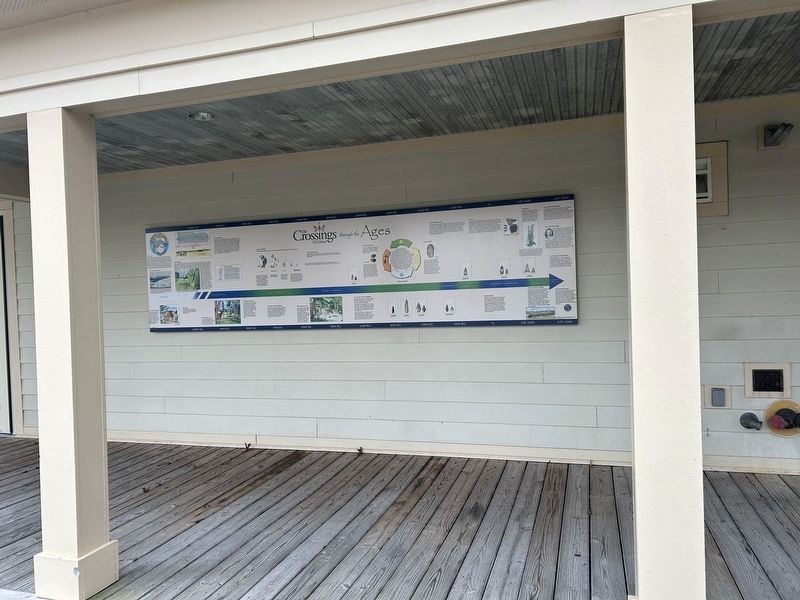
More about this marker. The marker is a very large timeline over 10 feet long. There are two timelines, one tracing the environment (mostly) and the human settlement in New York
Credits. This page was last revised on April 6, 2025. It was originally submitted on March 31, 2025. This page has been viewed 184 times since then and 27 times this year. Last updated on March 31, 2025. Photos:1, 2, 3, 4, 5. submitted on March 31, 2025, by Steve Stoessel of Niskayuna, New York. • Devry Becker Jones was the editor who published this page.