Halfweg in Haarlemmermeer, North Holland, Netherlands — Northwestern Europe
Vaart
⎯⎯⎯
Haarlem canal and towpath
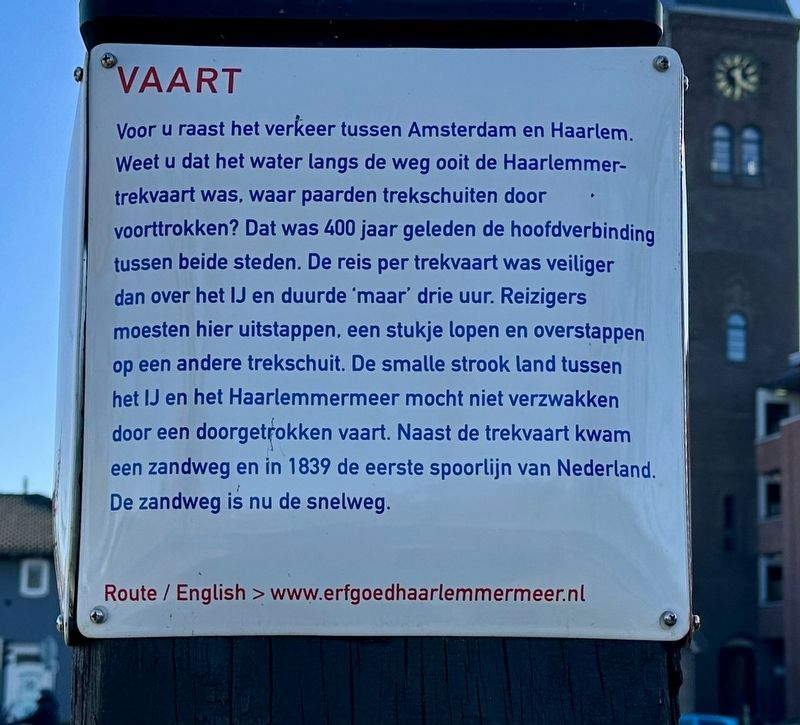
Photographed by Andrew Ruppenstein, March 18, 2025
1. Vaart Marker

Standing before you, the traffic between Amsterdam and Haarlem roars. Did you know that the water along the road was once the Haarlemmertrekvaart (Haarlem canal and towpath), where horses pulled barges? That was the main connection between the two cities 400 years ago. The journey by barge was safer than across the waters of the IJ and took 'only' three hours. Travellers had to get off here, walk a bit and transfer to another barge. The narrow strip of land between the
this page online
Erected by Haarlemmermeermuseum de Cruquius. (Marker Number 21.)
Topics. This historical marker is listed in these topic lists: Roads & Vehicles • Waterways & Vessels. A significant historical year for this entry is 1839.
Location. 52° 23.046′ N, 4° 45.257′ E. Marker is in Halfweg, Noord-Holland (North Holland), in Haarlemmermeer. It is at the intersection of Dubbele Buurt and Noord-Holland Route N200 on Dubbele Buurt. Touch for map. Marker is in this post office area: Halfweg, Noord-Holland 1165, Netherlands. Touch for directions.

Regionally, it is in Europe, the European Union, Atlantic Europe, the Benelux Low Countries, the Schengen Area, Western Europe, and the Western World. Historically, it finds itself in what was once the Holy Roman Empire.
Other nearby markers. At least 8 other markers are within walking distance of this marker: IJsteeg / Ij Alley (about 180 meters away, measured
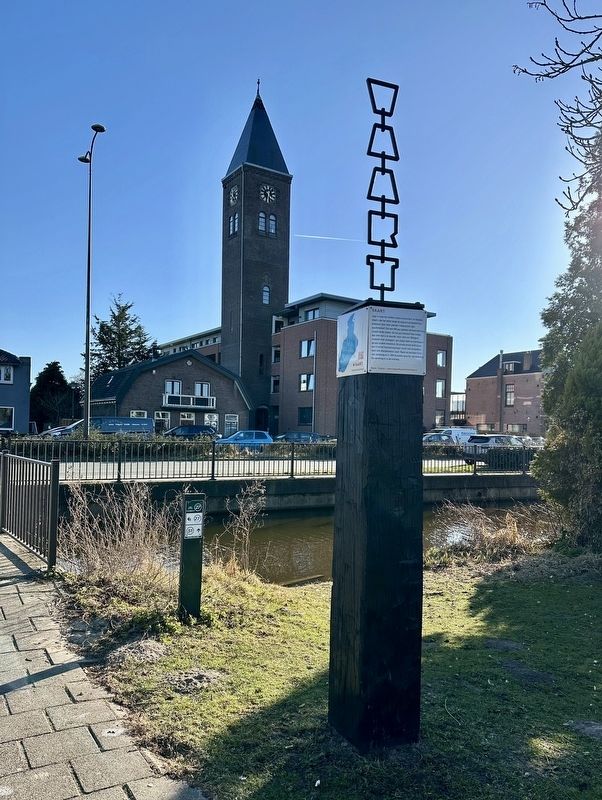
Photographed by Andrew Ruppenstein, March 18, 2025
2. Vaart / Haarlem canal and towpath marker
Also see . . . Haarlemmertrekvaart (Wikipedia). Excerpt:
Haarlemmertrekvaart (Haarlem's Tow-Canal) is a canal between Amsterdam and Haarlem in the province of North Holland, the Netherlands. It was dug in 1631, making it the oldest tow-canal in Holland. Travel on such canals was historically done by barges (or trekschuit in Dutch) which were towed by animals (and sometimes by man-power) on a path along the canal's edge (towpath).(Submitted on April 4, 2025.)
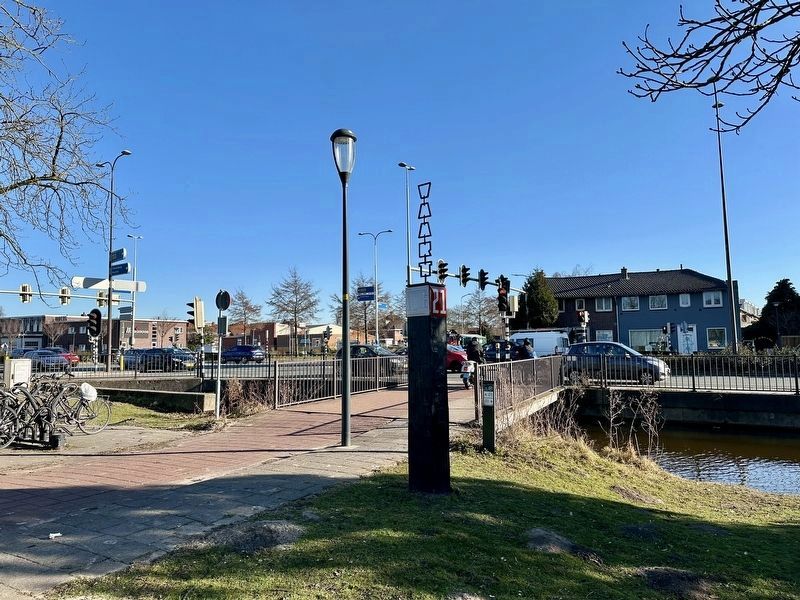
The first trekschuit 'sailed' in 1632 between Amsterdam and Haarlem, and could carry 30 passengers. Because of the sluice gate between the HaarlemLake and the IJ, the canal was not continuous. The passengers needed to disembark and change boats at this point, which was halfway, and where the town of Halfweg (meaning "halfway") formed. Commercial freight was not allowed to use the canal, and a complicated tax system on water transport kept the trekschuit system a stable means of passenger transport for centuries…Photographed by Andrew Ruppenstein, March 18, 20253. Vaart / Haarlem canal and towpath marker - wider viewWith the former canal visible beyond the marker, and beyond that, the former towpath (now a major roadway).
A railway parallel to the canal was built in 1839 which rendered passenger transport on the Haarlemmertrekvaart obsolete. While there is no longer any shipping on the canal, it is still being used for water management.
Photographed by Andrew Ruppenstein, March 18, 2025
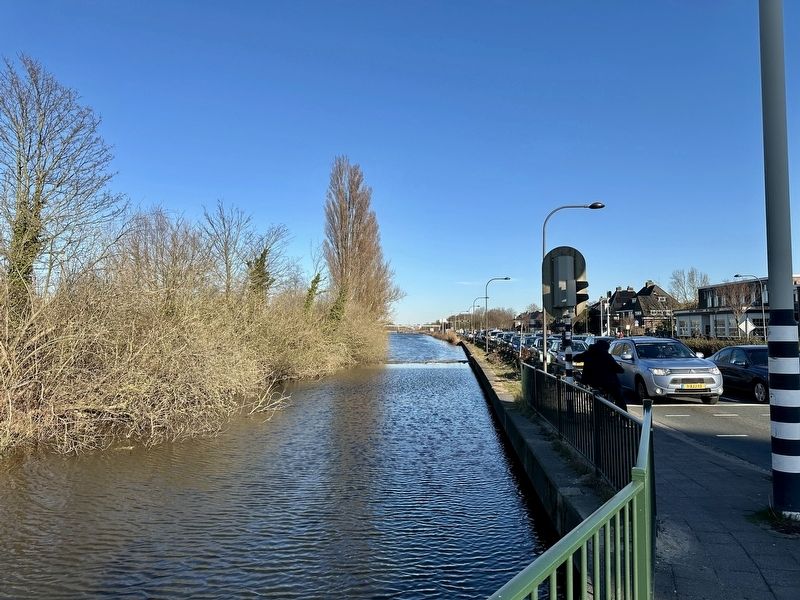
4. Looking east along the former barge canal back towards Amsterdam
Credits. This page was last revised on April 4, 2025. It was originally submitted on April 4, 2025, by Andrew Ruppenstein of Lamorinda, California. This page has been viewed 148 times since then and 45 times this year. Photos: 1, 2, 3, 4. submitted on April 4, 2025, by Andrew Ruppenstein of Lamorinda, California.
