Douglas in Chicago in Cook County, Illinois — The American Midwest (Great Lakes)
Haymarket Police Memorial

Photographed by Sean P. Flynn, April 14, 2025
1. Haymarket Police Memorial
This memorial is often referred to by a few different names, with one notable alternative being the Haymarket Riot Monument.
[Plaque on the front:]
In the name of the people of Illinois, I command peace
[Plaque on the rear:]
May 4, 1886
Eight officers killed
Mathias J. Degan • John J. Barrett • George F. Miller • Timothy J. Flavin • Michael Sheehan • Thomas Redden • Nels Hansen • Timothy Sullivan
[Plaque on the bottom of the base, facing the police station:]
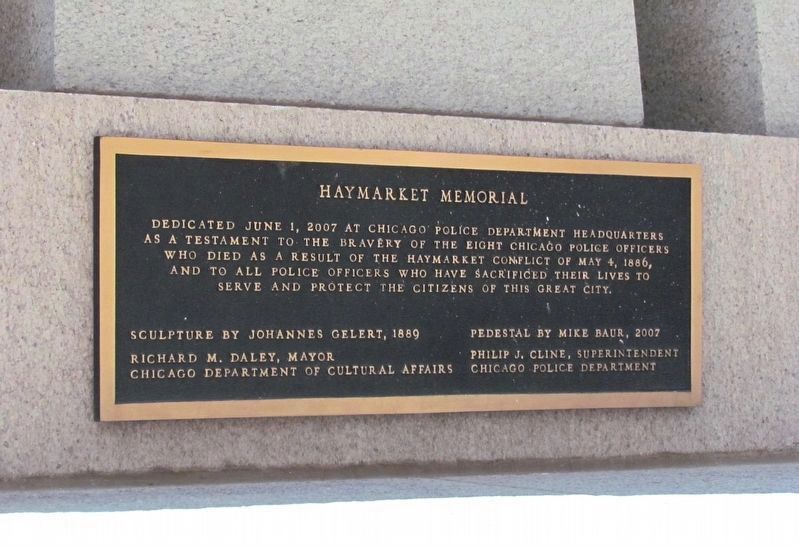
Dedicated June 1, 2007 at Chicago Police Department headquarters as a testament to the bravery of the eight Chicago police officers who died as a result of the Haymarket Conflict of May 4, 1886, and to all police officers who have sacrificed their lives to serve and protect the citizens of this great city.
Sculpture by Johannes Gelert, 1889
Pedestal by Mike Baur, 2007
Richard M. Daley, Mayor
Chicago Department of Cultural Affairs
Philip J. Cline, Superintendent
Chicago
this page online
Erected 1889 by Union League Club of Chicago.
Topics. This historical marker and memorial is listed in these topic lists: Disasters • Labor Unions • Law Enforcement • Peace. A significant historical date for this entry is May 4, 1886.
Location. 41° 49.826′ N, 87° 37.46′ W. Marker is in Chicago, Illinois, in Cook County. It is in Douglas. It is on 35th Street west of South Michigan Avenue, on the right when traveling east. The marker is near the west-facing entrance to Chicago's police headquarters. Touch for map. Marker is at or near this postal address: 3510 South Michigan Avenue, Chicago IL 60653, United States of America. Touch for directions.

Regionally, this marker and memorial is on Chicago’s South Side and in Chicago’s Bronzeville. It is also in the American Midwest. Globally, it is in North America, on the Great Lakes, in the Western Hemisphere, in the Western

Stephen Hogan (CC BY 2.0), courtesy of Wikimedia Commons
2. Haymarket Police Memorial: "In the name of the people of Illinois, I command peace"
These words (or something similar) are believed to have been shouted by a Chicago police officer moments before a bomb was thrown at Haymarket Square on May 4, 1886.
Other nearby markers. At least 8 other markers are within walking distance of this marker: Chicago Race Riot of 1919 (about 500 feet away, measured in a direct line); William J. Otterson (about 500 feet away); Edward Lee (about 500 feet away); John Walter Humphrey (about 500 feet away); Hymes Taylor (about 500 feet away); Joseph Sanford (about 500 feet away); Welcome to Bronzeville (about 600 feet away); a different marker also named Welcome to Bronzeville (about 600 feet away). Touch for a list and map of all markers in Chicago.
More about this marker. The police headquarters parking lot where this memorial is located is limited to law enforcement personnel only, and the general public may only view it from behind

Stephen Hogan (CC BY 2.0), courtesy of Wikimedia Commons, November 8, 2015
3. Haymarket Police Memorial, rear plaque
This south-facing plaque is not visible from the street. Seven police officers died in the immediate aftermath of the bombing in Haymarket: Mathias J. Degan, John J. Barrett, George F. Miller, Timothy J. Flavin, Michael Sheehan, Thomas Redden and Nels Hansen. Officer Timothy Sullivan died in 1888 of wounds he suffered in the affair.
This memorial features a nine-foot bronze statue of a helmeted Chicago police officer holding up his hand. The "command peace" text on the pedestal — today on a metal plaque; the same text was originally etched into the stone bases that were previously used — is attributed to a Chicago police captain who is purported to have said those words (or something similar) immediately before a bomb exploded in Haymarket Square on May 4, 1886.
This statue was the first major memorial to the Haymarket Affair to be erected, unveiled on May 30, 1889, in Haymarket Square (roughly Randolph and Des Plaines
Stephen Hogan (CC BY 2.0), courtesy of Wikimedia Commons, November 8, 2015
4. Haymarket Police Memorial dedication plaque
The plaque is on the base of the memorial, facing the police headquarters.
In the 135 years since its dedication, this statue has been damaged, vandalized and re-located numerous times, taking a circuitous

Photographed by Sean P. Flynn, April 14, 2025
5. Haymarket Police Memorial at the CPD headquarters
The memorial is easily visible from 35th Street about 200 feet north. However, only CPD personnel are permitted on the grounds of the facility.
The Haymarket Square itself has changed significantly since the 1880s; most notably, Interstate-90/94 (the Kennedy Expressway) was built through its western side in the 1950s. The site of the massacre today is home to a 2004 statue established in honor of the labor movement. Another memorial to the labor activists who died after being charged with the deaths at Haymarket Square, called the Haymarket Martyrs' Monument, is located at Forest Home Cemetery in suburban Forest Park, Illinois, about 10 miles west of downtown. That statue, dedicated in 1893, is a National Historic Landmark.
Regarding Haymarket Police Memorial. On

Photographed by Sean P. Flynn, April 14, 2025
6. Chicago Police headquarters
In this photo from the platform for the 35th-Bronzeville-IIT Green Line "L" Train stop, the Haymarket Monument is visible in the distance in front of CPD headquarters.
The officers who died within weeks of the riot were John J. Barrett, 26; Michael Sheehan, 29; Timothy Flavin, 27; Thomas Redden, 50; Matthias J. Degan, 34; Nels Hansen, 50; and George Muller, 28. Another officer, Timothy Sullivan, died in 1888 of wounds he suffered at Haymarket Square.
Eight men were arrested and charged with conspiracy commit the bombing.
Photographed by Sean P. Flynn, April 14, 2025
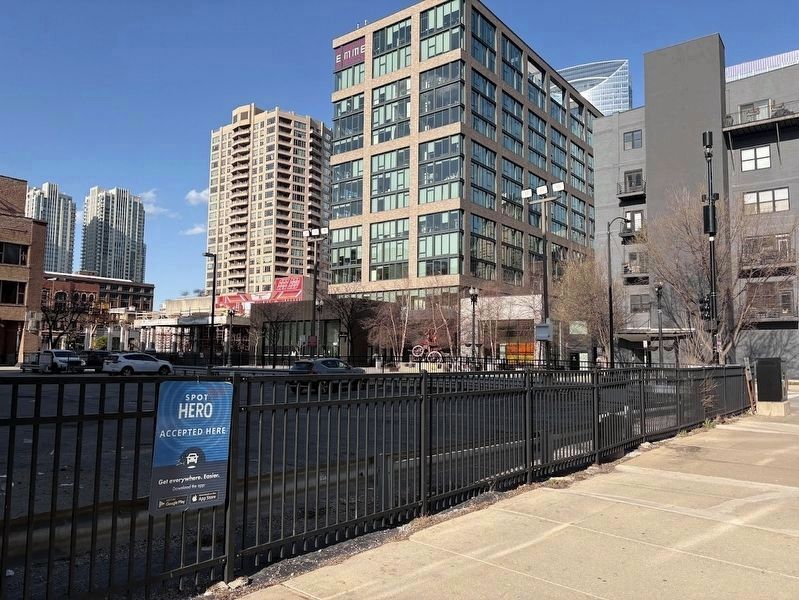
7. Haymarket Square
The site of the 1886 Haymarket Affair today is home to a 2004 monument dedicated in honor of the labor movement; it is visible in the center background. The police memorial was originally dedicated near here in 1889 (probably off-camera, but just right of this photo). It has moved about half a dozen times since then and is currently located in front of Chicago's police headquarters on the south side.
Related markers. Click here for a list of markers that are related to this marker. Haymarket Memorials

Appleton Collection; Courtesy of Chicago History Museum (ICHi-034262), circa 1891
8. Haymarket Police Memorial at its original (1889-1900) location in Haymarket Square
The memorial was erected in 1889 in Haymarket Square, site of the riot that killed 12 people, including eight police officers. It was moved out of the square in 1900 after facing repeated damage; today it's on the south side of Chicago at police headquarters.
Also see . . .
1. ChicagoCop.com: Haymarket Memorial Statue. A history of the police memorial's 135-year journey from Haymarket Square to the CPD's south-side headquarters (Submitted on April 16, 2025, by Sean P. Flynn of Oak Park, Illinois.)
2. Haymarket Police Monument storymap. This interactive article examines the Police Memorial's journey from Haymarket Square to its current location next to the Chicago Police headquarters. (Submitted on April 16, 2025, by Sean P. Flynn of Oak Park, Illinois.)
3. Charles F. Batchelder. A blog devoted to comic strips offers a brief bio of Charles F. Batchelder, a Chicago newspaper artist who designed the Haymarket Police Memorial. (Submitted on April 16, 2025, by Sean P. Flynn of Oak Park, Illinois.)
4. A Closer Look at the Public Art at Chicago Police Stations. From Forensic magazine.
Excerpt: “The monument(Submitted on September 10, 2025, by Sean P. Flynn of Oak Park, Illinois.)and its new pedestal were installed in 2007 outside the police headquarters building, which opened in 2000. Knowing the monument’s history and controversy, Baur said his pedestal’s design acknowledges the role of citizens in policing. Though he said he thinks of the 1889 monument as one 'to police officers, for police officers' — especially with its most recent placement in a location Baur said is more protected — his addition of the pyramid-shaped pedestal is meant to signify that “if police don’t have community support, then they’re worthless.' One thing Baur said he’d do differently: Make the pedestal shorter. He said he’s watched people try to take photos and struggle to get the top sculpture in the frame. 'They just see the pedestal,' he said.”Charles R. Clark; courtesy of Chicago History Museum (ICHi-072066), circa 19059. Haymarket Police Memorial at its second (1900-1927) locationIn 1900, the memorial was moved to the intersection of Randolph Street and Ogden Avenue, on the eastern edge of Union Park. On May 4, 1927, the 41st anniversary of the Haymarket Affair, a streetcar jumped its tracks and severely damaged the memorial. It was repaired and re-located further inside Union Park along Washington Boulevard (closer to the church in the background), where it stayed until 1957.

Additional commentary.
1. Damaged, vandalized, bombed, and now secured:

Carl S. Smith Collection, Courtesy of Northwestern University Libraries, circa 1965
10. Haymarket Police Memorial (1957-1972 site)
A man dressed like the officer depicted in the statue is joined by what appear to be policemen and other officials. The picture likely dates to sometime in the 1960s.
On May 30, 1889, the first memorial to the 1886 Haymarket Affair — also known, depending a bit on who's telling the story, as the Haymarket Riot or the Haymarket Massacre — was dedicated at Haymarket Square west of downtown Chicago. Dedicated in honor of the eight police officers who died of wounds suffered during affair, the memorial features a nine-foot bronze statue of a policeman with his hand raised, atop a pedestal that repeats a statement that police Captain William Ward is purported to have said immediately before the explosion.
In the more than 135 years since it was erected, this memorial has taken a circuitous and colorful journey to its present location in front of the Chicago Police Department headquarters in the Bronzeville neighborhood on the city's south side. Over that time, it has been repeatedly vandalized, damaged or destroyed several times,

Courtesy of Wikicommons, circa May 1986
11. Haymarket Police Memorial pedestal (the statue's 1957-1972 location)
The Kennedy Expressway can be seen in the background of this photo, which was apparently taken on May 4, 1986, the 100th anniversary of the Haymarket Affair. The statue had been removed in 1972 but the pedestal remained in place well into the 1990s, serving as something of an anarchist landmark (note the circle-A graffiti spray-painted to the pedestal). The same view today is a lot different, as the bridges over the expressway have been renovated and high-rises now dot the skyline west of the expressway. However the jut-out overlooking the expressway is still there.
Haymarket Square, this memorial's original location, was the site of the May 4, 1886, labor rally that turned deadly when a bomb detonated, leading to a gunfight between police and protestors. All told, about 11 people were killed, including seven police officers; an eighth officer died about two years later of wounds suffered at Haymarket.
Even before the smoke settled on Haymarket Square, the various sides of the affair — namely the labor activists on one side and the supporters of law enforcement on the other — sought not just to memorialize the event, but to place the event in what they believed to be the right historical context. It was the police supporter who erected this first memorial to the

Photographed by Sean P. Flynn, April 14, 2025
12. The Haymarket Police Memorial's 1957-1972 location in 2025
From 1957 until 1972, the Haymarket Police Memorial was located at this spot on Randolph Street, prominently looking over the Kennedy Expressway. After being vandalized, damaged or destroyed by protestors several times, the statue was moved to more secure locations on property owned by the Chicago Police Department. The remaining portion of Haymarket Square is visible in the background.
Haymarket was a prominent spot in what was then a bustling area; however, this turned out to be more of a curse than a blessing. The statue disrupted traffic in a busy area, and its prominent location made it an easy target for people opposed to its message, ultimately leaving it subjected to repeated damage and vandalism.
In 1900, in an effort to give it safer surroundings, the city moved the statue out of the square to a somewhat quieter spot a mile west, on the eastern edge of Union Park, near the intersection of Randolph Street and Ogden Avenue. The statue stood there until 1927, when, on the 41st anniversary of the Haymarket Riot, a streetcar jumped its tracks and crashed into the statue's pedestal. The city restored the statue

Created by Paul J. Morand; courtesy of Chicago History Museum (ICHi-003678), 1887
13. "Principals in the Haymarket Riot"
This 1887 photographic print features some of the main characters in the Haymarket Affair, including the trial attorneys, the police involved and the eight anarchists found guilty of conspiracy for the bombing. The caption from the Chicago History Museum states: "Photographic print dated 1887 of drawings of men involved in the Haymarket Affair, Chicago, Illinois, titled Principals in the Haymarket Riot. Portraits include attorneys George Ingham, Julius S. Grinnell, Captain William P. Black, and William A. Foster; Judge Joseph E. Gary; police officers Captain William Buckley, Captain A. W. Hathaway, Captain Michael Schaack, Captain Simon O'Donnell, Captain William Ward; Chief of Police Frederick Ebersold; Inspector of Police John Bonfield; and the defendants Albert R. Parsons, August Spies, Louis Lingg, Samuel Fielden, Adolph Fischer, Michael Schwab, George Engel, and Oscar W. Neebe."
In the intervening years, Chicago's west side underwent massive demographic changes, with several areas (including Haymarket Square) losing population while urban renewal projects changed the character of old neighborhoods. Union Park was right in the middle of this change, and police advocacy groups and the descendants of Haymarket Affair survivors grew concerned that the statue was being overlooked, and they pleaded throughout the middle of the century for a more prominent spot. According to one article in the Chicago Tribune, proposed locations included in front of City Hall and in a small park area just south and east of the Wabash Avenue crossing over the Chicago River.
Finally, in the 1950s, the statue found its new home, and it was only a few hundred feet from its original placement: on a pedestal near Haymarket Square overlooking the brand-new Northwest Expressway. The statue was moved there in 1957 and officially rededicated in 1958. It was a somewhat ironic location, for in the 70+ years since the Haymarket Affair, the west side's changes had not spared Haymarket, which had lost nearly all of its bustle and many of its historic buildings. In particular, the Northwest Expressway (later renamed after John F. Kennedy) cut a path right through the middle of the square.
Just as the statue’s supporters had hoped, the new location indeed provided the statue a much higher level of visibility as it greeted thousands of daily commuters along the new highway. At the same time, it also significantly increased its status as a target for protest and, eventually, damage by protester. Although the square itself had quieted considerably since the 1880s, it remained something of a pilgrimage site for labor activists, and the statue of a policeman with his hand raised immediately became a symbol of what they were opposing.
On May 4, 1968, the 82nd anniversary of the Haymarket Affair, the statue was vandalized with black paint after police and demonstrators had clashed during an anti-war protest. Then, on October 6, 1969, a bomb placed in the legs of the statue detonated, sending pieces raining onto the expressway and blowing out windows in the neighborhood. The Weather Underground protest group claimed credit for the explosion.
City officials and police supporters quickly rebuilt the statue and its pedestal, thanks to private donations of about $5,500. In May 1970, dueling ceremonies occurred in Haymarket square. In one ceremony, led by labor activists, the Illinois Labor History Society and the Illinois State Historical Society erected a plaque about titled "Haymarket Riot," which stated the details of the 1886 event and noted that, while seven officers had died, no "radicals" were linked to the bomb.
In the city’s official ceremony, the repaired police memorial was returned it to its pedestal over the Kennedy in a re-dedication ceremony led by Mayor Richard J. Daley. In a speech to a crowd of 500 people, Daley called for “law and order,” according to the Chicago Tribune. “This is the only statue of a policeman in the world,” Daley said. “The policeman is not perfect, but he is as fine an individual as any other citizen. Let the younger generation know that the policeman is their friend, and to those who want to take law into their own hands, let them know that we won't tolerate it.”
Despite Mayor Daley's pleas, the statue remained a target. In October, just five months after its re-dedication, the statue was bombed again, severely damaging the body and sending one of the legs flying. Weather Underground telephoned local newspapers to take credit for this bombing. “We just blew up Haymarket Square Statue for the second year in a row to show our allegiance to our brothers in the New York prisons and our black brothers everywhere,” a caller told the Tribune. “This is another phase of our revolution to overthrow our racist and fascist society. Power to the People.” An angry and stubborn Mayor Daley ordered the statue repaired again, and had it returned to Haymarket Square and placed under 24-hour surveillance.
Finally, in 1972, the city decided to move the statue out; the location over the expressway wasn’t safe, and the cost of protecting it was too expensive. The bronze statue was taken off its pedestal and moved to police headquarters, at that time located at 1121 S. State St., where it sat in the lobby for four years. The pedestal itself, however, remained on Randolph overlooking the Kennedy until around 1996, when it was removed. (Whether it was preserved and if so where it is today is not known. The platform for the statue is still evident next to the Kennedy.)
In 1976, the city moved the statue to a new granite pedestal located in the outdoor courtyard of the Chicago Police Training Academy at 1300 W. Jackson. It stayed there until 2007, when the city moved it to its current spot near the police headquarters at 3510 S. Michigan. The great-granddaughter of Matthias Degan, one of the policemen who died from injuries during the Haymarket Riot, conducted the unveiling. While the statue is visible from 35th Street about 200 feet away, and can also be seen from the CTA Green Line train that runs a short distance west, only police personnel is permitted on the headquarters campus.
As a result, this first memorial to the Haymarket Affair is, ironically, likely the least known of those standing today. The most notable is most likely the 1893 memorial in honor of the labor activists hanged for the bombing, which was erected at German Waldheim Cemetery (now part of Forest Home Cemetery) in suburban Forest Park, about 10 miles west of Haymarket Square. That monument was named a National Historic Landmark in 1997, and it remains an enduring pilgrimage location for labor activists; dozens of labor activists have been buried near the memorial. In 2004, another memorial in honor of labor activists was dedicated in Haymarket Square, close to this police memorial's original spot; the square still draws its fair share of visitors, and the neighborhood has undergone extensive development since the turn of the 21st century. Meanwhile, this statue honoring the police victims of Haymarket endures in safety — but relative obscurity — behind the gates of Chicago's police headquarters.
— Submitted April 16, 2025, by Sean P. Flynn of Oak Park, Illinois.
Credits. This page was last revised on August 31, 2026. It was originally submitted on April 14, 2025, by Sean P. Flynn of Oak Park, Illinois. This page has been viewed 1,361 times since then and 681 times this year. Photos: 1. submitted on April 14, 2025, by Sean P. Flynn of Oak Park, Illinois. 2. submitted on October 3, 2025, by Sean P. Flynn of Oak Park, Illinois. 3, 4. submitted on September 10, 2025, by Sean P. Flynn of Oak Park, Illinois. 5. submitted on April 16, 2025, by Sean P. Flynn of Oak Park, Illinois. 6. submitted on April 15, 2025, by Sean P. Flynn of Oak Park, Illinois. 7, 8, 9. submitted on April 16, 2025, by Sean P. Flynn of Oak Park, Illinois. 10. submitted on December 27, 2025, by Sean P. Flynn of Oak Park, Illinois. 11. submitted on April 16, 2025, by Sean P. Flynn of Oak Park, Illinois. 12. submitted on April 15, 2025, by Sean P. Flynn of Oak Park, Illinois. 13. submitted on May 3, 2025, by Sean P. Flynn of Oak Park, Illinois.
