Blanding in San Juan County, Utah — The American Mountains (Southwest)
Living in the Earth: A Look Inside a Kiva
Photographed by James Hulse, March 28, 2025
1. Living in the Earth: A Look Inside a Kiva Marker
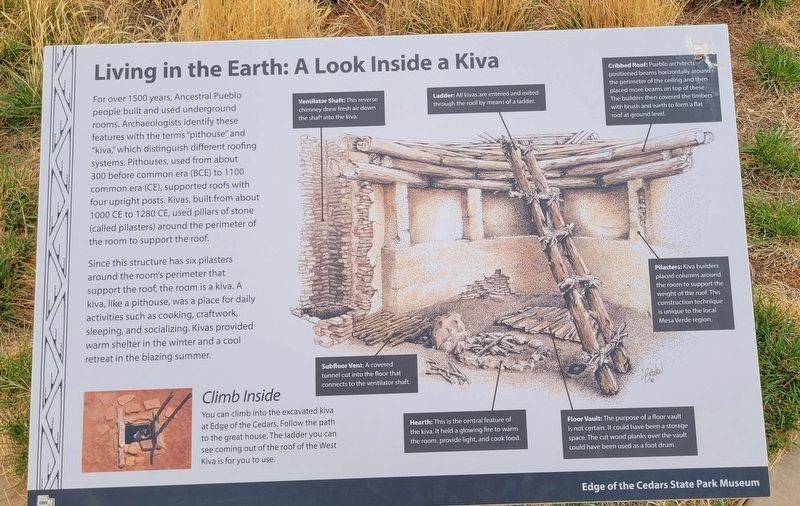
Since this structure has six pilasters around the room's perimeter that support the roof, the room is a kiva. A kiva, like a pithouse, was a place for daily activities such as cooking, craftwork, sleeping, and socializing. Kivas provided warm shelter in the winter and a cool retreat in the blazing summer.
Climb Inside
You can climb into the excavated kiva at Edge of the Cedars. Follow the path to the great house. The ladder you can see coming out of the roof of the West Kiva is for you to use.
Ventilator Shaft: This reverse chimney drew fresh air down the shaft into the kiva.
Ladder: All kivas are entered and exited through the roof by means of a ladder.
Cribbed Roof:
this page online
Ventilator Shaft: This reverse chimney drew fresh air down the shaft into the kiva. Cribbed Roof: Pueblo architects positioned beams horizontally around the perimeter of the ceiling and then placed more beams on top of these. The builders then covered the timbers with brush and earth to form a flat roof at ground level.
Subfloor Vent: A covered tunnel cut into the floor that connects to the ventilator shaft.
Hearth: This is the central feature of the kiva. It held a glowing fire to warm the room, provide light, and cook food.
Floor Vault: The purpose of a floor vault is not certain. It could have been a storage space. The cut wood planks over the vault could have been used as a foot drum.
Erected by Edge of the Cedars State Park Museum.
Topics. This historical marker is listed in these topic lists: Anthropology & Archaeology • Architecture • Indigenous Peoples and Communities
Photographed by James Hulse, March 28, 2025
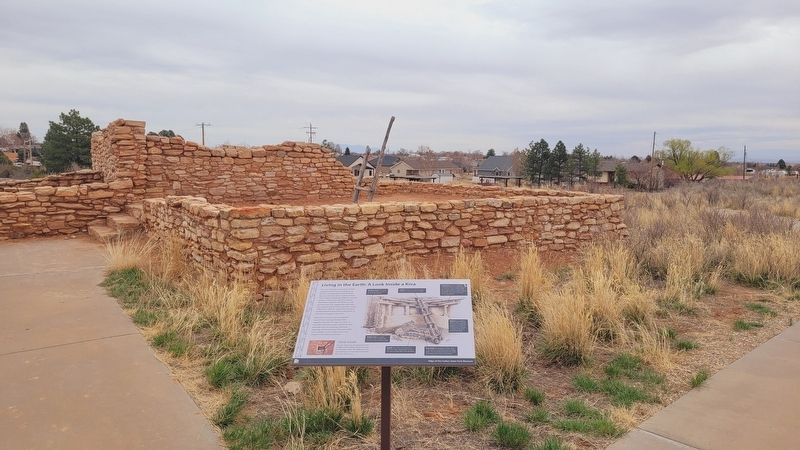
2. The entrance to the great Kiva and the Marker
Location. 37° 37.873′ N, 109° 29.447′ W. Marker is in Blanding, Utah, in San Juan County. It is on West 400 North near 600 W. The marker is located on the grounds of the Edge of the Cedars State Park Museum. Touch for map. Marker is at or near this postal address: 660 W 400 N, Blanding UT 84511, United States of America. Touch for directions.

Regionally, this marker is in Canyon Country. It is also in the American Mountain West, on the Colorado Plateau, and at the Four Corners. Globally, it is in North America, the Western Hemisphere, the Western World, and the Anglosphere. Historically, it finds itself in what was once New Spain and also Mexico’s Alta California.

Other nearby markers. At least 8 other markers are within walking distance of this marker: Trade with Far Off Places (a few steps from this marker); Drought, Frost, and Migration in the 1200s (a few steps from this marker); Exposure and Safe Keeping (a few steps from this marker); A Great House and a Great Kiva (a few steps from this marker); Leaving the Pieces In Place (a few steps
Photographed by James Hulse, March 28, 2025
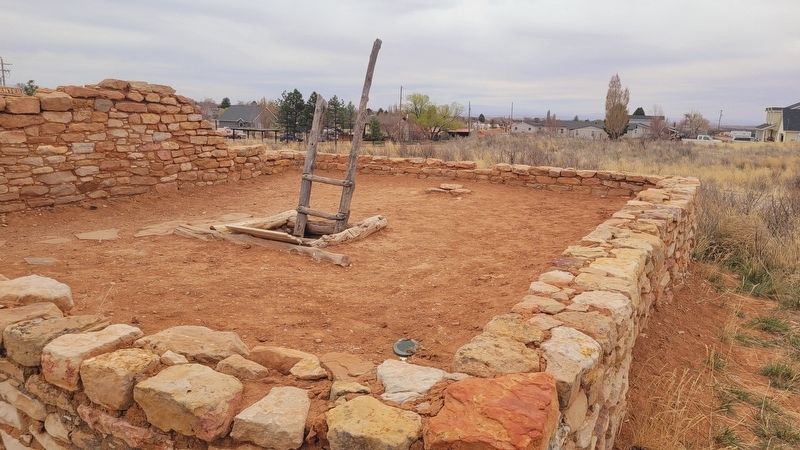
3. The ladder for the great Kiva
Photographed by James Hulse, March 28, 2025
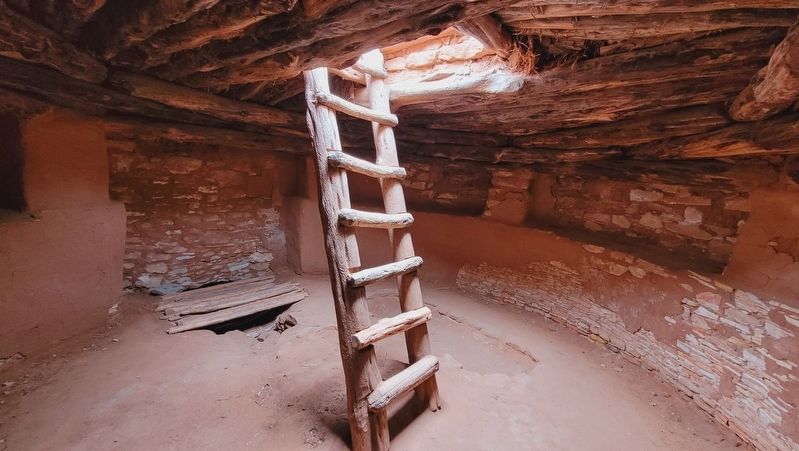
4. A Look Inside a Kiva
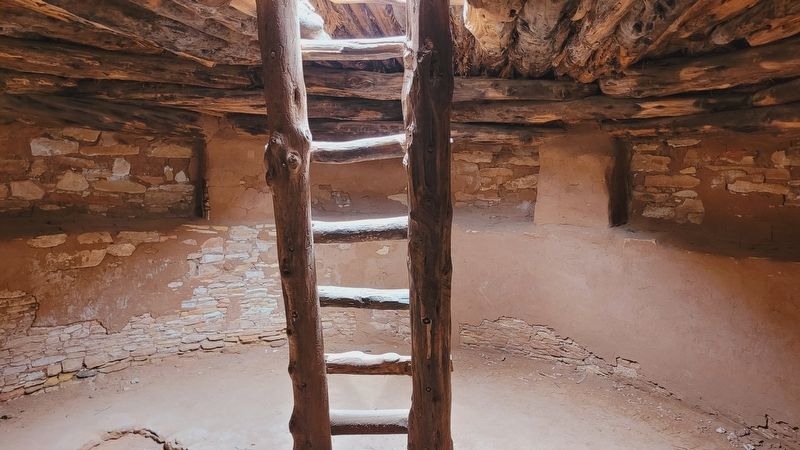
Photographed by James Hulse, March 28, 2025
5. A Look Inside a Kiva
Credits. This page was last revised on April 19, 2025. It was originally submitted on April 17, 2025, by James Hulse of Medina, Texas. This page has been viewed 332 times since then and 73 times this year. Photos: 1. submitted on April 18, 2025, by James Hulse of Medina, Texas. 2, 3, 4, 5. submitted on April 19, 2025, by James Hulse of Medina, Texas.
